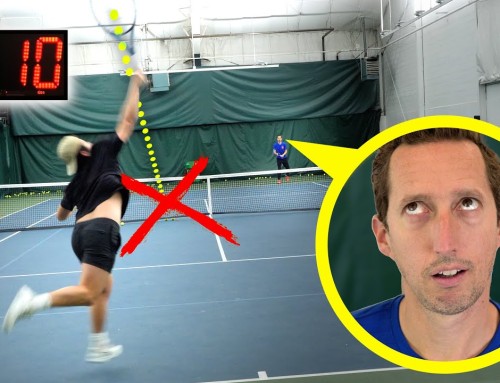
Every single day, thousands of tennis lessons happen around the world that don’t move the needle at all for the student taking them.
Are you one of those students?
I’m going to help you figure that out, and more importantly, show you exactly what to look for if you want lessons that actually create real improvement in your game.
Here’s something that might sound completely crazy to you: most tennis players don’t take lessons to get significantly better at tennis.
I know. Wild, right?
But it’s absolutely true. When I recently ran a workshop for career tennis coaches, we came up with a list of reasons why students actually take lessons. Sure, game improvement was on the list, but so were things like exercise, fun, socializing with friends, therapy sessions where they vent about life, connecting with practice partners, even babysitting.
There’s nothing wrong with any of those things. Tennis is a game after all, and most people play it to enjoy themselves, stay active, and connect with their friends. That’s the foundation of our entire sport.
But if you’re reading this right now, you’re probably not most tennis players.
You’re one of the outliers. You went to the trouble of seeking out information online about how to get better. That immediately puts you in a different category.
The problem is this: most tennis coaches have become incredibly skilled at delivering what most tennis players want, which is a surface level polish of the skills they already have. A few tips here and there. A small adjustment that doesn’t rock the boat too much.
And you know what? That makes total sense.
Changing your grip on your serve or switching your forehand stance to open stance forces you to relearn everything. It doesn’t let you have fun in the short term. It doesn’t let you keep the ball in play with your hitting partners. It completely disrupts your game temporarily.
Most players don’t want that disruption. They want to get maybe five percent better at what they already do. They want to win a couple more games against their usual opponents without leaving their comfort zone or peer group entirely.
But that’s not what you want, is it?
You want fundamental changes. You want to jump levels. You want to become a significantly different and better player.
So here’s the million dollar question: what makes a coach good or bad?
The answer is alignment. A good coach is someone whose specialty matches what you’re actually there for. If most players want surface polish and most coaches specialize in providing exactly that, then finding a coach who goes way beneath the surface to address root problems is going to take some homework on your part.
These coaches absolutely exist. There are incredible coaches out there with a deep passion for helping players make gigantic leaps forward. But you might need to do a little detective work to find them.
I recommend visiting different clubs and courts in your area. Watch five or ten minutes of various lessons with different coaches. Here are seven warning signs that a coach probably won’t deliver the transformation you’re looking for.
First, listen for cliches and catchphrases. You know the ones. Eye on the ball. Bend your knees. Finish over your shoulder. Low to high. If that makes up the majority of what you’re hearing, you’re not getting beneath the surface to what’s really holding you back.
Second, watch if this coach teaches multiple students. If every lesson looks exactly the same with the same drills, same explanations, same progressions, that’s a red flag. Even if two students are the same level with similar problems, the roadmap should be customized at least somewhat to each individual.
Third, count how many different skills get covered in one lesson. Have you ever taken this lesson? You spend five or ten minutes warming up at the net. Then five minutes on your forehand. Five minutes on your backhand. Five minutes on volleys. Maybe a couple overheads. Then you finish by hitting some serves while the coach tosses balls. Sound familiar? You can only make fundamental changes by spending a big chunk of time on one thing, not playing instructional whack-a-mole across your entire game.
Fourth, even if you do focus on just your forehand for the whole lesson, watch how often the coaching cue changes. If every few seconds the coach is telling you to focus on something different, that’s not how learning works. You need sustained focus on one specific change for it to become automatic and subconscious.
Fifth, does the coach give you homework? If you take an hour lesson, high five the coach, then spend the next six days just hitting with friends and playing matches before your next lesson a week later, you’re not going to make significant jumps. You need dedicated training time between lessons working on new habits.
Sixth, ask the coach questions about why you’re doing something. A great coach will calmly explain exactly why you’re working on what you’re working on, how it fits into the big picture, and how it helps you reach the next level. If they laugh it off, make a joke, or say it’s too complicated for you to understand, that’s a problem.
Seventh, notice if the coach ever comes to your side of the court. When you watch world class players train, their coach is almost always on the same side of the court with them while they hit with a ball machine or practice partner. Yet in typical lessons, the coach stands fifty or sixty feet away on the other side trying to diagnose what you’re doing. It’s very hard to give accurate, helpful insights from that distance.
If you watch a lesson and four or five of these red flags show up, that coach might be perfect if you just want to have fun and get a little better at what you already do. But if you want to fundamentally transform your game and become a significantly different player, they’re probably not going to get you there.
The good news? Now you know exactly what to look for.
Your Coach,
-Ian