I was working with Susan on her overhead recently, and she asked me a question that I hear all the time: “Was that the best batch of overheads I ever hit?”
The answer was yes. And the reason why tells you everything you need to know about what’s probably wrong with your overhead right now.
Susan had all the right pieces. She knew to get to the side. She knew to drop the racket like a serve. She understood the basic mechanics of the stroke. But despite having all those elements in place, her overhead felt rushed and inconsistent.
The problem wasn’t her technique. The problem was her timing.
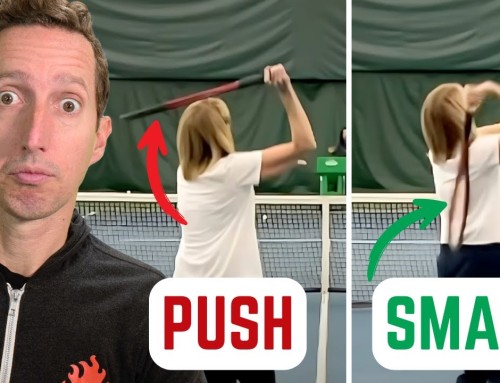
Let me show you what I mean. I had Susan hit a few overheads while I watched just her racket. What I noticed immediately was that once the lob went in the air, her racket never stopped moving. It just kept going through the whole path without ever arriving at a set preparation position.
She was filling all the time with constant movement. There was never any preparation moment or pause point where she was actually ready to swing.
Now compare that to what I do. I use the exact same feed from the ball machine. I’m actually standing closer to the ball than Susan was. But somehow, it looks like I have all the time in the world while she looks rushed.
How is that possible?
The difference is that I have a preparation phase and a swing phase. Susan was trying to time out constant movement through the entire shot. I prepare immediately, arrive at trophy position, and then no matter what happens between that moment and when I need to swing, I’m ready anytime.
Think about what that means. If I’m already in trophy position and I suddenly realize the ball isn’t where I thought it was, I can take a quick step and adjust. My arm doesn’t have to do anything. I’m already prepared to swing.
But if you’re constantly moving your racket through the entire motion and you suddenly realize you’ve misjudged the ball, now you’ve got a whole lot of stuff to do with your arm to catch up. You have to simultaneously figure out where you need to be AND complete your swing motion. That’s too much to manage in real time.
This is why your overhead feels rushed even when you have plenty of time.
Here’s what I want you to understand: preparation should go right into trophy position. We’re going to cut out all the other stuff and just go directly to preparation. Once you’re there, you stay there until you’re ready to swing.
You create a deliberate preparation phase where you’re immediately going back to that setup position. From there, regardless of whether you timed it correctly or judged it wrong, you’re ready to drop and swing anytime. All that’s left to do is relax your arm and rotate your body.
The rhythm we’re looking for is: lob, prepare. Lob, prepare. You immediately get back to trophy position. No questions. No constant movement. Just preparation.
When I first explained this concept to Susan, she said it felt uncomfortable. I asked her why, and she couldn’t really explain it. Probably because she’d never done it before. Most players haven’t. They’ve developed this habit of filling time with movement because that’s what feels natural.
But natural and effective aren’t always the same thing.
We started practicing just the preparation phase. Ready position to trophy position. Over and over. Then we added the forward swing with a deliberate pause. Ready position, trophy position, count to two, then drop and swing.
The first thing Susan noticed was that even with a deliberate pause at trophy position, she was still early on some swings. That told us she had even MORE time available than she thought. She could hang out in that preparation position longer and still make clean contact.
But having the time and using it correctly are two different things.
The next challenge we worked on was positioning. I had Susan stand in trophy position with her left arm extended up, and we just practiced catching balls in the cone of her racket. The goal was to position herself so the ball would fall exactly where she wanted it without having to make last second adjustments with her arms.
At first, she was making all kinds of compensations. Leaning, stretching, moving her arm around to catch the ball. But the more we practiced, the better she got at using her feet to get into the right position while maintaining a solid trophy pose.
This is critical because you can’t hit a solid overhead consistently if you’re making last second adjustments with your upper body. You need your whole structure to be in the right spot, and that means being active and dynamic with your feet while maintaining a stable preparation position with your upper body.
After enough repetitions, something clicked. Susan started getting to a solid position and maintaining it all the way through contact. Five or six in a row landed exactly where we wanted without any leaning or stretching. Her consistency jumped dramatically.
Then we added back the actual overhead swing, and this is where it got interesting. I noticed that Susan was consistently hitting the ball off the bottom of her racket. She was waiting too long. Her swings were too late on average.
This surprised me because most players struggle with being too early, not too late. But it makes sense when you think about it. Susan had spent so much time trying to fill all the available time with movement that when we created a deliberate pause, she didn’t know when to initiate the swing anymore.
The solution was simple: swing earlier than you think you have to. Get closer to the ball. Don’t wait for it to drop so far.
After adjusting for that timing element, Susan hit the best batch of overheads she’d ever hit. Clean contact, solid positioning, confident execution. All because we separated the preparation phase from the swing phase and gave her a stable position to operate from.
Here’s what I want you to take away from this.
First, stop filling time with constant racket movement. Create a deliberate preparation phase where you arrive at trophy position and stay there until you’re ready to swing.
Second, understand that feeling like you have time and actually using that time correctly are different skills. Most players feel rushed because they’re trying to time out continuous movement instead of preparing once and then swinging.
Third, work on positioning yourself correctly while maintaining a stable trophy pose. Use your feet to get into the right spot. Don’t make last second adjustments with your arms and upper body.
And finally, if you’ve developed this habit of constant movement, you’re going to need a lot of repetitions to reprogram your timing. Find an easy spot with an easy feed and just groove the feeling of preparation, pause, then swing. Even if it’s the same feed a thousand times, that’s valuable repetition because you’re building a reference point for what the appropriate timing should feel like.
Your overhead doesn’t have to feel rushed. You probably have more time than you think. You just need to learn how to use it.
Your Coach,
-Ian