One of the most common dilemmas in tennis — one that comes up in almost every single rally of every single match — is the decision between crosscourt vs down the line.
And most players make that choice on instinct, on habit, or on impulse. Very few players have actually sat down and thought through the real pros and cons of each option.
So let’s do exactly that, because understanding this changes how you play the game completely.
Let’s start with crosscourt, because frankly, it should be your bread and butter shot in most situations.
First and most importantly — it’s safer. The net is lower in the middle than it is at the sides, so hitting crosscourt gives you a little extra clearance right where you need it most.
On top of that, the crosscourt direction gives you four and a half more feet of court to work with compared to going down the line. That’s a massive difference.
And here’s the one most players never think about — when your timing is slightly off and you’re a little late on the ball, a crosscourt miss tends to drift toward the center of the court and stay in play.
A down the line miss with slightly late timing goes wide. Every time. So even your mistakes are more forgiving when you’re playing crosscourt.
The second big benefit is that crosscourt is simply more effective at moving your opponent.
When you hit a sharp crosscourt angle, you can pull your opponent completely off the court — way past the sideline, into no man’s land, scrambling just to get the ball back. Down the line simply cannot do that. The furthest a down the line shot will ever push your opponent is to the sideline. That’s it. You will never drag someone off the court with a straight shot.
There’s a great drill to experience this for yourself. Grab a practice partner and do a figure eight — one of you hits everything cross court, the other hits everything down the line. Do it for five or ten minutes and watch what happens. The person hitting down the line will be exhausted. The person hitting crosscourt will be in control, consistently pulling the other player side to side while working far less.
It becomes obvious very quickly.
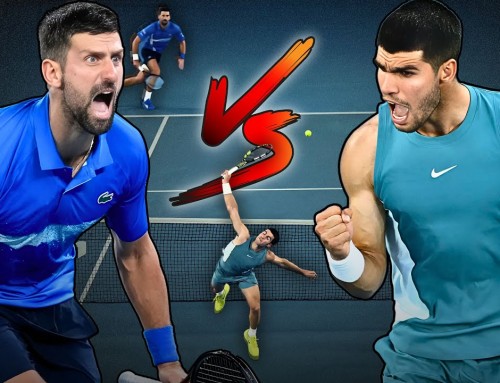
This is also why, when you watch Djokovic and Sinner grinding out a baseline rally on TV, you’ll see them trading cross court shot after crosscourt shot. It’s not because they can’t go down the line — obviously they can. It’s because they’re both smart enough to understand the geometry of the court and the risk involved in changing direction before the right opportunity presents itself.
They’re being patient. They’re waiting for the moment when going down the line actually makes sense and won’t cost them the point.
Now, cross court vs down the line isn’t as simple as always choosing one over the other, because crosscourt has real downsides too.
The biggest one is predictability.
If every ball you hit goes crosscourt, your opponent figures that out fast. And against someone at your level or above, being that predictable is dangerous. They’ll start anticipating your shot before you even swing. They’ll be in position before the ball gets there. You’ll be handing them control of every rally without even realizing it.
And if your opponent’s forehand happens to be significantly better than yours, pounding the ball crosscourt on the deuce side over and over is basically feeding the monster. You’re playing right into their strength, and you’ll pay for it.
So let’s talk about going down the line, because it absolutely has its place.
The single biggest advantage is time. A down the line shot travels a shorter distance to reach your opponent’s corner, which means it gets there faster.
When everything else is equal — same height, same speed — the ball arrives at the down the line target sooner. That fraction of a second matters enormously, because it takes time away from your opponent and puts them in a defensive, scrambling position before they’re ready.
The second big advantage is surprise. Because smart players know the percentages — they know you should be hitting crosscourt most of the time — they start leaning, cheating, shifting their weight in that direction.
And the moment they do that, a well-timed down the line shot catches them completely flat-footed. Their momentum is going one way. The ball goes the other.
Watch a Sinner vs Djokovic rally in slow motion sometime and you’ll see exactly this — Novak shifting slightly left to cover the crosscourt, then Sinner rips one down the line and suddenly Novak has to completely reverse his momentum. That’s the power of unpredictability.
But understanding cross court vs down the line means you also have to be honest about the risks of going down the line too often.
It’s harder.
The net is higher near the sidelines. The court is shorter in that direction. Your margin for error shrinks significantly. And the one thing that ends tennis matches more than anything else — at every level, including the pros — is unforced errors.
Most points don’t end with stunning winners. They end with one player making a mistake. Going down the line too aggressively, too early in the point, too often — you’re not beating your opponent.
You’re beating yourself.
And on top of that, every time you go down the line and it doesn’t finish the point, you open up the entire crosscourt angle for your opponent to exploit. You do all the hard work. They get the easy shot.
So what’s the bottom line?
You need both.
This isn’t an either/or conversation. The whole game of cross court vs down the line is really about timing, patience, and reading the situation in front of you.
Crosscourt is your foundation — your safety net, your consistency shot, your way of keeping pressure on your opponent without taking unnecessary risks.
Down the line is your weapon — your way of taking time away, catching your opponent off guard, and cashing in when the opportunity is right.
Use crosscourt to build the point. Use down the line to end it.
Practice both. Get comfortable with both.
And start making those decisions on purpose instead of on impulse.
When you do, you’ll be amazed at how much smarter your tennis becomes — and how many more matches start going your way.
Your Coach,
-Ian