I had a student recently whose weak overhead was driving her crazy, and the strange part is she already had a fantastic serve.
Same overhand motion.
Same body.
Same racket.
And yet one shot had power and the other one didn’t.
That contradiction is exactly why I wanted to write about this, because it reveals something most players — and honestly, a lot of coaches — get wrong about the overhead.
Here’s the thing everyone assumes: if you can serve well, you should be able to hit an overhead well, because they’re basically the same motion.
I’ve even had college baseball pitchers walk onto the court with me, guys who can throw a ball with tremendous power and precision, who still couldn’t put together a decent service motion.
Being good at one overhand movement doesn’t automatically transfer to another.
Your body has to actually learn each one specifically, and my student was living proof of that.
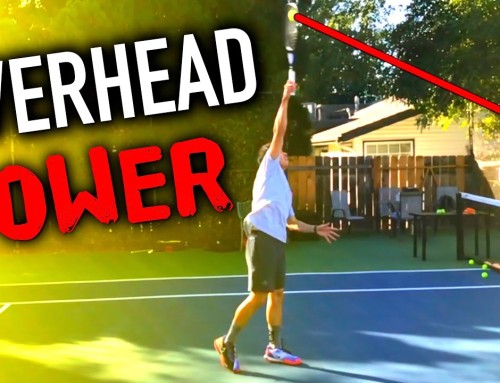
Her serve had this long, smooth pulling motion — racket on edge, dropping all the way down to waist height, butt cap leading the way up to contact, full pronation, the works.
Her overhead, on the other hand, looked like she was serving a tray of drinks.
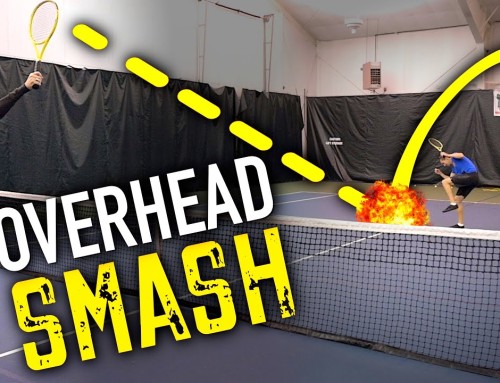
The racket barely dropped past head height, never got low enough to create any real runway, and the whole motion turned into a short, pushy shove instead of a long, accelerating swing.
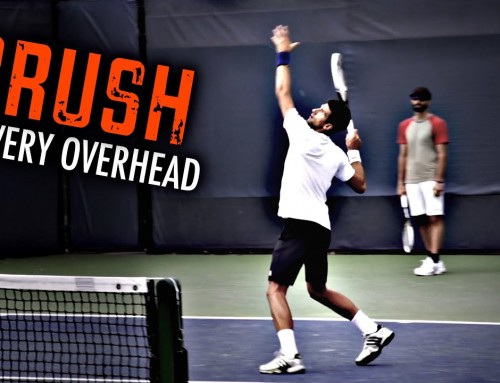
Watch any world-class player hit an overhead and you’ll notice something curious: sometimes, when the lob gives them extra time, they’ll pause.
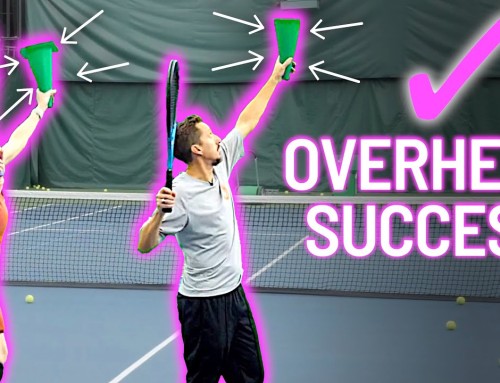
Not randomly — they pause with the racket up in what’s essentially a trophy pose, the exact same position you’d see at the start of a serve.
Then, once they commit to the shot, the racket drops all the way down to waist height and everything flows continuously from there straight through contact.
That pause, and where it happens, turns out to be the whole ballgame.
So we started simple.
I showed her video of her own serve next to her own overhead, side by side, so she could see the contradiction with her own eyes.
Then I had her do shadow swings at the net, just visualizing a lob falling out of the sky, trying to connect her brain to a motion her body already knew how to do — just in a different context.
When she got in front of the ball machine and hit her very first overhead with this new feeling, she crushed it.
I was thrilled.
But a few reps later, something interesting happened: a pause showed up again, except in totally the wrong spot.
Instead of pausing up in the trophy position like Carlos Alcaraz does, she was dropping the racket all the way down and pausing there, at the bottom, before swinging up into the ball.
She wasn’t wrong to change something — she’d genuinely lengthened her motion by four or five times what it used to be.
She just hadn’t figured out where the waiting was supposed to happen.
Pausing at the bottom kills the very runway you just worked so hard to create, because now you’re starting your acceleration from a dead stop instead of carrying momentum down and back up.
The fix wasn’t complicated, but it did take deliberate repetition.
I had her practice pausing on purpose — but up high, in that trophy-pose position — and only letting the racket start its continuous drop once she’d committed to the shot.
From there, everything needed to flow in one unbroken motion: drop, swoop, accelerate, contact. No stopping halfway.
I’ll be honest, some of her early attempts were rough. She shanked a few.
That’s completely normal, and it’s worth saying out loud because so many players get discouraged the moment a “fix” doesn’t immediately produce a better result.
She was rewiring a totally different range of motion and timing pattern than she’d ever used on this shot before.
Give yourself room to be bad at something new before you get good at it.
The overhead doesn’t get nearly enough credit for how genuinely difficult it is.
You’re dealing with variable ball heights, wind, spin, sometimes the sun or the lights right in your eyeline — and somehow you’re supposed to stay patient, wait for the right moment, and then unload a long, accelerating swing on command.
It’s a demanding skill, and if yours has felt inconsistent or arm-y, there’s a good chance the issue isn’t your power or your athleticism at all. It’s simply where you’re pausing.
If you’re dealing with the same kind of flat, disappointing power on your overhead, take a look at where your racket stops during your motion.
If it’s stopping low, or stopping at all in the wrong spot, that’s very likely your answer.
Your Coach,
-Ian