This strategy keeping you stuck at 3.5 is so common, I’d bet money you’re using it right now.
It shows up at every level, from 2.5 to 4.5, and it’s quietly costing you matches.
The worst part? Most players genuinely think it’s helping them win.
The flawed strategy is hitting it where your opponent isn’t, which is still the most common tactical approach among everyday players.
On the surface, it makes sense.
Your opponent stands here, so you hit it there. Make them run. Stress them out. Maybe even steal a winner.
The problem is, ironically, this approach usually leads to more running and more errors for the player using it, without them ever realizing why.
Let me show you exactly what happens.
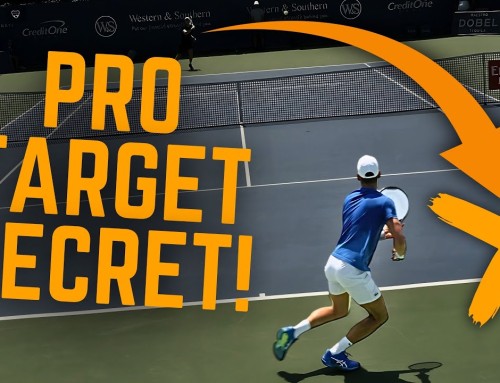
We’re mid-point here. Put yourself in this player’s shoes as he prepares to hit a forehand.
Watch his opponent slide past the hash mark, well over to the other side of the court.
You can almost hear the thought running through his head. Got you. You’re wide open now. Easy lane behind you. Probable winner. Green light, go for it.
Except there are three serious problems with that read.
Problem one: his opponent is actually standing in exactly the right spot.
Here’s why.
From this point of contact, the player on the other side has two extreme target options. An angled shot crosscourt, or a shot down the line behind his opponent.
Draw lines connecting both targets back to the opponent’s position, and here’s what you’ll notice.
The crosscourt angle keeps pulling the ball further off the court the more extreme it gets.
The down-the-line option only ever forces a run as far as the sideline.
Split the difference between those two targets, and the opponent’s outside foot is sitting almost exactly in the middle.
He’s perfectly positioned.
Here’s a simple rule for singles: when the ball sits on one side of the court, you should be positioned slightly toward the other side.
So when this player takes the bait and goes down the line, it’s a trap for two reasons.
First, that lane was never actually open. His opponent had already staggered himself correctly to cover it.
Second, the down-the-line shot carries real added risk. The net sits higher there, and the court runs shorter, which means a much higher chance of a miss.
Which is exactly what happened.
But it gets worse from here.
Say this player hits that down-the-line shot successfully.
Where does he now need to recover to for the next ball?
Following that same staggered positioning rule, he needs to shift all the way across to the opposite side.
Compare that to the crosscourt option. His opponent runs just as far either way, with far less risk of an error.
But with the crosscourt shot, the player is already standing roughly where he needs to be for the next ball.
By choosing the down-the-line target instead, he’s doubled or tripled his own recovery distance before the next shot even arrives.
And it compounds further.
Once he scrambles across the court to cover his own recovery, where’s the open space for his opponent’s next shot?
Straight back crosscourt, into the exact space this player just vacated.
Less risk and less running for the opponent. More risk and more running for him.
Make this same decision repeatedly, and your odds of losing by unforced error climb dramatically, your running requirements explode, and you’re handing your opponent a high-percentage shot behind you on nearly every exchange.
This is the real mechanism behind the strategy keeping you stuck at 3.5, and most players never see it happening in real time.
Here’s why this matters so much at every level.
Most points in tennis end on an error, not a clean winner.
Build your strategy around chasing winners instead of earning a genuine positional edge, and you’ll consistently beat yourself.
Now, to be fair, down the line is sometimes exactly the right call.
The key is recognizing when your opponent actually hands you that opportunity.
Here’s a different point from the same match.
Watch this player’s position as the ball comes in. He’s moving forward, balanced, well inside the baseline.
Same two target options exist. Crosscourt angle, or down the line.
But look at his opponent’s position this time. Nowhere near that central staggered point between the two targets.
Because he’s genuinely out of position, the down-the-line shot now makes real sense.
It stretches his opponent into a full run and opens a legitimate high-percentage angle away from him.
This time, the player hitting gets to stand still. His opponent does all the running, caught in no-man’s-land, neither at the baseline nor the net.
That’s when the wide-open court actually appears, and that’s the moment to take it.
The earlier example was a mirage. It looked open. It wasn’t.
This one is real.
Winning tennis players at every level understand something simple: tennis isn’t about unpredictability or sneaky shot selection.
It’s about quality execution of smart, proven patterns, not the strategy keeping you stuck at 3.5.
If you want to learn the actual high-IQ pattern that replaces this flawed strategy entirely, let me know in the comments and I’ll make it the next lesson.
Keep up the great work on your tennis.
Your Coach,
-Ian