If you have ever watched a professional tennis match from court level, you know exactly what I am talking about. The ball comes off the racket with this aggressive, almost violent dip. It looks like the laws of gravity have been temporarily suspended and then suddenly reinstated. It feels like magic. It is not magic. It is how to hit topspin in tennis. And once you understand what actually creates it, and what does not, you can start building it into your own game with a handful of simple drills.
Let me walk you through all of it.
Topspin is rotation. Specifically, it is the ball spinning end over end in the direction it is traveling. As that rotation happens, the felt on the ball grabs the air around it. That interaction creates high pressure above the ball and low pressure below it. The result is a downward force on the ball as it travels through the air.
In practical terms, the more topspin on the ball, the sooner it dips and dives down into the court on the other side. That is why professionals can hit the ball incredibly hard and still keep it in play. The spin is doing the work of bringing the ball down. It is giving them extra margin over the net and extra margin inside the baseline at the same time. That combination is what makes topspin so valuable.
Without it, the harder you hit, the farther the ball goes. With it, you can swing freely and trust that the spin will pull the ball down into the court.
Before we talk about what does work, we need to clear up a few things that do not.
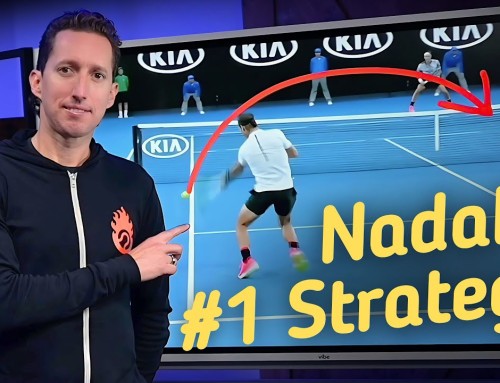
The first misconception is that you need to curl or manipulate the racket around the top of the ball at contact, kind of massaging or maneuvering the strings over it. Here is the reality. When Rafa Nadal, the player who has hit more topspin than anyone in the history of the game, makes contact with the ball, high speed camera footage at 240 frames per second shows the ball is gone in a single frame. That is about four thousandths of a second. There is physically no time to flip or twist or manipulate anything. The ball is gone before any of that could possibly happen.
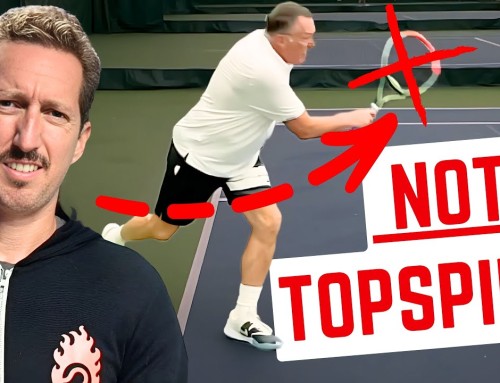
The second misconception is that hitting the top of the ball is what creates topspin. When you watch certain players in real time it can look like the racket is flipping over the top of the ball and covering it. But when you slow that footage down you see something different entirely. What is actually happening is the ball is making contact with the lower edge of the racket face, which destabilizes the frame, and then the ball is already gone while the racket keeps spinning on its own. It is a symptom, not a cause.
The third misconception is that adding a reverse finish or a windshield wiper follow through will automatically produce topspin. I see everyday players add these finishes onto fundamentally flat swings all the time thinking the finish is what creates the spin. It is not. The follow through is a byproduct of the swing that produced the topspin. Put the cart before the horse on this one and you will add the look of topspin without any of the actual spin.
Here it is. The face sends it, the path bends it.
In the fraction of a second the ball is on the strings, wherever the racket face is angled, that sets the starting direction of the ball. Whatever path the racket is traveling on during that same instant, that is what determines how the ball rotates and therefore how it curves.
On a flat shot, the racket face and the racket path are aligned in the same direction. The ball takes off in a straight line with maximum force and minimum spin. On a topspin shot, the racket face is aimed at the target but the path of the racket is traveling steeply upward. As the racket moves up past the back of the ball it rolls the ball forward, end over end, in the direction of the target. That rotation is what bends the ball down into the court.
The steeper the upward path, the more spin. The more spin, the more the ball curves down. That is the whole game.
I want to show you two students because the contrast makes this crystal clear.
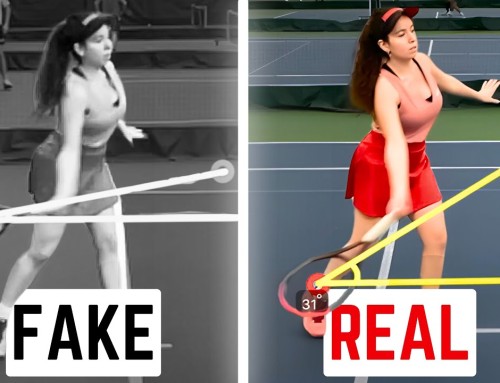
The first player was not hitting any topspin at all. When I drew a line at her contact point and traced the direction of her racket as it approached the ball, it was almost perfectly level. Her racket face was slightly open so the ball was getting over the net, but there was no upward path creating any forward rotation. The harder she hit, the farther it went. And here is the part that trips people up: immediately after contact she was flipping and twisting her racket aggressively. It felt like she was doing something. She was not. The ball was already gone.
The second student looked completely different. He had a loose enough arm and early enough timing to drop his racket way below the contact point before swinging. When I drew that same line at contact, his racket was attacking from a dramatically different angle, coming steeply upward through the ball. The result was aggressive dip, aggressive bounce on the other side, and the ability to swing with real intention without spraying the ball long.
The difference was entirely in the direction of the swing.
These are the exact progressions I use with students and they work. Start from the beginning even if you think you are past it. The feel you build in step one carries all the way through to step five.
First progression, Start by choking up on the racket and holding it by the throat. Now just rotate the tip back and forth in a half circle, getting the feel of your entire chain, shoulder, bicep, elbow, forearm, hand, all pivoting and rotating together. Once that feels natural, drop a few balls and hit them with just that motion. You are listening for a clicking or brushing sound, which is the strings moving as they grab the back of the ball and shift forward, and you are watching for a visible arc on the ball as it leaves your strings.
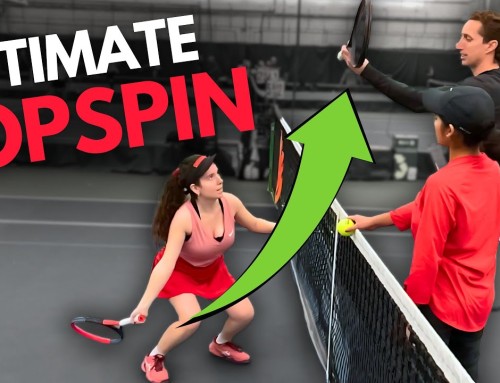
The second progression is to grip the racket normally and practice going straight upward. From a fully dropped, relaxed arm position, raise the racket straight up past the point of contact. Just vertical. Practice that movement a few times in the air and then start dropping balls and swinging through with that same steep upward path. Same indicators: listen for the click, watch for the curve.
The third progression takes that same drill and moves you back to no man’s land. A little more space, a little more runway, a little more swing. The focus here is on relaxing the arm and dropping as low as possible before coming up. The lower you start, the more path you have to roll the ball.
The fourth progression introduces the drop from a high position. Start with your racket head up, practice dropping it fluidly down to a low position, and then use that momentum to swing upward through the ball. The goal is to make that one seamless motion, high to low to high, so the drop itself becomes part of building the swing rather than something separate.
The fifth progression puts everything together from the baseline. Racket head up, drop it as low as possible, swing up fluidly through contact. Full motion, real speed, real spin. This is where it all comes together. When you can do this consistently and start bringing it into actual rallies, you will feel immediately what it is like to swing freely and watch the ball come down on the other side instead of sailing long.
Spend time on each step before moving to the next. The click and the curve are your feedback. If you are not hearing and seeing both of those things, something in the path or the timing needs adjusting. But when they show up, you will know it immediately.
Topspin is not reserved for professional players or people who grew up playing competitive tennis. It is a technique built on one simple principle. Swing upward past the back of the ball. Everything else follows from that.
Go work on it. Your game will never feel the same.
Your Coach,
Ian