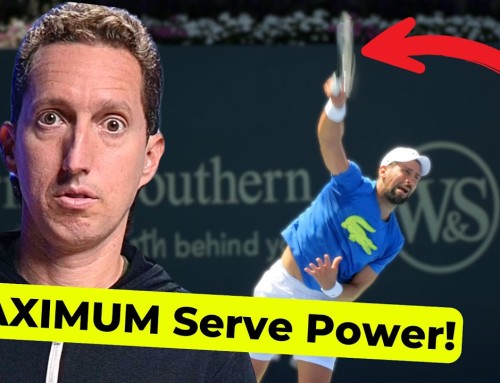
I was working with my student, Barry on his serve, and we discovered something that I see constantly with players at every level.
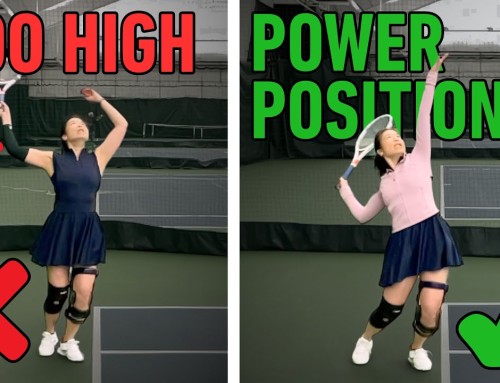
He had a pretty solid trophy position and a decent racket drop, but something wasn’t quite right with his pronation through contact.
Here’s the thing: pronation should happen on ALL serves, whether you’re hitting flat, slice, or kick. It’s not optional. It’s fundamental to generating power and spin while protecting your shoulder.
But Barry was doing something fascinating that I think you might be doing too.
He was holding on.
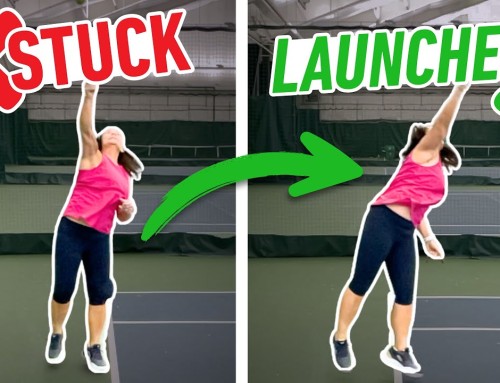
His arm looked good through the trophy position. The racket drop was sufficient. The edge position was solid. But then right through contact and beyond, everything got rigid and locked in.
It reminded me exactly of what we’d worked on earlier with his forehand. He was holding onto the follow through instead of letting it release naturally and smoothly.
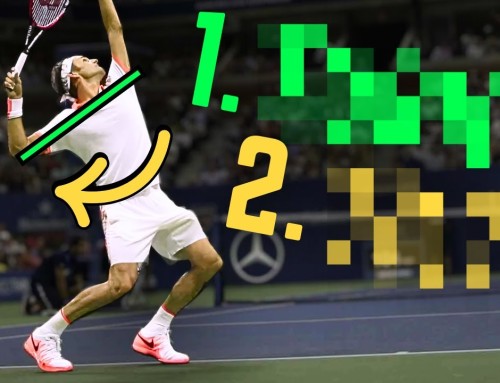
Think about Roger Federer’s serve for a second. Watch how smoothly and loosely his hand releases through and after contact. There’s no tension, no forcing, no mechanical manipulation. It just flows.
The crazy part is that Barry’s drop and edge position were actually good enough that pronation SHOULD have happened automatically. When you stretch and unwind from that position, the hand and arm naturally want to continue turning outward.
But his wasn’t turning. He was getting tight right through the point of contact.
Here’s what most players don’t understand about pronation: it shouldn’t be forced.
I see so many players who’ve watched YouTube videos and studied slow motion footage of the pros, and they KNOW they’re supposed to pronate. So what do they do? They try to make it happen mechanically.
That’s the mistake.
Pronation should happen as a byproduct of a stretch and then a release of the shoulder. You set up the position, you create the stretch, and then you let it go.
When I worked with Barry, I had him slow everything way down. I wanted him to feel the different positions without forcing anything. We walked through it step by step: the racket drops, you get to the edge position, and then somewhere between there and contact the hand has to turn so the strings face the target.
Then that turn continues out to the side.
All of this happens in a tiny sliver of time during a real serve, which is why it’s so hard to diagnose and fix. But slowing it down reveals everything.
So if you experience this, check your finishing position. If your arm is stopping on the right side of your body, you’re forcing the internal rotation with your forearm instead of letting your body’s rotation naturally bring the racket across to the left side.
Here’s a drill you can try: after you make contact, focus on turning your palm outward smoothly and passively. Not forcibly. Just let it happen. Your hand should naturally turn to face away from you as your arm continues across your body to the left.
Here’s the tightrope walk you’re trying to navigate: you don’t want your arm locked in and rigid, but you also don’t want to forcibly flip and twist it. You want something in between.
You want release without force.
This is really tricky because you’ve probably watched enough videos to know you’re SUPPOSED to pronate. So you have all these repetitions of trying to make it happen mechanically.
You’re trying to split the difference between forcing it and not doing it at all.
The key is understanding the positions and then trusting your body to connect them smoothly. Feel the edge position where your racket drops and your strings face away from the target. Then feel how your hand needs to turn so the strings face the box at contact. Then let that turning motion continue naturally through your follow through.
Slow motion practice is your friend here. Take your time. Feel each position. Don’t rush to full speed until the release starts to happen on its own.
If you’re struggling with pronation on your serve, ask yourself this: am I holding on too long? Am I getting tight through contact? Am I trying to force something that should happen naturally?
The answer might be that you need to let go more than you need to do more.
Pronation isn’t about making something happen. It’s about setting up the right positions and then getting out of your own way.
Your Coach,
-Ian