I was working with a student who had been struggling with serve consistency for months.
His mechanics looked pretty good during slow-motion practice swings. Nice rhythm, decent toss, solid motion through the ball.
But the moment he actually tried to serve in a point situation? Chaos.
Balls sailing long. Inconsistent contact. And that frustrated look on his face that told me he had no idea what was going wrong.
Sound familiar?
Here’s what I discovered when I recorded him from the side angle…
His contact point was a mess.
Not because he didn’t know where to meet the ball. But because two critical factors were working against him every single time he made contact with the ball.
The first problem was his toss placement.
When he missed his first serve long, I asked him a simple question: “What does that tell us about your toss?”
He knew the answer immediately. “Too far back.”
Exactly right.
When you toss the ball too far behind you, physics takes over. Your racket face opens up at contact, and the ball launches off your strings at an upward trajectory instead of diving down into the service box.
It’s like trying to throw a football while leaning backward. The mechanics just don’t work.
But here’s where it gets interesting…
Even when his toss was in a decent position, he was still missing serves long. That’s when I realized the second problem.
His arm was collapsing at contact.
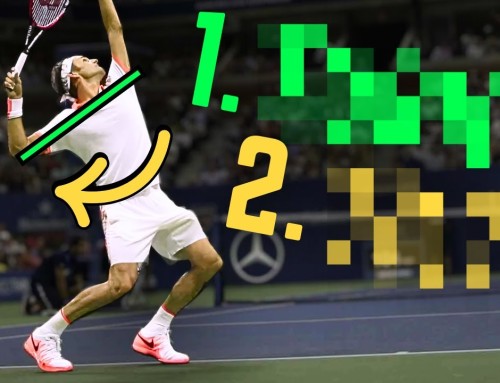
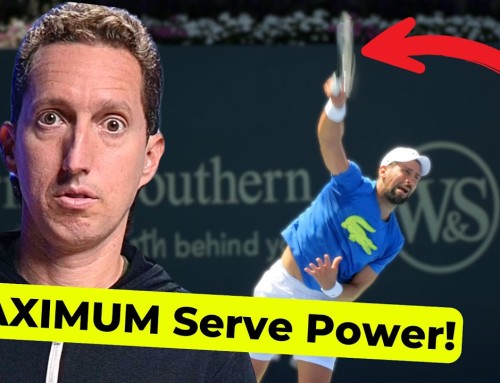
Look at any professional player at the moment of contact on their serve. Federer, Djokovic, doesn’t matter who. You’ll see the same thing every single time.
A straight line running from their shoulders through their dominant arm and up into the racket.
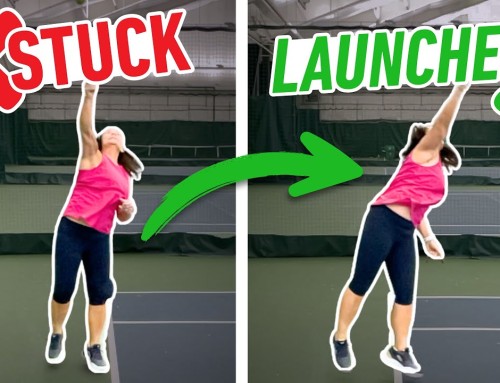
My student? He had what I call a “scrunched” position. His arm was bent, his shoulder wasn’t extended, and his entire upper body looked compressed at the moment of contact.
That collapsed position forces the racket face open, even with a perfect toss.
Think about it this way…
When you’re trying to reach something on a high shelf, you don’t bend your arm and scrunch your shoulder down. You extend fully to create a stable, strong position.
Your serve contact point works exactly the same way.
The solution requires fixing both elements simultaneously.
First, the toss needs to move forward. Not way out in front where you’re lunging for it, but far enough forward that your racket face naturally closes slightly at contact.
Second, you need to create that straight line extension through your shoulder and arm.
Here’s the tricky part though…
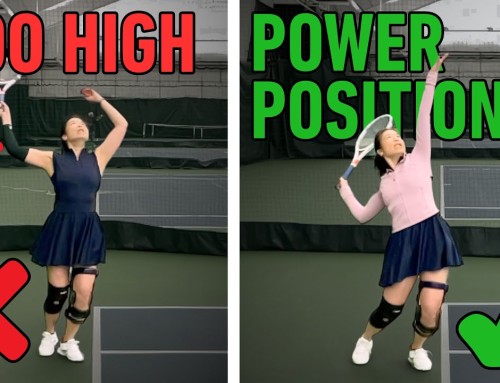
Your shoulders shouldn’t be level at contact. They should be pitched at an angle, with your hitting shoulder elevated and your non-hitting shoulder lower.
Why?
Because that pitched position creates a strong, stable platform that supports your arm and allows for full extension without putting your shoulder in a weak or injury-prone position.
Level shoulders with a raised arm? That’s a recipe for inconsistency and potential injury.
When I had my student shadow swing and pause at contact, his shoulders were too level and his arm was too raised. We needed more pitch in the shoulders and a stronger connection between his arm and his body.
After we made the adjustment, the difference was immediate.
Instead of the ball ramping off his racket like it was launched from a motorcycle jump, it started diving down into the service box.
That diving trajectory is your proof that you’re making contact in the right position.
If your serves are consistently sailing long, you’re dealing with one or both of these issues.
Take a video of yourself from the side angle. Pause it right at contact.
Ask yourself: Is there a straight line from my shoulders through my arm? Are my shoulders pitched at an angle? Is my toss positioned far enough forward?
If the answer to any of those questions is no, you’ve found your problem.
The good news is that once you understand what you’re looking for, fixing it becomes a matter of deliberate practice.
Shadow swing and pause at contact. Feel that strong, extended position. Then try to recreate it when you actually toss and hit the ball.
You’ll probably need to make contact sooner than you’re used to. Most players let the ball drop too low, which contributes to that collapsed arm position.
Meet the ball higher. Extend fully. Keep those shoulders pitched.
Your serve will thank you for it.
Keep working.
Your Coach,
-Ian