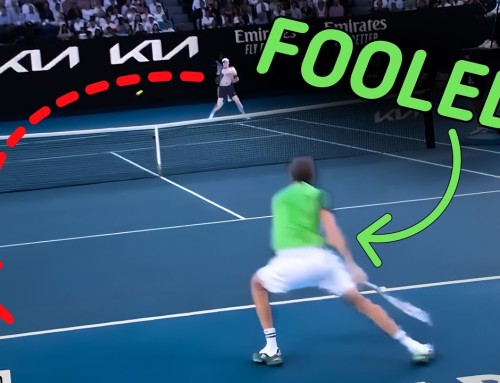
I recently came across a set played between Karo and Taylor Fritz, the current world number 12, and what struck me wasn’t the tennis itself. It was Karo’s reaction afterward.
He kept downplaying it. Kept saying it was just a practice set.
Think about that for a second. You’re playing on camera, potentially in front of hundreds of thousands of people, against a top professional, with everything on the line for your career aspirations, and your reaction is basically… no big deal. That right there is mental toughness in tennis at its highest level.
That reaction tells you everything you need to know about mental toughness.
Here’s something I want you to understand. Mental toughness isn’t an on/off switch. It exists on a spectrum.
On the low end, you completely fold under pressure. You slow down, tighten up, and become a totally different player the moment something important is on the line.
In the middle, you have SOME ability to stay composed, but you can’t quite reach your full potential when it really matters. And at the high end, pressure actually makes you BETTER. Your best skills are available to you, and you can swing with total freedom no matter what’s at stake.
Now here’s the part most players miss.
Mental toughness and your tennis level are not the same thing. I’ve seen 3.5 players with rock solid mental toughness and 4.5 players who completely fall apart the moment things get tight. One of the big pillars of being a complete tennis player is the mental game, but it’s just one pillar alongside technical skill, fitness, and tactics. You need all of them.
So how do you actually build mental toughness?
I refer back to something I call the concentric circles of learning. Picture three rings. The innermost ring is your comfort zone. That’s where your familiar skills live, where everything feels easy and automatic. Just outside of that is the Learning Zone. This is where growth happens. You’re uncomfortable, but not so uncomfortable that you’ve lost control.
Then there’s the Panic Zone, so far outside your comfort zone that you go into fight or flight mode and can’t learn anything at all.
The goal is to spend as much time as possible in that middle ring.
Karo has left his comfort zone so many times, practicing with elite players, competing under real pressure, that what used to terrify him has become his new normal. The cameras and the YouTube audience and a world number 12 across the net? That’s just Tuesday for him now.
You and I aren’t there yet. But we can get closer.
If you push yourself just 10 to 20 percent outside your comfort zone on a consistent basis, your mental game will grow. Maybe that means signing up for a tournament when you feel like you’re not ready. Maybe it means playing against someone you know is better than you. Maybe it means recording yourself and actually watching it back.
Small steps, taken consistently, add up to real change.
That’s how you stop crumbling under pressure and start playing your best when it matters most.
Your Coach,
-Ian