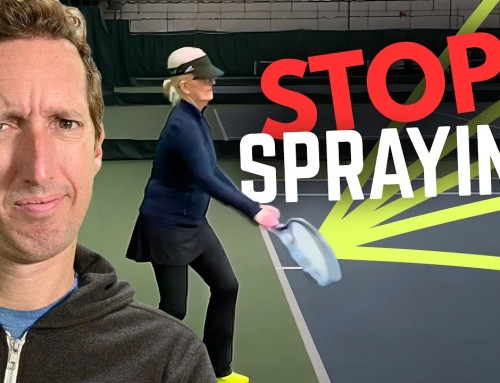
I had a student come to me recently with a very familiar complaint. Her forehand felt weak. She was putting in the effort, swinging hard, and getting almost nothing back in return. Sound familiar?
When I took my first look at her swing, I was genuinely confused. Because what I saw at her contact position made absolutely no sense given what she was telling me.
Here is what I normally see from most players around the 3.5 level. At the point of contact, their hips and shoulders are still mostly facing sideways.
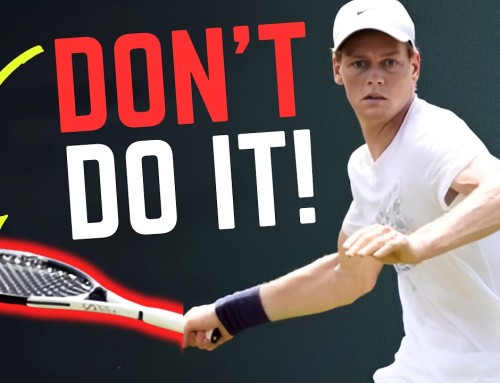
That is pretty standard for that level. Now compare that to a 4.5 level player. His body is leading, his hips and shoulders have already rotated forward, and his arm and racket are lagging behind.
The racket almost looks like it is playing catch up. And then look at a professional like Caroline Wozniacki or Victoria Azarenka. Same thing, just even more dramatic. The body leads. The arm follows. Every single time.
So when I saw this student’s contact position looking the way it did and heard her telling me her forehand was her weakest shot, something wasn’t adding up.
That is when I had to do a little detective work.
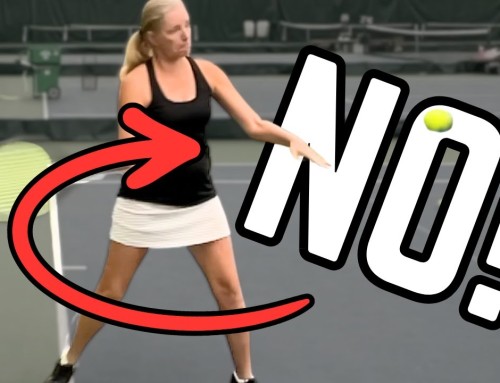
I went back earlier in the swing and slowed things down. What I found was that her right elbow was jumping out ahead of everything else.
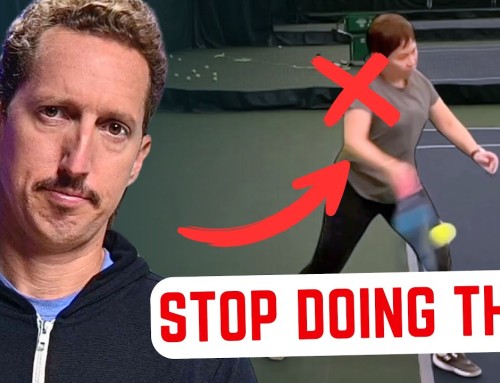
Instead of her hips and shoulders leading the charge and her arm staying passive and relaxed behind them, her elbow was the first thing moving forward. I call this a push. And the problem with a push is that it breaks the kinetic chain before it ever has a chance to build any real energy.
Think of it this way. In any powerful tennis swing, what you want is for the big parts of the body to lead and the small parts to follow. The hips go first, then the shoulders, then the arm, then the racket head. That sequence is what creates effortless power.
When the arm jumps out early and takes over, the big muscles of the body never get their turn to contribute. You end up doing all the work with the smallest and weakest links in the chain.
What was wild about this particular student was that her body was actually trying to catch up and arriving in roughly the right position by contact. But the damage was already done. Once the elbow leads, the kinetic chain is broken, and no amount of catching up fixes that.
So here is what we worked on together.
The first thing I did was hold her racket gently and waited for her to pull against me using her shoulders and hips. That feeling of stretch, coming from the shoulder and oblique, is exactly what initiating with the body is supposed to feel like and it is the foundation of real tennis forehand power.
Once she could feel it, we moved on to her recreating that same sensation on her own without my help.
From there we layered in shadow swings, then easy feeds, then balls from the baseline. Each step added a little more challenge while keeping the focus on one thing: lead with the body, keep the arm passive.
Forty five minutes later she was hitting the ball with the same force as before but with dramatically less effort. She was smiling. She could feel the difference immediately.
That is what happens when the body finally moves in the right order.
This is how advanced players make the game look so easy. They are not trying harder than you. They are just pulling with the body first and letting the arm come along for the ride.
If you have ever watched a strong player at your local courts and thought they looked effortless, this is exactly why.
If your forehand feels like a constant struggle, start paying attention to what is leading your swing. Chances are, it is your arm. And the fix is simpler than you think.
Your Coach,
-Ian