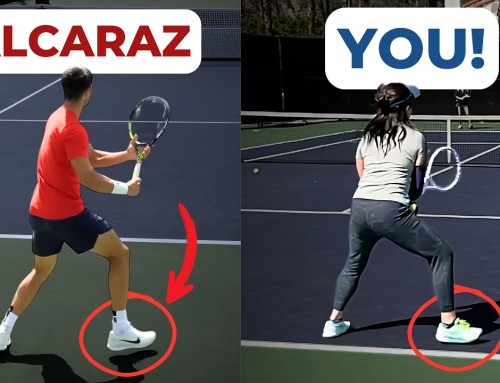
Most doubles players at the net feel like a spectator. The ball goes back and forth, back and forth, and nobody hits it to them. Their opponents just keep feeding each other from the baseline like the net player does not even exist.
If that sounds familiar, here is why it is happening.
The doubles court is 36 feet wide. To cover the entire thing at once you would need six people standing shoulder to shoulder. That is the reality nobody talks about.
So when you are standing at the net searching for that one perfect spot where you can protect your alley AND dominate the middle of the court, you are searching for something that does not exist. There is no magic position. You have to give something up.
The question is what to give up, when to give it up, and how to do it without getting burned.
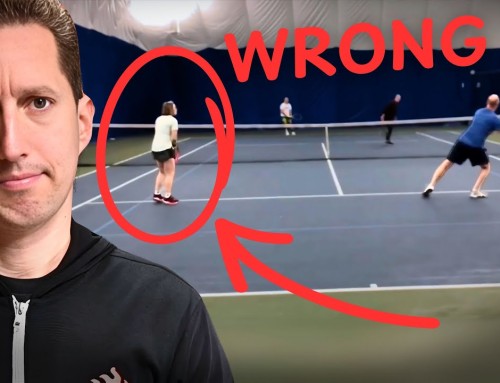
Here is what I see from most recreational doubles players. They move a few feet to the left, a few feet to the right, and call it active net play.
But if the total range of your movement from one side to the other is only about six feet, you are giving your opponents an enormous amount of open court to work with. That baseline player on the other side knows exactly where you are and exactly where you are not. They will just keep hitting away from you all day long.
On the other end of the problem, some players overcorrect. They see a ball going crosscourt and make a big aggressive move toward the middle, but they do it too early and show their hand completely.
The moment that baseline player sees you sprinting toward the center, they just redirect the ball down the line and you are done. You end up getting the evil eye from your partner and retreating back to hugging your alley for the rest of the match. That is the costly mistake that holds back so many players who are trying to level up their doubles net play.
So what does it actually look like when it is done right?
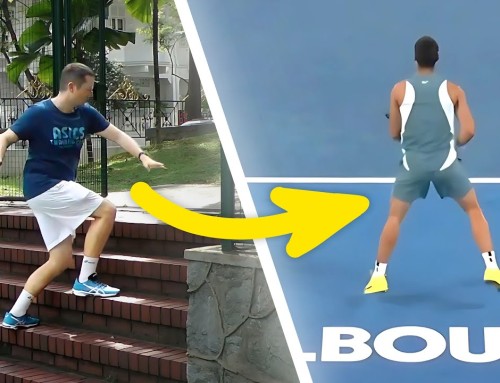
Watch Bob Bryan play doubles. One of the greatest doubles players of all time. What you will notice is that he starts from a position that is slightly squeezed toward the middle of the court, maybe ten percent off his alley. Not dramatic, but enough to give him a head start.
Then, as the ball travels toward the baseline player on the other side, he does not move right away. He waits. And the moment that baseline player begins their forward swing, that is when Bob commits toward the middle.
This timing is everything.
Once a player starts their forward swing they have already chosen their target. They cannot retime the shot. They cannot redirect the ball.
So by the time they even register your movement in their peripheral vision it is already too late for them to do anything about it. You have essentially become invisible during the one moment that actually matters.
This same timing works at every level. I have seen 3.5 players use this exact move and cover the entire width of the net because they simply timed their step with the forward swing of the baseline player on the other side. It is not about being fast. It is about being timed correctly.
Here is what to take back to the court with you.
First, give up a little of the alley. Not all of it, but some of it. Start slightly more toward the center than you normally would.
Second, do not move early. Wait for the forward swing of that baseline player and let that be your trigger. When the racket starts moving forward, you start moving toward the middle.
You are going to get beat down the line sometimes. That is part of the deal. But if you make this trade consistently you will intercept far more balls than you ever did standing still, and your doubles game will never look the same.
Your Coach,
-Ian