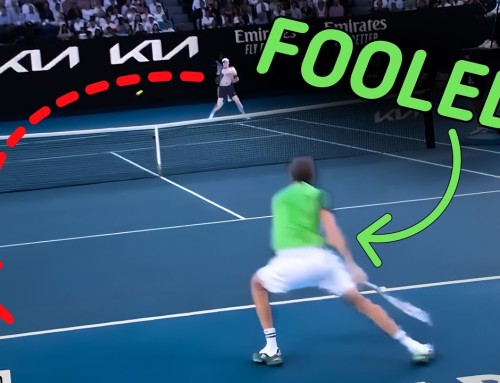
Here’s something I want you to think about the next time you go bowling.
You wind up, release the ball, and as it rolls down the lane you start leaning left and right trying to “steer” it toward the pins.
We’ve all done it. It’s actually kind of funny to watch. And deep down, we all know it doesn’t work.
So why are millions of tennis players doing the exact same thing with their rackets every single day?
Let me explain.
There are four distinct phases to every single tennis shot. Preparation — where you load, coil, and store energy in your body. The forward swing — where you uncoil and send all of that energy toward the point of contact. Then there’s contact itself — the moment the ball physically touches the strings.
Here’s the part that blows most players’ minds when they first hear it:
Contact happens in just 4/1000 of a second.
One frame on a 240fps camera. That’s it. The ball is on the strings, and then it’s gone.
Which brings us to phase four: the follow-through.
And here’s the truth about the follow-through that nobody seems to be telling people — its one and only purpose is to allow your body and racket to smoothly decelerate.
That’s it.
Once the ball leaves your strings, you cannot influence it. You cannot add spin, you cannot change direction, you cannot do anything to affect where that ball goes. It’s already gone.
And yet, every day, coaches and players all over the world are obsessing over finish positions as if they’re the key to better tennis.
“Finish over your shoulder.”
“Finish by your opposite pocket.”
Sound familiar?
I see this play out constantly in two really common ways.
The first is what I call the “fake follow-through” on the forehand side. A player swings flat and level through the ball, and then — right after contact — their hand flips over toward the opposite pocket. To them, it feels like they’re brushing up and adding topspin. It even looks like topspin.
But it isn’t.
The racket path during contact was flat. You cannot create spin with a flat racket path no matter what your hand does after the ball is already traveling toward the other side of the court.
The second one I see is on the one-handed backhand. A player’s racket is actually traveling downward to the ball, makes contact with no lift whatsoever — and then dramatically swings upward and extends high because that’s what they’ve been told a good one-handed backhand finish looks like.
The finish doesn’t match the momentum. It doesn’t match the energy. It’s a costume.
Both of these players are doing the tennis version of leaning left and right at the bowling lane.
Now here’s what’s fascinating: when you watch elite players like Jannik Sinner finishing up over his shoulder, or Jack Sock finishing with his racket wrapping all the way around by his opposite hip — those finishes aren’t made. They’re allowed to happen.
Jack’s extreme wrap-around finish? It’s a natural byproduct of the tremendous lag, stretch, and circular energy he releases through contact. That circular momentum has to go somewhere. It goes around.
Sinner’s high finish over his shoulder? Same principle — the smooth circular lift of his racket through contact simply continues on that path naturally.
Neither of them is making the racket go there. It just goes there on its own.
And that’s the key distinction nobody talks about: making a follow-through happen versus letting it happen.
When you start forcing finish positions, here’s what actually happens to your game. Your swing mechanics get rigid and tight. You produce less power because a locked-up body can’t swing freely. You create less spin because you can’t generate the smooth circular racket path the pros have. You lose accuracy because jerky, abrupt direction changes make clean repeatable swings nearly impossible. And over time — you risk pain and injury.
All because you were focused on the wrong phase of the shot.
If you’re not getting the power, the spin, or the lift you’re looking for — fixing your follow-through will never solve it. The problem lives before contact, in your preparation and in how you’re using your body’s kinetic chain.
This is exactly where tennis follow through doesn’t matter becomes important to understand.
When those things are right, the follow-through takes care of itself.
The biggest mistake players make is believing tennis follow through doesn’t matter is something they need to argue with — instead of understanding it as a reminder that contact is already gone.
So the next time you catch yourself trying to force a finish position, I want you to remember the bowling lane.
The ball is already gone. Let the racket go where the momentum takes it.
And this is why tennis follow through doesn’t matter is such a powerful concept when you actually apply it correctly.
Your Coach,
-Ian