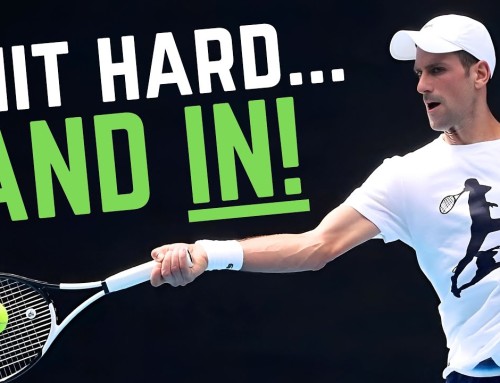
Novak Djokovic and Carlos Alcaraz just played an incredible match, and it got me thinking about something almost every recreational player misses. Watch either of them cover the court and you’ll notice they never look like they’re scrambling. They float. Every direction change looks smooth, almost effortless. That’s not luck, and it’s not just athleticism. It’s a specific skill, and once you understand it, you can move like the pros too.
Here’s the piece most players never notice. Watch Novak recover from a shot and lift into his split step. His whole body is neutral, feet even, facing his opponent, ready to go either way. Now watch what happens the instant Carlos hits the ball. Novak doesn’t land, get set, and then decide which way to run. He comes down already flowing in the right direction, using the same energy from his jump instead of stopping and starting over.
That single detail is the real secret behind learning to move like the pros. It’s one continuous motion, lift, read, flow, not three separate steps stitched together.
Carlos does the exact same thing on every recovery. Lift neutral, identify where the ball is headed, then let his momentum carry him there without any hesitation in between. Sometimes that even means changing direction mid-air, planting one foot, pivoting the other, and pushing off back the way he came, all without breaking that same fluid rhythm.
Now here’s the hard truth. Most everyday players, myself included at times, don’t even split step at all. I worked with a group of students recently in Costa Rica, and one player’s rallies had zero split step whatsoever. Flat-footed the entire time, just standing and reacting late to every ball. We’ve all been told a million times to split step and get into a ready position, and most of us still aren’t actually doing it.
After just a couple of training exercises, that same player looked completely different. She lifted off the court, read the ball’s direction, and pivoted the correct foot the correct way, on her very first attempt. That’s the door opening. That’s what it looks like when a player finally starts to move like the pros instead of chasing the ball a step behind.
The entire thing comes down to timing, and it breaks into three steps. First, lift into a neutral split step before your opponent even makes contact, since you don’t yet know which direction the ball is going. Second, read the ball’s direction while you’re still in the air. Third, as you land, pivot your outside foot toward the ball and let your existing momentum flow that way.
Your eyes and brain need roughly a quarter to a third of a second just to process where a ball is headed. That’s exactly why the lift has to come before contact, not after. Even Djokovic and Alcaraz don’t time this perfectly on every single point. If I had to guess, they nail it maybe half the time. So don’t expect perfection from yourself either.
Once you can move like the pros, the next piece is hitting the ball with real power, and it comes from the same underlying idea, letting the biggest parts of your body do the work.
Watch Novak set up for a forehand and his chest turns well past his hips, storing energy in that stretch between upper and lower body. As the ball approaches, he unwinds that coil first, hips and chest leading, with his arm and racket trailing slightly behind in what’s called a lag position. By contact, his whole torso faces the net. The arm’s only real job is delivering the energy his body already created.
Carlos builds that same setup on his forehand, and both players repeat the identical pattern on their two-handed backhands. Hips turn, chest turns further still, and right before the ball arrives, everything unwinds together so the chest and belly button are facing the ball at contact.
Most club players get halfway there. They coil into the same sideways position… and then nothing happens. The body stays put while the arm and hand swing forward on their own, doing all the work that the bigger, stronger muscles were supposed to handle. All that stored energy just goes to waste.
If that describes your swing, you’re in good company. It’s the majority of players at every level below the pros.
So if you want to move like the pros, both on defense and on offense, it really comes down to two habits working together. Split step early enough to flow your momentum toward the ball, and let your hips and chest unwind before your arm ever starts swinging.
Get that timing down, and covering the court stops feeling like running. It starts feeling like floating.
Thanks for reading, and I’ll see you on the court.
Your Coach,
Ian