If you want to talk about inside out forehand tennis, there is no more powerful or satisfying weapon you can add to your game — and once you understand how to use it, your opponents are going to have a very bad day.
But first, let me paint you a picture.
Imagine you’re stuck hitting backhand after backhand after backhand. Your opponent has figured you out. They’re placing the ball perfectly to your backhand side every single time, taking away your stronger shot, keeping you uncomfortable and defensive.
I call that backhand jail.
And honestly? I think I’d rather be in regular jail.
That’s what a smart opponent with precise, consistent groundstrokes can do to you if you don’t have the tools to escape. But here’s the beautiful thing — the inside out and inside in forehand is your get-out-of-jail-free card.
Draw an imaginary line straight down the middle of your body. When the ball travels away from you as you hit it — that’s an outside forehand. When the ball travels toward your body — that’s an inside forehand.
From that inside forehand position, you have two choices.
Hit the ball back out in the direction it came from — that’s inside out. Hit it back down the line in the opposite direction — that’s inside in.
Simple definitions. But the strategy behind them? That’s where it gets really powerful.
When you run around your backhand and choose to hit a forehand instead, three things happen all at once.
One — you don’t have to hit your weaker shot. Two — you get to hit your stronger shot. Three — you can direct the ball right back to your opponent’s weakness.
Think about that for a second. In one decision, you’ve flipped the entire dynamic of the point. You went from being the player eating backhands in the corner to being the player dictating with your best shot aimed at their worst shot.
That’s not just good tennis. That’s inside out forehand tennis working exactly the way it’s supposed to.
None of this works without the right footwork. And the good news is — it’s learnable.
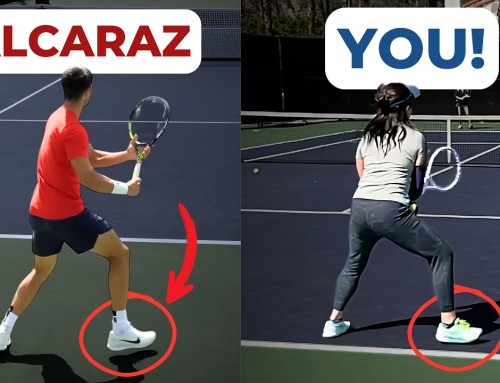
Here’s the pattern. You split step, and as you’re coming down you read the ball and recognize you can make this a forehand. The very first move is to point your outside foot inward. For right-handed players, that’s your left foot angling in.
Then you make two big, long strides — not little shuffle steps, but full sweeping strides that cover ground fast. One big pivot step with your right foot, one big reaching step with your left, and suddenly you’re set up and ready to rip a forehand from a ball that was headed straight to your backhand.
The key word there is big. Players who struggle with this are taking tiny steps. The pros cover enormous ground in just two strides because they commit fully to each one.
Here’s something that might change how you think about your forehand forever.
A modern forehand isn’t a straight hitting motion — it’s a circular one. The tip of your racket travels in a circular path around your body. And depending on where in that circle you make contact, the ball goes in a completely different direction.
The single most important factor? Where your strings are facing the instant the ball touches the racket.
Strings angled out to the right at contact — the ball goes inside out. Strings facing straight ahead — the ball goes inside in, straight down the line. This means to hit inside out, you let the ball travel just a little deeper into your stance before making contact. To go inside in, you meet it a little earlier in the swing.
Once you feel this, directing your inside out forehand tennis shot becomes far more intuitive than you’d expect.
Now — with great power comes great responsibility. And this shot can absolutely blow up in your face if you’re not careful. Here are three ways it happens even to the pros.
First — misjudging the ball. You see what looks like an opportunity to run around your backhand, but the ball is actually deeper or faster than you realized. Now you’re hitting off your back foot in an awkward position, and what should have been a winner becomes an unforced error on a ball your opponent didn’t even hit that hard.
Second — hitting a mediocre shot from a compromised position. If you go to all the trouble of running around your backhand but only produce an average ball, you’ve done two terrible things at once — you’ve given your opponent an easy target AND left yourself completely out of position for their next shot. This backfires fast.
Third — moving too far out of position. Sometimes players run so far around their backhand they end up hitting from outside the doubles alley. At that point, the shot you hit absolutely must be outstanding. Because if it isn’t, you’ve handed the point to your opponent on a silver platter. The pressure of needing a perfect shot from that position causes players to tighten up and miss — unforced errors that sting because they were completely self-inflicted.
The bottom line with all three of these? Only go around your backhand when you can genuinely make a high-quality shot from a manageable position. Otherwise, a solid backhand is the smarter play.
The next time you’re in a point and you feel that ball drifting toward your backhand — pause for just a half second and ask yourself: do I have time to make this a forehand?
If the answer is yes, commit to it fully. Big strides. Stay loose. Pick your target — inside out to their backhand, or inside in down the line — and trust the swing.
Because the moment you start deploying inside out forehand tennis with confidence and intention, backhand jail becomes a thing of the past. Your opponent will be the one scrambling. Your opponent will be the one hitting their weaker shot under pressure.
And you’ll be the one running the point.
Thanks for reading, and I look forward to seeing you take your game to the next level!
Your Coach,
-Ian