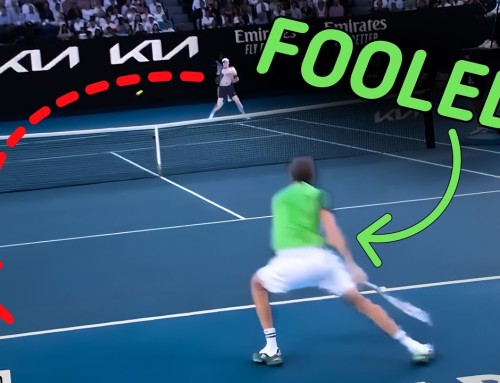
Three stances separate the pros from everyone else…
Every great tennis player relies on three basic stances to move around the court, and most everyday players only ever use one. That one habit alone is quietly making the entire game harder than it needs to be.
Here they are.
A neutral or square stance, where your feet sit at roughly a right angle to the baseline.
An open stance, where your feet angle toward the net, opening your body forward.
And a closed stance, where your front foot crosses over, closing you off from the net entirely.
That’s true on both the forehand and the backhand, which means a complete player really needs six total variations in their toolbox, not just one comfortable go-to.
Here’s why it matters so much.
Each stance loads a different foot for balance and push-off. For a right-handed player, an open stance forehand relies mainly on the right foot to drive and unwind the racket.
A square or closed stance forehand relies on the left. Flip to the backhand side and it reverses, open stance leans on the left foot, closed or square stance leans on the right.
Skip training half of these, and you’re only ever comfortable responding to certain balls from certain directions.
I recently reviewed footage from a 3.5 level match to show exactly what this limitation looks like in real life.
Shot after shot, this player hit forehands from an open stance and backhands from a closed stance. Almost every single shot loaded onto his right foot. Only one time in the whole sample did he use a square stance forehand off his left foot.
That’s not random. That’s a player who’s right-leg dominant, and it boxes him in athletically no matter how clean his technique looks on any given shot.
World class players don’t have that limitation, because they’ve been deliberately trained to hit off either foot, in any stance, on both sides of their body. Moving forward, moving wide, getting pushed back, it doesn’t matter what the situation throws at them.
So here’s a genuinely useful tennis footwork drill for building that same versatility yourself, and you don’t need a court to do it. All you need is a set of stairs.
Walk up shadowing an open stance forehand, planting your right foot on each step while you coil and uncoil your upper body.
At the top, come back down and repeat using your left foot instead, this time shadowing a square or closed stance forehand. Then switch to backhands. Go up using your right foot for a closed stance backhand, come back down using your left foot for an open stance.
It’ll probably feel strange the first time, and that’s exactly the point. You’re training coordination between your upper and lower body on the side that needs it most, with zero pressure of an actual rally in the way.
You’ll likely notice you feel far steadier on one side than the other. That’s completely normal. Nobody is naturally balanced and strong on both sides of their body, which is exactly why this kind of tennis footwork drill is worth doing on purpose, instead of just hoping it develops on its own over time.
Once you’ve built some comfort on the stairs, take it to the court. Drop balls to yourself and practice hitting off your right foot and your left foot, on both your forehand and your backhand. Doing this in a live, dynamic rally is a completely different challenge, but everyone has to start somewhere.
Full credit here goes to Tomas from Field Tennis, whose work I’ve followed for years. This is one of the best, simplest drills I’ve come across for training this exact skill.
If you’ve always felt strong on one side of your body and awkward on the other, this is your starting point. Give this tennis footwork drill a real shot, even just a few minutes at a time, and you’ll start opening up shots that used to feel completely out of reach.
Thanks for reading, and I’ll see you on the court.
Your Coach,
Ian