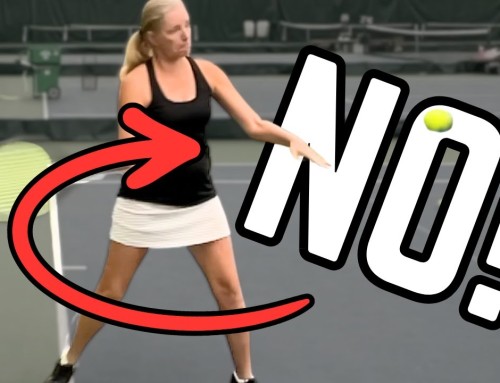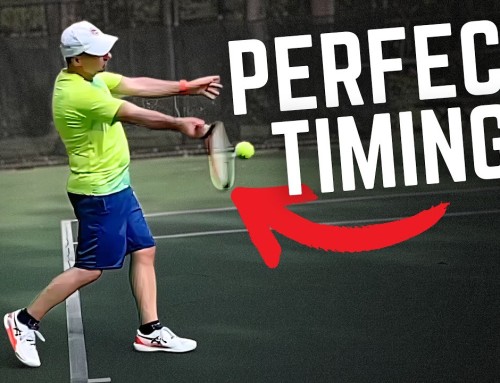
I had a student who was so inconsistent with her forehand that she’d started blocking or slicing it just to keep the ball on the court. She was hitting hard forehands into the back curtain, into the net, sometimes finding the court, with almost no rhyme or reason as to which one she’d get on any given swing. It had gotten so frustrating that she was starting to think about quitting.
An hour or two of focused work later, her forehand looked like a completely different shot.
Here’s exactly what changed, and it comes down to one thing most players never think about: racket face angle.
Before I even touched her swing, I wanted to prove a point. I hit three forehands, same grip, same long smooth circular swing path on all three. One landed in the court. One flew directly into the back curtain. One went straight into the net.
Same swing. Three wildly different outcomes. Why?
The racket face angle at contact was the only thing that changed — and barely at that. The ball that landed in the court had strings slightly open. The one that sailed into the back curtain had strings only two or three degrees more open than that. The one that drilled the net had a completely flat racket face.
Two, three degrees. That’s the entire difference between a ball landing in the court and a ball flying over the fence. And here’s the part that should really grab your attention: the harder and more aggressively you swing, the more sensitive your results become to tiny shifts in racket face angle.
Now back to my student’s original forehand.
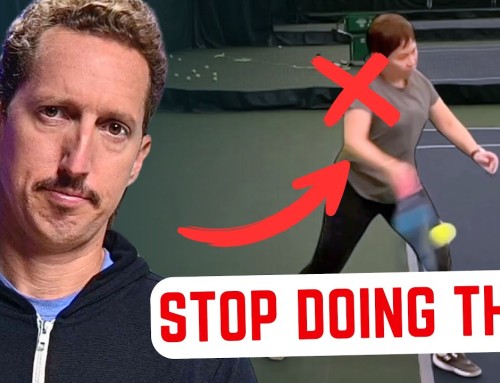
As she took the racket back, her strings were already facing slightly upward — open. Not by a lot. But remember what we just proved: it doesn’t take much. She’d drop the racket and swing forward to contact with that same slightly open racket face angle, and because she could feel herself launching ball after ball, she started compensating the only way she knew how — with a last-second flip, closing the racket right before, at, or just after contact, depending on the moment.
That flip is why her results were all over the map. Depending on exactly when that flip happened relative to contact, the ball could go anywhere from the bottom of the net to deep into the back curtain.
So what does a proper racket face angle actually look like? Let’s check the pros.
Carlos Alcaraz starts with his strings slightly closed, keeps that angle remarkably steady as he unwinds, and arrives at contact with a noticeably closed racket face. Why doesn’t that ball rocket into the net? Because his racket head speed and the upward path of his swing generate so much force that a closed face is exactly what’s needed to keep the ball down.
Novak Djokovic starts even more closed, opens slightly as he swings forward, and stays closed — just less aggressively — at contact, since he’s rallying with less pace than Carlos playing a real point.
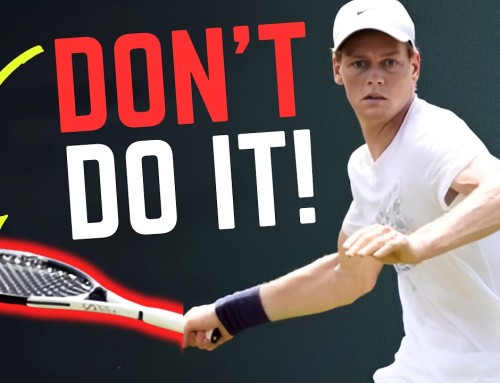
Jannik Sinner starts with the strings pointed almost backward, transitions through downward-facing, and arrives at contact somewhere between Novak and Carlos — slightly closed.
Three different styles. Three different starting positions. But notice what none of them do: none of them ever let their strings face upward through their swing. Not once. Because with that much acceleration and force going into contact, an open racket face angle at any point would make the ball impossible to control.
For an everyday player swinging with real acceleration, the target racket face angle at contact is usually close to square — maybe very slightly open. The harder you swing, the more that angle needs to close to compensate. It’s a spectrum, not a fixed number.
Here’s how we fixed my student’s flip, step by step.
Step one: I had her shadow swing with an exaggerated, intentionally over-closed racket face, just so she could feel what that extreme felt like in her hand.
Step two: Then the opposite — an exaggerated open racket face angle, so she could feel that extreme too.
Step three: Now we aimed for square. Shadow swings only, pausing right at the imaginary point of contact so she could see and feel exactly where her hand and racket were.
Almost immediately, something shifted. Instead of starting open like her old forehand, she started closed, then let the racket rise and slightly open on the way up to contact — just like the pros. No flip required.
Then we hit an actual ball. Her very first attempt: slightly closed racket face angle on the drop, slightly open at contact, and the flip was gone. Just a clean, steady angle all the way through the swing.
And here’s the detail that told me everything: watch the writing on the ball. Before, it barely rotated forward off her racket. This time, it was rolling end over end toward the other side of the court. This was a player who had never once hit with topspin — and suddenly, she was.
Side by side, her old forehand and her new one aren’t even the same shot. The old one starts open, loaded with volatility, forcing her into that last-second flip just to have a chance of controlling it. The new one starts closed, rises smoothly, and needs no correction at all — she can simply pull the racket through contact with total confidence.
If your forehand feels unpredictable — some balls launching, some diving into the net, seemingly at random — stop looking at your grip or your swing path first. Check your racket face angle, especially what it’s doing in that split second around contact. Chances are you’re flipping it too, just like she was, without ever realizing it.
Fix that one thing, and you open the door not just to more consistency, but to more topspin and more power without any extra fear of spraying the ball.
Your Coach,
-Ian