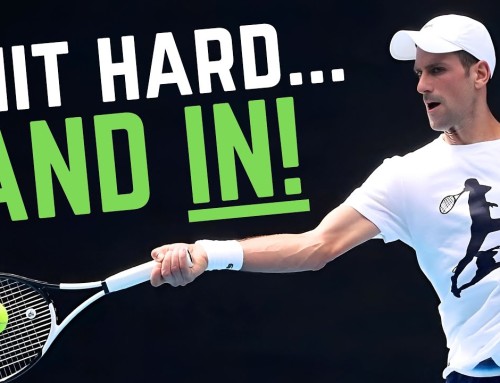
If you’ve been struggling to find real forehand power in tennis, I want to tell you about a student of mine who came to me with a problem you might recognize.
He was a fantastic athlete. Strong, coordinated, competitive. He could already hit the ball pretty hard.
But he was working way too hard to do it.
Watching his forehand was almost painful. His arm was rigid and locked. Everything tightened up at the moment of contact. He was practically choking himself on the follow through.
And here’s the thing — you can hit a tennis ball hard that way. But there will always be an artificially low ceiling on how far you can go. All that tightness and tension keeps the racket from moving freely, from accelerating the way it’s truly capable of.
Now compare that to any world class forehand you’ve ever watched.
Different players, different games, different styles — but they all share one thing. Their swings look smooth, long, and almost effortlessly circular. That’s not a coincidence. Their torsos are the primary power source, while their arms simply deliver that power without getting tight and tense.
That’s the secret to real forehand power in tennis. And it’s exactly what this drill is designed to unlock.
Here’s what I had him do. It’s a little weird. But stay with me.
Step 1: Grab a racket with no strings.
I’m serious. Dig one out of the garage, borrow one, find one somewhere. Then start making slow, smooth shadow swings. No ball. No target. Just you, moving your torso and letting your arm hang as passively as possible — like a rope, with the racket dangling from the end of it.
Feel what it’s like to have your arm completely loose. Your torso drives everything. Your arm just comes along for the ride.
Step 2: Introduce the ball machine — but don’t hit.
Here’s where it gets interesting. I fed him balls from the machine and told him to keep swinging with that same smooth, passive feeling — even though the ball was coming right at the stringless racket.
Watch what happens every single time I do this drill.
The shadow swings? Buttery smooth. Beautiful.
The moment the ball appears? Everything tightens up. The arm jerks. The fluidity disappears.
Even though his conscious mind knew there was no collision coming — no strings, no contact — his subconscious mind pulled him right back into his old habit. The tightness crept back in without him even realizing it.
That moment right there is one of the most eye-opening things a player can experience. Because most players have absolutely no idea how tight and tense they normally are until they feel the contrast.
Step 3: Smooth it out.
This is the training phase. Keep working with the stringless racket and the ball until your swing looks and feels exactly the same whether the ball is there or not. I gave my student feedback in real time — letting him know the instant he started speeding up or tensing up.
Slowly, he started finding it. That smooth, effortless, torso-driven motion that is the foundation of genuine forehand power in tennis.
Step 4: Pick up your regular racket.
Once you feel confident your swings are consistent — stringless or not — grab your normal racket and start hitting. Bring that same sensation with you. That same looseness. That same passivity in the arm.
My student’s first swings with the regular racket? Completely transformed. Longer swing. Smoother path. Less physical effort — but the ball was going just as hard as before.
That’s efficiency. And efficiency is what opens the door to higher and higher levels of play.
Step 5: Increase intensity — but only from the torso.
This is the critical piece. As you start to swing harder, that extra effort must come from torso rotation — not from tensing up the arm again.
My recommendation: increase your torso intensity by just 5% at a time while keeping your arm feeling exactly as loose and passive as it did with no strings. The moment you feel that tightness creeping back in, put down the regular racket, grab the stringless one, do one or two minutes of smooth swings, find the sensation again, and then come back.
Inch up the intensity. Keep the looseness. That’s the formula.
I’ve done this drill with so many students over the years, and the results are always the same — outstanding. Because once you feel what a truly effortless forehand is supposed to feel like, you can never go back to grinding through the ball the hard way.
That’s the real gift of this drill. It doesn’t just teach you a technique. It rewires what forehand power in tennis actually feels like from the inside — and once you have that feeling, everything changes.
Give it 19 minutes. I think you’ll be amazed.
Your Coach,
-Ian