I had a student make a breakthrough in his forehand power and smoothness in just 13 minutes. Not 13 weeks. Thirteen minutes.
And it wasn’t because he learned a new grip, a new stroke, or some fancy new technique. It came down to one thing: a forehand timing secret that separates smooth, powerful forehands from the tight, clunky ones almost every everyday player struggles with.
Let me show you what I mean.
Watch Novak Djokovic hit a forehand — any forehand, moving in any direction. Left, right, forward, backward, even full sprint or mid-air on the run. It doesn’t matter. By the time the ball touches his strings, his chest and his hips are unwound and facing forward toward the net.
Every single time.
That’s the forehand timing secret right there: it’s not just that his body rotates — every player’s body rotates. It’s that his rotation finishes at the exact right moment, right as contact happens. His torso rotation is his primary power source, which means his arm never has to strain or muscle the ball to create speed. The body does the work.
Now here’s my student, before we made any changes.
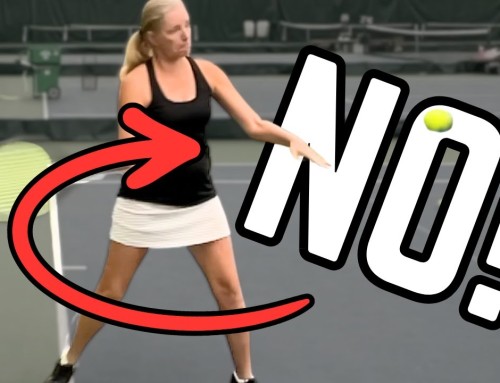
He’s moving to hit an inside-out forehand, same as Novak. His body is turning — don’t get me wrong, he knows how to rotate. But as the ball reaches his racket, his chest and his hips are still mostly facing the camera. Not the net. Not yet.
Same story moving to his right along the baseline. Same story on an easier, shorter ball moving forward. Same story on the toughest shot of all, getting pushed back off the baseline.
Here’s the part that surprised me the most, and honestly the part that trips up so many players: he does eventually finish rotating. In fact, if you keep watching, his hips and chest keep turning well past contact, all the way around until he’s facing the opposite fence. A full 180 degrees of rotation.
So it’s not that he isn’t using his body. It’s that his forehand timing secret was broken — his rotation was arriving late. And because the body showed up late to the party, his arm had to jump in and do the work instead, which is exactly why his forehand looked tight, rigid, and like he was fighting the ball instead of hitting it.
Here’s how we fixed it.
Step one: slow shadow swings.
No ball. Just rehearsing the correct order of movement — chest and hips leading, arm following behind. My student thought this was already what he was doing. Turns out his sequence was right, but his timing had quietly drifted late without him ever noticing.
Step two: shadow swing, then pause and check in.
This is a step I’ve been experimenting with lately, and it’s been a game-changer. Shadow the swing, pause right at the moment you believe is ideal contact, and just feel it. Where’s your body? Where’s your racket? Set the intention, then lock in that feeling as a kind of mental and physical bookmark.
Step three: easy underhand tosses.
Now we introduce the actual challenge — a real ball. And this is where the real difficulty shows up. It’s not hard to know how your body should move. It’s hard to line that movement up in time and space with a fuzzy yellow object flying at you. If the timing’s off even slightly, the arm takes back over, and you’re right back to that rigid, muscled forehand.
We checked contact point after contact point: is he facing forward? Yes. Again? Yes. Again? Yes. Slow, easy, no pace, no pressure — just training the body to hit that window nine times out of ten.
Step four: add distance and pace.
Once he was consistent up close, we moved him back to the baseline, which meant the ball arrived faster and the timing window got tighter. He nailed it anyway — because the pattern was already locked in from the easier reps.
Step five: add movement.
This is the final piece — moving left, right, forward, backward, just like Novak does, while still finding that same window at contact.
I want to be clear about something: even Novak doesn’t unwind perfectly on every single shot, especially under extreme defensive pressure. Nobody does. It’s a spectrum. The closer a player is to neutral court position, the more consistently they hit that window. The further into defense they get pushed, the harder it becomes for anyone.
But here’s the real difference between world-class players and everyday players: everyday players often miss that window even on the easiest of shots, the ones with no pressure at all. That’s the gap this forehand timing secret closes.
If your forehand feels tight, rigid, or like you’re constantly muscling the ball instead of letting it fly, don’t assume you need a new swing. Check your timing first. Slow it down, shadow it, feel where your body is at contact, and rebuild the sequence from there.
Get that forehand timing secret right, and the power stops coming from your arm — and starts coming from your whole body, exactly like it should.
Your Coach,
-Ian