The most common forehand power mistake is one almost every player makes without realizing it.
So many of you asked the same question after last week’s video: how do you actually fix it?
So today I’m walking you through the real drills my students use to make the switch.
From arm-led swings to body-led power.
Here’s what actually happens when the body doesn’t lead the forehand.
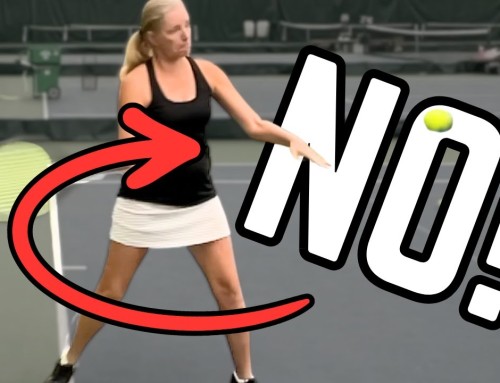
Watch the racket. Now watch the wrinkles on her shirt.
The racket, the hand, and the arm all start moving toward contact before those wrinkles ever budge.
Her arm is initiating the swing. Her arm is the primary power source.
And that’s the problem.
As she swings forward, her racket and arm blow right past her body trying to reach the ball.
Her shoulders stay sideways. Her hips stay sideways. Right at the moment of contact.
That jammed, cramped, too-far-back contact point everyone obsesses over?
It’s not the real issue. It’s just the symptom.
Here’s what makes this so hard to catch on your own.
To the player swinging, this feels completely smooth. Completely athletic.
Watch the same swing in full motion, at regular speed, and it looks totally fine to the naked eye.
It’s not until you slow it down frame by frame that you see how far off the body actually is.
This is exactly why fixing the most common forehand power mistake starts with awareness, not effort.
Now here’s the transformation.
Left side: her original forehand.
Right side: the same player, after just 30 minutes of focused practice.
Drill one is where it all begins.
The goal here is simple: the torso goes first, and the arm trails behind like a passenger.
At the actual moment of contact, we want the shoulders parallel to the net.
We want the hips parallel to the net too.
That’s the target position, and she reached it within minutes of starting this drill.
Yes, this first stage feels slow. Tedious, even.
But remember this: speed hides mistakes.
Get excited, start swinging fast trying to copy your favorite pro, and you’ll just reinforce your old habits at a slightly better rate.
Most players need a complete overhaul in the order their body moves, not a tiny tweak.
Moving slow and deliberate at first is what makes that overhaul possible.
So in this drill, she leads with her torso and lets everything else trail.
She starts to exaggerate the motion, which is exactly what we want.
Exaggeration helps her feel the real difference between her old habit and this new pattern.
Drill two adds actual balls, but from an easy position near the service line.
We layer shadow swings with real hits so her body learns this new sequencing.
At first, she’s better, but still not fully parallel to the net at contact.
This is completely normal, and it’s exactly why filming yourself matters so much.
So I start using one word out loud: twist.
I say it early, well before contact, to trigger her body to initiate the turn sooner.
She exaggerates more. And more.
Then comes the breakthrough swing.
Her shoulders past parallel. Her hips right where they need to be.
That audible cue, combined with repeated exaggeration, is what finally unlocked the correct contact position.
From here, it’s about repetition.
Stack good swings on top of good swings, layering shadow reps between real hits.
The only way to know if you’re actually doing it right is to record yourself and check.
Drill three raises the difficulty by moving her back to no-man’s-land.
The ball travels faster now. The timing gets tighter. It’s closer to a real match forehand.
Look at the space between her racket and her body on these swings.
Here’s something important: we never once talked about her contact point directly.
We never coached her arm or her racket position at all.
Every single change came from fixing the order her body moves in.
Fix the sequence, and the arm and contact point fall into place on their own.
This is the real lesson buried inside the most common forehand power mistake players make.
They chase symptoms. They obsess over contact point, racket angle, follow-through.
But unless you isolate the true root cause and stay disciplined about it, you’ll drift right back to your old forehand.
Drill four brings her back to the baseline, hitting real forehands.
She’s still layering shadow swings in between, leading early with her body every time.
Watch the extension. Watch the strength in that contact position now.
All from prioritizing one thing: torso first, shoulders parallel, hips parallel.
Here’s your challenge this week.
Run these same four drills. Record yourself. Check your positions honestly.
If your forehand has felt weak, inconsistent, or unreliable for years, this is likely the exact fix you’ve been missing.
Thanks for reading, and I’ll catch you in the next lesson.
Your Coach,
-Ian