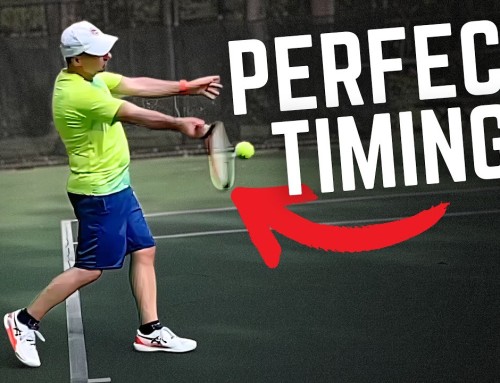
These kinetic chain forehand came from one single thought I gave a student to focus on, and it fixed six different problems in her forehand at the same time — without her ever thinking about any of those six problems directly.
The tip came from a phrase borrowed from legendary coach Chubbs Peterson: it’s all in the hips.
Before I show you exactly what that one tip did, I need to unpack something you’ve probably heard a hundred times but might not fully understand yet — the kinetic chain.
The kinetic chain forehand is simply the ideal flow of energy through the body, moving from the ground up and out into the ball. It doesn’t matter what your personal style looks like. This order matters for every single player.
Watch Novak Djokovic. His weight shifts from his back foot to his front foot first — that kicks off the whole sequence. Then his back knee starts to turn inward, before the racket ever begins moving forward. Then his hips rotate. Then his chest and torso rotate. Only after all of that has already begun does his arm, and finally his racket, get pulled along behind it.
Big, strong muscle groups lead. Small muscle groups follow. That’s the kinetic chain in a single sentence. By the time Novak’s racket touches the ball, his hips, torso, and chest are all facing fully forward, because the timing of that unwind lines up perfectly with contact.
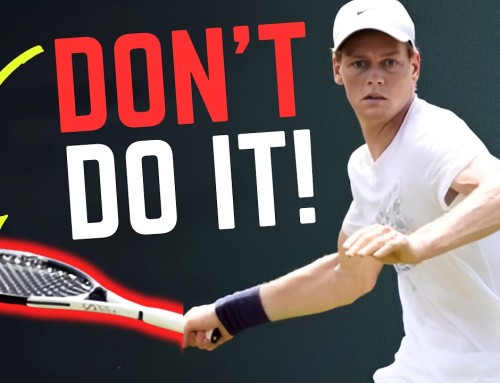
Now watch Iga Świątek — completely different grip, completely different style of forehand. Same principle, though. Weight shifts from back foot to front foot. Her knee turns in. Her hips rotate. Her chest and torso unwind. Her arm and racket get pulled along for the ride. By contact, her hips are fully forward, her chest is fully forward, and her back foot has released and pivoted, with all her momentum now on her front foot.
Two very different-looking forehands. Identical kinetic chain underneath.
Now here’s my student’s original forehand, and this is where things get interesting.
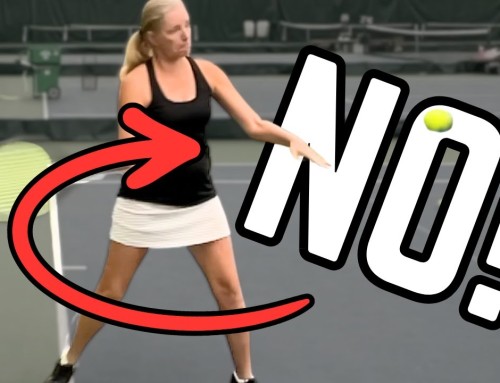
She starts the same way — weight transitioning from back foot to front foot, just like Novak and Iga. But as we move forward through the swing, watch her hips. They’re still facing the camera. Her upper body starts to unwind on its own, but everything below her waist — her hips, her back knee, her back foot — stays planted and stuck.
That’s a bottleneck in the kinetic chain. All the ground-up energy that should have flowed smoothly into her torso and out through the racket gets cut off right at her hips. And when a link in that chain breaks, everything above it has to work harder to compensate. The swing gets tighter, more rigid, harder to control — exactly the kind of inconsistency she’d been struggling with.
To her credit, she’s a talented athlete, and she still managed to get her arm and racket into a reasonably good position at contact through sheer coordination. But she was fighting an uphill battle the whole time because the kinetic chain wasn’t flowing correctly underneath it.
So here’s the one tip I gave her: make sure your hips are facing forward before the ball reaches your racket. That’s it. One thought. Nothing else.
We started with shadow swings, deliberately exaggerated — hips reaching a fully forward position well before contact would actually happen in a real swing. That’s exactly what I want to see in training, because once a real ball enters the picture, she’ll naturally settle somewhere in the middle.
Her very first real attempt, tossing the ball underhand from across the net, and her hips were already unwinding beautifully. From there we moved her back to the baseline and fed her easy balls — the same feed, in fact, from the exact evaluation session where she’d told me her forehand felt inconsistent and out of control.
The contrast was immediate.
Watch her back foot: stuck on the old forehand, released and transitioned forward on the new one. Watch her back knee: same story. Watch her hips: fully unwound now instead of stuck facing the camera.
And here’s the part that really shows why finding the one root cause matters so much — she started making contact further out in front of her body. I never once mentioned contact point. I never asked her to hit the ball further out front. It just happened, because the entire kinetic chain was flowing correctly instead of getting stuck at her hips.
Her follow-through changed too. On the old forehand, her arm had to flex and hook to compensate for the broken chain below it. On the new one, her arm stayed relaxed and passive, riding a longer, smoother, more circular path all the way back behind her head instead of stopping short near her ear.
Six different improvements — back foot, back knee, hip rotation, contact point, follow-through length, and follow-through smoothness — all from one single instruction: get the hips facing forward by contact.
If you’re a player working on your own forehand, or a coach helping someone else, this is the real lesson behind these kinetic chain forehand fixes. You can’t hand someone five things to think about at once. Find the one root piece the kinetic chain depends on, fix that, and watch how many other problems quietly disappear on their own.
Your Coach,
-Ian