Real topspin is probably the biggest missing piece in your forehand right now.
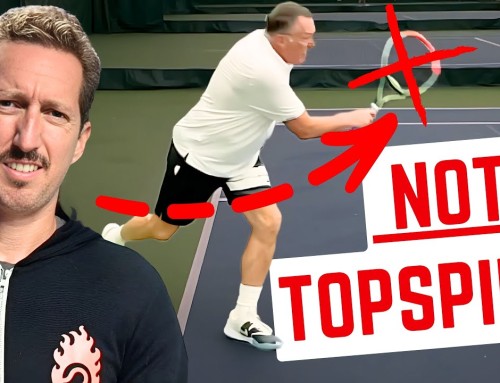
Last time, I showed you why most players think they’re hitting topspin but aren’t.
Today, I’m walking you through the exact drills I use with my students to build real, game-changing spin.
But first, let’s talk about why this actually matters.
Look at the comparison on screen.
Red represents a relatively flat shot. Blue represents a shot with real topspin.
That forward rotation creates a high pressure pocket of air over the top of the ball, which pushes it downward.
Practically speaking, that means you can aim higher over the net and still land the ball safely inside the court.
Without that rotation, there’s a hard ceiling on how hard you can swing before the ball sails long.
Aiming lower over the net doesn’t fix this either. It just increases your margin for error in a different way.
The key to generating that rotation comes down to one thing: the direction your racket is traveling the instant the ball touches your strings.
Remember the phrase from last time? The face sends it, the path bends it.
In the image on screen, the green arrow shows the racket’s path. The red arrow shows which way the strings are facing.
An upward path combined with a forward-facing string bed sends the ball forward while rolling it end over end.
The steeper and faster that path, the more the ball spins, and the more it curves back down safely.
Here’s a player who came to me recently struggling with exactly this problem.
She could hit the ball hard. Genuinely great athlete.
But she was spraying balls everywhere and getting frustrated because nothing stayed in play.
Which is confusing, because visually, it really does look like she’s generating spin.
Racket dropping low. Knees bending. Swinging low to high. Finishing over the shoulder.
All the cues we’re told create topspin.
But what actually matters is the racket’s direction the moment it touches the ball.
Mark her point of contact. Go back to where she starts accelerating toward the ball.
Suddenly the path looks almost level.
That initial drop was a false drop. Her racket was slowing down and resetting, not accelerating upward yet.
Measure the real angle from her true acceleration point to contact, and it’s barely anything at all.
Technically some forward roll, sure. But nowhere close to what it feels like from the player’s side.
All that bending, dropping, and finishing over the shoulder still wasn’t enough, because the actual path at contact was mostly forward, not upward.
Now here’s what real topspin actually looks like.
A 4.5 level player I worked with recently.
Watch his racket. It’s blurry the entire way through, meaning he’s accelerating continuously, not pausing anywhere.
Mark his low point and his contact point, connect them, and you get a 25 degree upward incline.
More than double that first student’s angle.
Which means more than double the spin. More than double the curve. More than double the safety margin.
And he’s doing all of this while hitting just as hard, arguably harder, than the first player.
Here’s the real takeaway before we get into drills.
Bending your knees, dropping your racket, finishing over your shoulder, even adding a windshield wiper motion, none of that guarantees real topspin.
So ask yourself honestly: are you actually generating enough spin for your game, your goals, your level of aggression?
Now let’s get into the drills that actually fix this.
Drill one: the wall drill.
Start right at the net. Imagine a ball sitting right at the tape, and picture a wall extending straight up from the net that your racket physically cannot pass through.
Most players, when they first try this, instinctively swing right through that imaginary wall anyway. Old habits are strong.
If that happens, have someone stand on the other side and literally block your racket’s path so you feel the limit.
This feels exaggerated on purpose. That’s the point.
If you feel silly doing this on a real court, do it in your living room against the back of your couch.
This drill exists purely to break your current swing habit and force a completely different path.
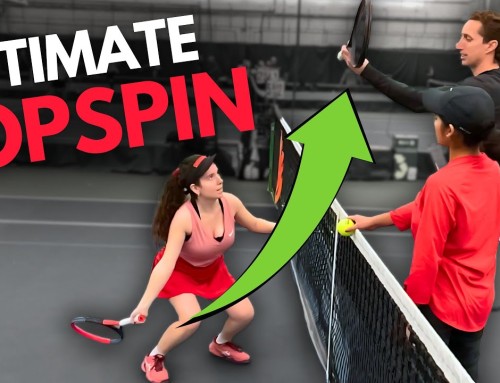
Drill two: step back one step.
You can still see the imaginary wall, but now you’re actually hitting a ball, dropped from your own hand.
Do a few shadow swings first, picturing your racket traveling straight up that wall without contact.
When you connect with the real ball using this path, watch for a big arc. A real curve and dip in the ball’s flight.
Also listen for a clicking sound at contact. That’s the ball grabbing the strings, the strings sliding briefly out of place, then snapping back as the ball leaves. That sound means real vertical acceleration is happening.
Drill three: move back to the service line.
Now you’re hitting tossed or self-dropped balls from a more realistic distance.
Keep visualizing that wall. Keep listening for that click. Keep watching for the curve.
When you measure the angle on these swings, the difference is dramatic. What was once a flat, forward path becomes a genuinely steep, accelerating upward path.
In my student’s case, we literally tripled her upward swing angle using just these three drills.
Triple the angle means triple the spin, triple the curve, and triple the safety margin on every shot.
Take these same three drills to your local court with nothing but a pocket full of balls, no partner, no ball machine required, and you’ll see the same kind of shift.
I’d love to hear how it goes for you.
Keep up the great work on your game, and I’ll talk to you in the next lesson.
Your Coach,
-Ian