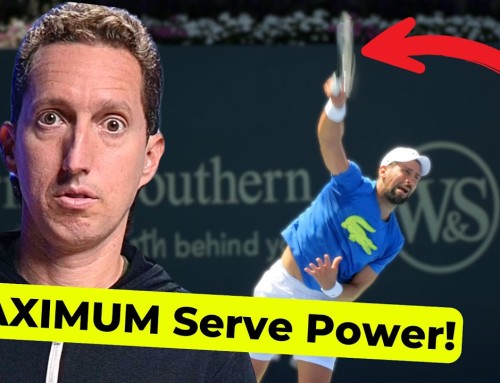
If there’s one shot in how to master the tennis serve that can completely change your results, it’s your serve.
It’s the only shot you have full control over. No opponent. No reaction. Just you and the ball.
And yet, it’s also the shot most players struggle with the most.
I’ve seen so many players who work hard on their groundstrokes, their volleys, even their footwork… but when it comes to the serve, they’re just trying to “get it in.”
If that sounds familiar, there’s a reason for it.
Most players are building their serve on the wrong foundation from the very beginning.
The biggest difference between recreational serves and high-level serves comes down to one simple idea:
The shape of the swing.
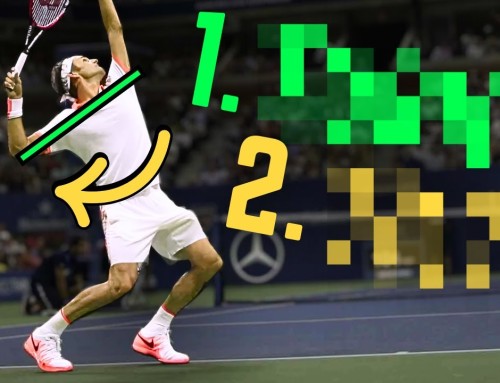
When you watch great servers, whether it’s Roger Federer or Serena Williams, there’s something very consistent about what their racket is doing. If you follow the tip of the racket through the motion, it doesn’t move in a straight line.
It traces a smooth, continuous circle.
That circular motion gives them a long runway to build speed, build rhythm, and then release all of that energy right at contact. That’s where the power and spin come from — not from forcing it, but from building it naturally through the motion.
Now compare that to what most players do.
Instead of a circle, they move the racket straight back and straight forward. It’s a much shorter motion, and it relies on smaller muscles. That means more effort… and less result.
So if your serve feels like a lot of work for not a lot of power, this is probably why.
One of the biggest keys to creating that circular motion is what your racket face is doing.
Most players instinctively want to point the strings toward the service box right away. It feels logical — after all, that’s where you want the ball to go.
But that actually limits your ability to create a full motion.
High-level players do the opposite. Early in the motion, their strings face off to the side. As they move into the drop and begin to swing up, the strings rotate and face the opposite direction. Then, right before contact, everything unwinds and snaps forward toward the target.
That sequence — side, drop, unwind — is what creates the smooth loop and the acceleration you see in advanced serves.
Without it, you’re stuck with a short, choppy motion that can’t produce much speed or spin.
Before you even worry about the motion, though, you have to get the grip right.
This is non-negotiable.
The ideal grip for serving is the continental grip, where your index knuckle sits on bevel number two. It might feel awkward at first, especially if you’re used to a forehand grip, but it’s what allows the racket to move freely through that circular path.
If your grip is too far toward a forehand position, you’re almost forced into that straight back-and-forth motion. And no matter how hard you try, it’s going to hold you back.
So if your serve hasn’t improved in a while, this is one of the first places to check.
Once the grip is in place, the next step is understanding how your body and arm should move.
A great way to feel this is without the racket at first.
Turn your body sideways, bring your arm up into a relaxed position, and practice rotating your shoulder so your hand moves inward, then outward. What you’re doing here is learning how to stretch and release the shoulder.
That stretch is what creates the “loading” phase of the serve, and the release is what creates the speed.
When you add the racket back in, that same motion naturally creates the circular path. The racket drops, loops, and comes back up smoothly without you having to force it.
And that’s a big theme here — nothing should feel forced.
One thing that surprises a lot of players is how much timing changes when you switch to a proper motion.
If you’ve been using a shorter, linear swing, your timing is probably built around that. But a longer, circular motion takes more time.
Which means your toss, your rhythm, and your coordination all need to adjust.
This is where a lot of players get frustrated. They try the new motion, but everything feels off, so they go right back to their old habit.
Instead, you need to give yourself space to learn it.
Practice the motion first without hitting the ball. Then add a gentle toss. Let your body learn the new timing gradually. If you rush this step, you’ll never fully develop the motion.
Now let’s talk about the toss, because even a perfect swing won’t work if the toss is inconsistent.
Two things matter most here: length and simplicity.
Great servers don’t “throw” the ball. They lift it.
Their arm moves in one smooth motion from start to finish, like a single lever. There’s no flicking of the wrist, no sudden movement with the fingers, no extra pieces.
Just a long, controlled lift… and then they let the ball go.
That’s why their toss looks so effortless and repeatable.
If your toss feels unpredictable, it’s usually because you’re adding extra movement somewhere — a bend, a flick, or a quick release. The simpler you make it, the more reliable it becomes.
As for where the ball should go, a good general target is slightly in front of you and a little to your hitting side.
That gives you room to rotate, extend, and make contact at full reach without feeling jammed.
A simple way to practice this is to use a target on the ground. Toss the ball and let it drop without hitting it. See where it lands, and make small adjustments until you can place it consistently in the same spot.
This kind of feedback is incredibly valuable, and it helps you build a toss you can trust under pressure.
When you put all of this together — the right grip, the circular motion, the proper timing, and a consistent toss — everything starts to click.
Your serve feels smoother.
You don’t have to force power anymore.
And suddenly, you have the ability to hit with pace, spin, and control.
It doesn’t happen overnight, but once you’re on the right path, the progress becomes much more predictable.
If your serve has been holding you back, don’t try to fix everything at once.
Start with the motion. Build that smooth, circular path. Then layer in the grip, the timing, and the toss.
Stick with it, even if it feels uncomfortable at first.
Because once you develop a fundamentally sound serve, it becomes one of the biggest weapons in your entire game.
Your Coach,
Ian