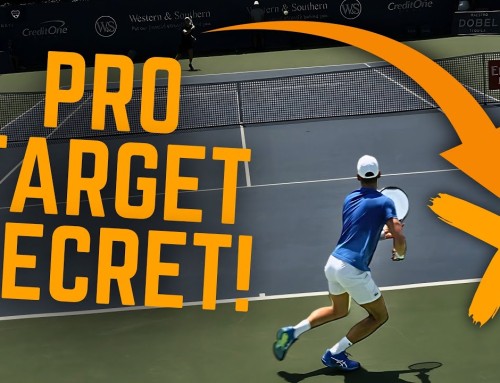
Learning to track the ball in tennis is harder than you think, because the real technique is deeply counterintuitive.
You’ve told yourself to watch the ball thousands of times.
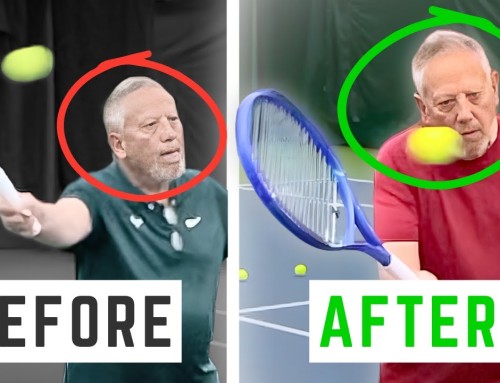
You think you’re doing it, but if you’re like these experienced competitive players, you probably aren’t.
Here’s what I see all the time.
Contact is happening out to the side, but the eyes are looking forward.
Contact is happening high and to the right, but the eyes are looking forward.
Again and again, the contact point is off to one side, and the eyes are pointed straight ahead.
These passionate players have taken dozens of lessons, played hundreds of matches, and practiced thousands of hours.
But when it comes to following the ball precisely, they’ve practiced the wrong thing.
The reason is simple: the process is super counterintuitive.
Let me show you by analyzing one of the best ball watchers in tennis history.
Every fan has seen freeze frames of Roger Federer with his eyes locked on the ball at the instant it touches the strings.
But most players don’t understand what it takes to arrive at that position.
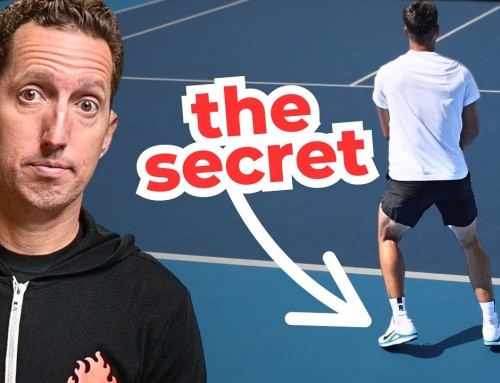
Watch him run across the baseline to prepare for a forehand.
Look at the logo on his chest.
His chest starts turning toward the net well before the ball arrives, so his torso leads the swing while the arm and racket trail behind.
So energy unwinds from his body toward the net, and his racket follows, pulled around behind him.
The racket’s energy through contact heads toward the other side of the court, and so does the ball, toward his intended target.
Here’s the tempting, counterintuitive part.
Where you want the ball to go is a completely different place from where your eyes need to be.
While his body, racket, ball, and target all go one way, his face does the opposite.
His head turns back in the other direction to track the ball from where it’s coming, all the way into his strings.
It reverses the direction of every other powerful, tempting force in the swing.
He does this on every shot.
His energy goes forward while his head turns back to follow the ball.
On volleys, his head goes back while the racket goes forward.
The payoff is that at contact, his eyes end up looking straight down his arm at the point of contact.
You can see it on his forehand, his backhand, his backhand volley, and his forehand volley.
Carlos Alcaraz has a very similar discipline.
His body and racket move one way while his face moves the other.
By the time he makes contact, he’s looking down his arm at the ball.
You’ll see the same pattern on his forehand volley and his backhand volley.
Unfortunately, most everyday players haven’t built this habit.
When they reach out to the side, their face stays pointed forward, so it never turns to meet the ball.
Arm this way, eyes that way.
Some players do the exact opposite of Federer.
Their face actively turns forward with the body, so by contact it has rotated more forward than when it started.
Others keep the face completely locked in one direction.
Contact happens out wide, but the eyes stay straight ahead.
So which style do you follow?
Do you look down your arm to track the ball accurately, or keep your head away from contact, looking forward?
Tell me what you think in the comments.
To be clear, you don’t have to copy Roger exactly.
Some pros, like Aryna Sabalenka, don’t look dead down their arm at contact.
But they follow the same principle: the face and eyes track the ball in one direction while the racket travels toward the other side of the court.
Competitive adults, on the other hand, let curiosity get the best of them.
We badly want to know how our shot turned out, so we sneak a peek by looking forward.
But failing to track the ball accurately into the racket will wreck your chances of success.
That’s exactly what these recent students came to fix.
One player wanted to improve her lob off the return of serve in doubles.
She was frustrated by how hard it was to dial in the right height and depth.
Can you see how her setup makes that nearly impossible to do consistently?
Another player was frustrated by shanking easy, high, floating forehand volleys into the net, shots he knew he should have put away.
Can you see why?
Here’s the good news.
You don’t have to be Federer or Alcaraz to learn how to track the ball in tennis.
After some simple drills, the first player turned her face and followed the ball cleanly into contact on her return of serve.
The second player did the same thing on his forehand volley, just like Federer and Alcaraz.
If you want the step-by-step drills I used with them, so you can start tracking the ball precisely on every shot, tell me in the comments.
Keep up the great work on your game, I’m proud of you, and I’ll talk to you again soon.
Your Coach,
-Ian