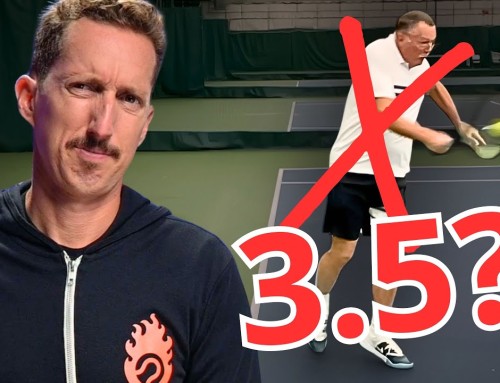
Tennis lessons wasting your time and money is a problem most adult players never see coming.
For years I’ve kept a respectful tone when talking about other coaches.
That ends today.
Rapid fire: low to high, wrist low, head high, watch the ball, do it faster.
After more than 20 years of teaching, I’ve seen too much wasted time and money from passionate adult players like you to stay quiet.
If you’ve ever felt like you’re paying for lessons but not getting any better, you’re about to learn why.
Please don’t get me wrong, because great local coaches do exist.
They’re just very hard to find, and unless you know what to look for, your odds of landing one are low.
That’s why I’m making this lesson, to help you spot an ineffective session from a mile away.
Unless you only want entertainment and exercise, in which case you wouldn’t be here.
Here are the top five signs of tennis lessons wasting your time and money.
Problem one: quantity over quality.
Instead of doing the hard work of changing bad habits, the coach aims for the most strokes, the most tips, and the most balls hit.
Ever had a lesson with forehands, then backhands, then volleys, then overheads and returns, and five minutes of serve at the end?
It feels productive in the moment.
But your brain and body need time on one single focus to reprogram a movement.
Skimming the surface of five strokes in 60 minutes creates lasting change in none of them.
Problem two: whack-a-mole coaching.
Remember that arcade game?
Most lessons bounce from tip to tip.
Bend your knees, swing low to high, finish over your shoulder, hit out in front, and don’t forget to bend your knees.
It sounds like a lot of coaching, and therefore a lot of value.
But neuroscience shows the brain can consciously focus on only one new thing at a time.
When your attention gets pulled in four directions on one swing, none of those cues becomes an automatic habit.
You leave with a head full of cues and no lasting change.
Problem three: guessing instead of knowing.
Ninety-nine percent of lessons are taught from 50 or 60 feet away, using only the naked eye.
No matter how good your coach was as a player, or how long they’ve taught, a huge amount of detail gets missed without slow-motion, frame-by-frame video.
Their guesses may be well informed, but they’re still guesses.
The only way to know what happens in the milliseconds before, during, and after contact is video analysis.
Sadly, seeing that in a lesson is about as common as spotting Bigfoot.
Guessing leads to vague, cliche, jargon-filled instruction, like the comedy sketch where the coach just keeps repeating “brush the ball.”
The student keeps trying, the coach never changes the instruction, and nothing improves.
Problem four: fish dispensers.
You know the saying: give a man a fish and he eats for a day, teach him to fish and he eats for a lifetime.
Most lessons hand out fish.
Surface-level tips, one after another.
What they never teach is how to learn, how to self-assess, and how to self-adjust in real time.
They also don’t teach how to make a new habit stick without the coach on court dishing out magic phrases.
That’s why so many players feel dependent on their weekly lesson.
You keep returning for another fix, but you’re mostly going in circles because of the quantity and whack-a-mole problems above.
Problem five: no detailed practice plan.
Changing bad habits in one skill, let alone all of them, is impossible in one hour a week.
The rest of your week is full of match play, where you compete to win and your old habits get reinforced.
Under pressure, you fall back on the most comfortable, familiar way of swinging.
So with one weekly lesson, two or three matches, and no solo training to groove new habits, you’ll stay at the same level week after week and year after year.
That’s the pattern behind tennis lessons wasting your time and money for so many players.
So ask yourself an honest question.
Do your lessons look like this: lots of strokes, lots of tips, no sustained focus, no video, and no plan?
If so, it’s not because you’re unteachable.
It’s because the lesson status quo is broken.
Here’s the good news.
Once you know what a great lesson looks like, you’ll never waste your time and money again.
Want to learn how to guide yourself to the next level without relying on in-person coaching?
Tell me in the comments, and I’ll make it my very next lesson.
Your Coach,
-Ian