Out of every shot in the game, the tennis volley is probably the most misunderstood — and I say that after years of watching passionate, hard-working players get it backwards without ever realizing it.
Here’s the strange part: most adult competitive players have actually been coached into the wrong technique on purpose.
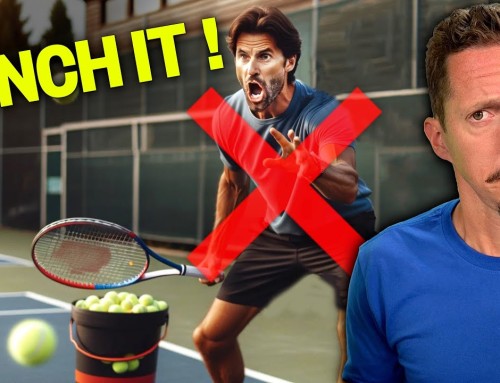
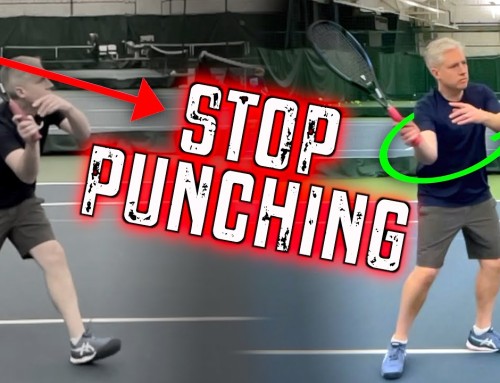
Somewhere along the way, someone told them “don’t swing, step across, and punch the ball.”
It sounds simple and safe. But it produces the exact opposite of what the best players in the world do at net.
Watch a handful of pro volleys in slow motion and two things jump out immediately.
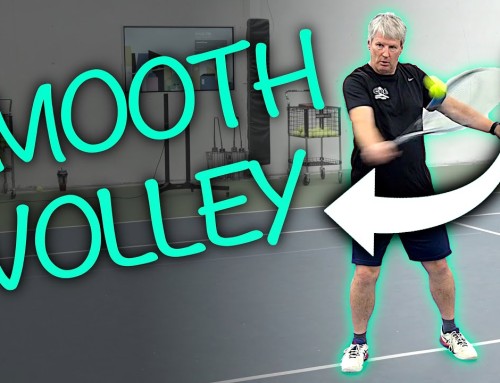
First, the racket starts above the point of contact and travels downward through the ball — a U-shape on the forehand side, more of a straight line or gentle J-shape on the backhand.
Second, the racket never comes to a dead stop at contact.
It keeps flowing forward and through, even after the ball is gone.
That downward path does something really specific: it puts backspin on the ball, which keeps it low when it bounces on the other side, and it naturally opens the racket face just enough to clear the net with margin to spare.
But here’s the part that surprised me the most when I really studied it closely — that high-to-low path also lets a player absorb pace.
Watch closely as a fast incoming ball meets an open racket face with a relaxed hand, and you’ll actually see the racket get pushed backward, away from the ball, before continuing forward toward the target.
The ball is winning that little collision on purpose. That absorption is what allows touch, placement, and control, even against a hard, heavy shot.
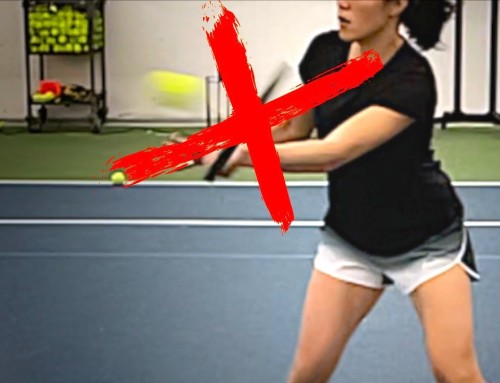
Now flip that around and look at what most club players do instead. Square racket face.
Flat or upward path into the ball. No absorption, no give.
It turns the volley into a punch — a glancing, ricocheting collision between two firm objects with nowhere for the energy to go except wherever it randomly bounces.
That’s why so many amateur volleys either sail long or clip the net. There’s simply no margin built into the shot.
I want to walk you through how one of my students made this exact transformation, because seeing the “before” is honestly the best way to understand the “after.”
She was coming up and into her forehand volleys, almost like a mini groundstroke, hitting with a square face and an upward path.
On her backhand, she was doing something similar — starting below the ball and rising into contact, flat and square once again.
She had a little bit of natural softness in her hand, but without backspin to work with, there was no way to open the face without sending the ball flying.
Precision just wasn’t available to her with that setup, no matter how much she practiced.
The very first thing we addressed had nothing to do with her swing path at all — it was her grip.
She’d been switching grips between forehand and backhand volleys, which let her close the racket face on each side individually.
It felt intuitive, but it created two real problems.
First, closing the face eliminates backspin entirely. Second, and more importantly, volleys happen fast — there’s rarely enough time mid-exchange to consciously switch grips when the ball changes sides.
So step one was simple: get close to a continental grip, and use that same grip on both sides.
It doesn’t need to be textbook-perfect, but it needs to be consistent.
From there, we worked in phases.
First, shadow swings — practicing the high-to-low path on both sides with the new, consistent grip, using a racket held out as a visual stand-in for the contact point so she could feel her racket continuing to move through that point instead of freezing there.
Then we added soft, underhand-tossed balls, just to let her feel the downward path and the follow-through at real (if slow) speed — not yet worried about matching the recoil and absorption you’d see against pace, just building the pattern.
Finally, we brought in the ball machine at full speed, and that’s when everything clicked.
Her racket started coming from above the ball down through contact. Her face opened naturally.
The backspin appeared. And instead of locking up at the moment of contact, her racket kept flowing — which is exactly what creates that smooth, satisfying feel a good volley has, and which conveniently leaves the racket already moving back toward the ready position for the next shot.
The whole transformation — grip change, path change, backspin, everything — took place in about thirty to forty minutes. If she can rebuild her volley technique that quickly, you can absolutely do the same.
If you want to try this yourself, start with the grip. Get consistent first.
Then work through the same progression: shadow swings focusing on high-to-low, soft tosses to feel the path, and finally live balls once the pattern feels natural.
Confidence at net comes from margin, and margin comes from backspin and touch — not from squaring up and punching the ball as hard as you can.
Your Coach,
-Ian