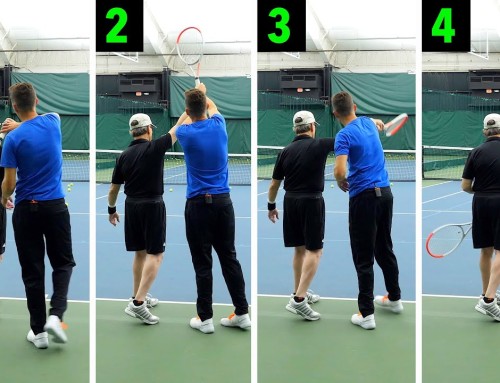
Almost every tennis player wants a kick serve. It is one of those shots that looks effortless when the pros do it and feels completely out of reach when you try it yourself. Understanding the secrets of a perfect kick serve starts with recognizing that a big reason for that gap is the amount of terrible advice floating around about how it actually works.
There is a simple principle that governs every single shot in tennis. The face sends it and the path bends it. At the moment of contact, wherever the strings are facing determines where the ball starts going. Whatever direction the racket is traveling at that same instant determines what kind of spin goes on the ball. That is it. Everything else flows from those two things.
A kick serve is not pure topspin and it is not pure slice. It lives somewhere in between. The ball curves from right to left through the air and then kicks back out to the right after it bounces. That combination of movements is what makes it so difficult to return and so valuable to have in your arsenal.
Now here is what the kick serve is NOT.
You are not curling the racket from the bottom of the ball up and over the top. I have seen this demonstrated by well known coaches and it is simply not what happens. You are also not brushing straight up the back of the ball the way Rafa does on his topspin forehand. The ball is only in contact with your strings for about five thousandths of a second. There is no time for any kind of carving or manipulation.
Whatever direction your racket is traveling in that split second is what determines the spin. Full stop.
The swing path direction that works is 7 o’clock to 2 o’clock. But even more important than the path is your body alignment. When you watch a professional hit a kick serve, their chest and hips are facing along the baseline, not toward the net. They are throwing the racket out to the side in a rainbow arc across the back of the ball. That sideways delivery is what creates the kick.
Compare that to a flat first serve where the chest faces the net post and the racket releases straight out toward the other side of the court. Two completely different body orientations producing two completely different results.
Most recreational players can never hit a kick serve because they are still delivering the racket forward. You cannot bend the ball sideways by swinging straight ahead. The direction has to change before the spin can change.
Here is the progression I use to fix this.
Start on the service line and practice alternating between a flat forward swing and a sideways swing, using the court line as a visual guide for your racket path. The goal at this stage is simply to feel the difference. Once that starts to click, add a toss and start actually hitting, without worrying at all about where the ball lands. Just focus on swinging past the ball and feeling it bend.
From there move back to no man’s land and then eventually to the baseline. Each time you move back, use the nearest court line as your directional anchor. Keep alternating between shadow swings and real hits. Listen for the click of the strings and watch for the curve in the ball.
Once you start seeing consistent bend, you can gradually adjust. Bring the contact point a little further to the left. Angle the racket slightly more to the left at contact. Your swing path will naturally start moving a little more upward and you will begin to see the ball curve high to low instead of just right to left. That is when the kick starts to show up.
The transformation does not happen overnight but the path there is clear. Get your body sideways. Throw the racket out to the side. Start bending the ball for real. These are the real secrets of a perfect kick serve and everything else is just a matter of incremental adjustment from there.
Your Coach,
Ian