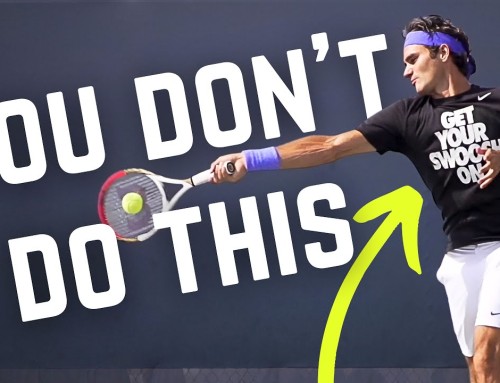
“Watch the ball.”
You’ve heard it a thousand times. From your coach, from your parents, from every tennis tip you’ve ever read online.
And here’s the uncomfortable truth: that advice, applied the wrong way, is actually making you slower on the court.
Let me explain.
Humans have over 180 degrees of total field of vision. But right in the middle of all that? Only 5 degrees of sharp, focused sight — what scientists call foveal vision.
Five degrees. That’s it.
Here’s a quick way to feel this in real life. Next time you’re talking to someone face to face, notice how you can only focus sharply on one of their eyes at a time. Not both. Just one.
What that means on a tennis court is huge: you can only truly watch one thing at a time. The ball, or your opponent. Never both simultaneously.
So when everyone tells you to watch the ball in tennis after you’ve already hit it… you’re wasting your most valuable asset. Your attention.
While you’re tracking the ball sailing across the court, your opponent is setting up their next shot — loading their racket, shifting their weight, positioning their body — and you’re missing every single clue.
That’s why so many players feel behind in their points. Not because they’re slow. Because they’re watching the wrong thing.
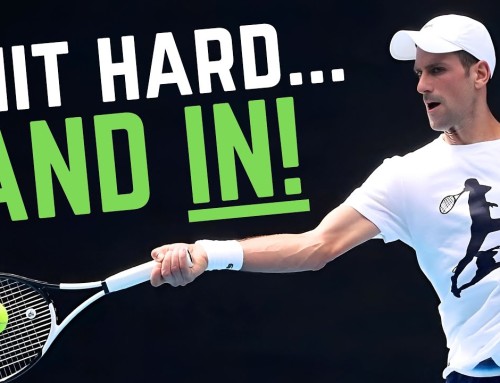
The best players in the world — Novak Djokovic, the Bryan Brothers — they’re not watching the ball after they hit it. They’re reading their opponent like a book.
Think about what Novak does. He hits a volley to the open court, and instead of admiring it, he immediately locks onto his opponent. He watches how they move toward the ball — are they in balance, or are they stretching and scrambling? He watches their racket face — is it open, suggesting a lob? Is it closed and loaded, suggesting an attack?
By the time the ball is actually struck, Novak has already made his decision and is already moving.
That’s not luck. That’s anticipation. And anticipation is a learnable skill.
Here’s what separates anticipating players from reactionary ones — and most club players are reactionary. Anticipating players are reading the story before the last page. Reactionary players wait for the ending and then try to catch up.
The clues are always there. Your opponent’s footwork tells you how much time they have. Their non-racket hand tells you whether they’re set up to hit with pace. The direction of their strings before contact tells you where the ball is going before it leaves the racket.
Once you know what to look for, the game slows down dramatically.
And in doubles? This becomes even more critical.
I’ve watched countless club doubles players do the same thing — they turn their head to watch the ball in tennis matches, tracking their partner’s shot, waiting to see what happens.
And in that exact moment, their opponents are shifting position, poaching, moving up to attack — and our well-meaning player has absolutely no idea. Because their head was pointed the wrong direction.
Bob Bryan doesn’t do that. Watch the bill of his hat in any match. It never turns back toward his partner. It stays locked on the net player across from him, hunting for information about what’s coming next — not what’s happening now.
That’s the difference between playing in the present moment and playing one step ahead.
Now, I want to be clear about one thing: when the ball is coming toward you and you’re about to hit it — yes, absolutely watch the ball in tennis. That’s exactly when sharp focus on the ball matters most.
But the instant you’ve hit it? It’s time to shift your eyes to where the real information is. Your opponent.
The game of tennis is a conversation. And right now, most players are only listening to half of it.
Start paying attention to the other half. You might be surprised how much your opponents have been telling you all along.
Thanks for reading, and I look forward to seeing you take your game to the next level!
Your Coach,
-Ian