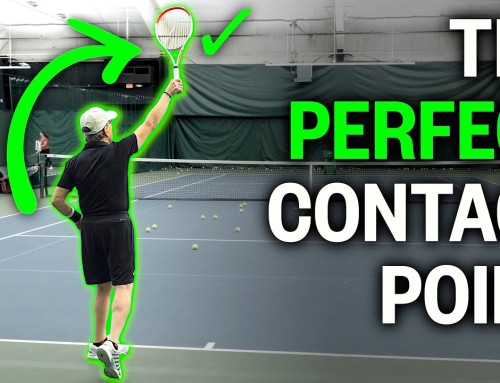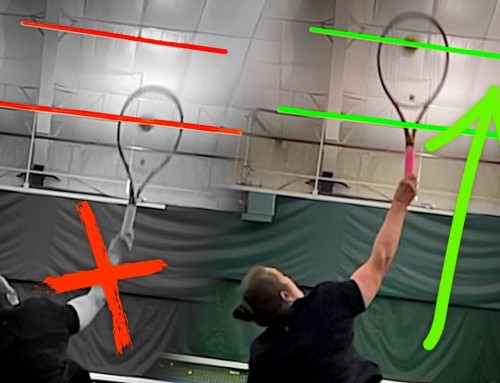
I recently spent some time working with a solid 4.0 player on his serve, and what I discovered was eye opening.
At first glance, his serve looked really solid. Good technique, decent power, nothing obviously wrong. But when we slowed things down and looked at the video frame by frame, we uncovered a problem that was literally blocking his natural power from flowing through the ball.
And here’s the kicker: he was doing exactly what multiple coaches had told him to do over the years.
He was keeping his tossing arm up.
You’ve probably heard this coaching cue before. Maybe you’ve even been told this yourself. Keep your tossing arm up on your serve. It’s one of those classic pieces of advice that gets repeated over and over in tennis.
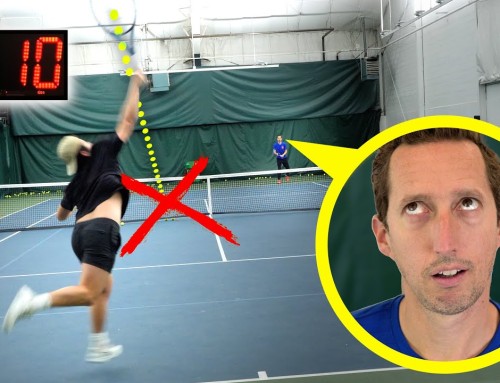
The problem? When you keep that arm up too long, it can actually ruin your results.
Let me show you what I mean and more importantly, what you can learn from this.
I pulled up footage of Roger Federer, Serena Williams, Andy Murray, Novak Djokovic, and Carlos Alcaraz. I wanted my student to see what the best servers in the world actually do with their tossing arm.
Here’s what we noticed: when their racket starts moving up towards contact after the racket drop, their tossing arm is already down around waist height or below.
Not up at the top where they released the ball. Down.
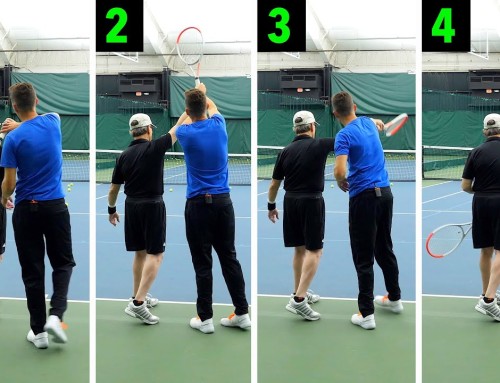
And there’s a beautiful synchronization happening. As the racket drops, the tossing arm drops. As the body rotates upward toward contact, the arms are trading places like a seesaw. The right arm goes up, the left arm comes down, and the chest rotates upward all at the same time.
It’s smooth. It’s coordinated. It’s athletic.
Now here’s the critical question: are the arms trading places because the body is turning, or is the body turning because the arms are trading places?
In other words, which is the leader and which is the follower?
The body should always be the primary mover. The engine. The power source. The arms follow along with what the body is doing.
But when you look at most common serve advice, it’s all arm and hand focused. Scratch your back. Brush your hair. Drop the racket. Reach up high. Snap your wrist. Keep your tossing arm up.
All of these tips take your focus away from what your body should be doing, and that leads to mechanical, disconnected motions.
When we slowed down my student’s serve, here’s what was happening.
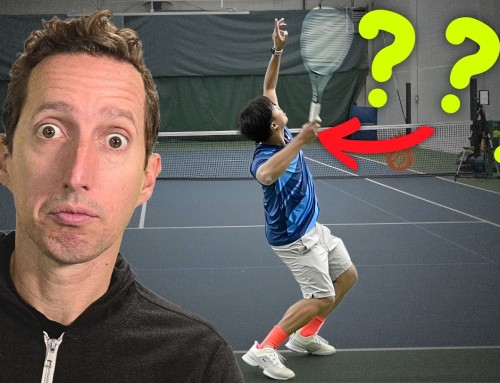
First, his right arm initiated upward without his chest. Then his body started following, trying to catch up with his arm and racket. But the whole time, his left arm stayed frozen at the top where he released the toss.
Three separate phases of movement instead of one smooth, coordinated motion.
By the time he made contact with the ball, his left arm was still up there, a solid three feet higher than where the pros have their tossing hand at contact. And that arm was actually blocking the smooth transfer of energy up toward the ball and out into the court.
Now to be clear, we don’t want the tossing arm dropping too early either. That causes its own set of problems. But this student had been told hundreds of times by well meaning coaches that every time he hit a ball into the net, he needed to keep his tossing arm up.
The more he tried to do that, the more his body got out of sync.
Here’s what I want you to take away from this.
Your serve should be one smooth, coordinated athletic motion. Your body leads, your arms follow. Everything works together.
When your tossing arm stays up too long, you’re creating a mechanical sequence instead of an athletic movement. You’re blocking the natural flow of energy from your legs, through your core, and out through your arm into the ball.
Think of it like a seesaw. As your racket arm goes up toward contact, your tossing arm should be coming down. Your chest should be rotating upward. All of this happens together, not in separate phases.
The timing matters too. Your tossing arm should start dropping right around when your racket reaches its lowest point in the racket drop, and it should continue down as your racket accelerates upward toward contact.
If you recognize yourself in this description, here’s a progression you can work through.
Start by placing both hands under your chin with straight arms parallel to your shoulders. Practice rotating from a turned and tilted trophy position where your left arm is high and your right arm is low. Then rotate your body and let your arms transition together so your right arm finishes high and your left arm finishes low.
This drill helps you feel what it’s like to have your body actually leading the movement with your arms following along.
Next, do some slow segmented shadow swings. Pause and take inventory at each position. Make sure you’re coordinating your arms together with your body. Film yourself because your brain will lie to you about what your body is actually doing.
Then progress to smooth continuous shadow swings without stopping. You’re filling in the gaps and teaching your body how to move athletically. Make sure you’re timing the drop of your left arm correctly, not too early and not too late. It should drop when your body initiates the upward rotation.
Finally, do two smooth shadow swings at the right tempo, then actually toss and hit a ball on the third rep.
This takes time and deliberate practice. You’re fighting against thousands of repetitions of doing it the old way. But when you start coordinating your body correctly and releasing your power at the right time, you’ll produce much bigger results with much less effort.
My student isn’t completely fixed after one session. This will take time and repetition to make it a new subconscious habit. But you can see the difference immediately when his body moves as one coordinated unit instead of three separate phases.
More flow. More energy. More power with less effort.
If this resonates with you and you want to break free from the mechanical serve that’s been holding you back, start working through this progression. Film yourself. Be patient with the process.
And remember that your body should always lead while your arms follow.
Your Coach,
-Ian