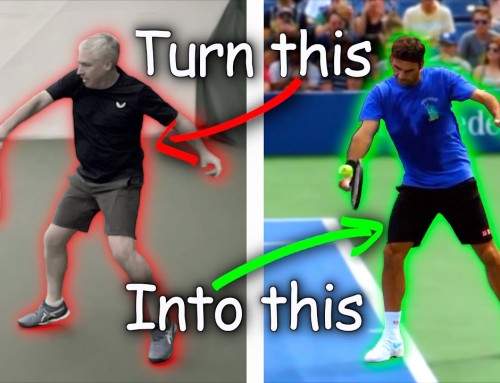
One of my students went from a jammed, tight backhand to a fluid, smooth backhand in just a few minutes, and the fix had nothing to do with technique explanations — it came from a weird training exercise involving a medicine ball.
Before I show you the drill, let’s talk about what makes a world-class two-handed backhand work in the first place.
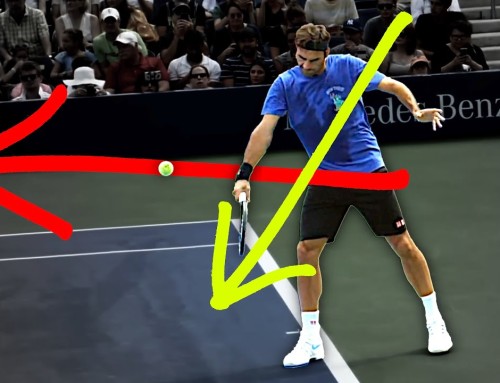
Watch Novak Djokovic at the moment of contact, and you’ll notice his chest and his hips are both facing the ball as the strings meet it.
That means his entire torso has already unwound, delivering his hands and racket from behind his body all the way out in front to meet the ball.
It’s not quite as far around as a forehand — more like just under a 45-degree angle with the hips and shoulders — but the timing is what matters. His hands arrive right on schedule, out in front, arms extended.
Here’s where it gets interesting. Normally, when a competitive adult player has a stiff, tight two-handed backhand, it’s because the torso hasn’t unwound enough and the hands get left behind.
But my student’s case was different — her torso was actually unwinding beautifully, just like Novak’s. And yet her arms and hands were still completely jammed up close to her body.
Her shoulders and hips were pointed exactly where they needed to be, but her hands were late to the party, leaving her arms bent and cramped at contact.
The result was a tight, tense contact position and a short, compact follow-through — a small circle instead of the long, flowing arc you see in a professional swing.
So instead of explaining any of this to her, I handed her a five-pound medicine ball and had her stand behind the singles sideline, throwing it at a target on a wall about twelve to fifteen feet away.
That’s it.
No technical cues, no instructions about her arms or her hands — just “throw the ball at that target.”
The weight of the ball did something a tennis racket never could: it made it physically impossible to keep her hands and arms pinned close to her body.
Try throwing something heavy with stiff, tucked-in arms and you’ll immediately feel how unnatural and unathletic that is.
The weight forced her hands to come along for the ride as her body rotated.
Within just a couple of throws, her arms were hanging naturally, her body was uncoiling and rotating, and her arms were tracing a much bigger circle because of the momentum and weight involved.
By the time she reached her “release point” — essentially an imaginary contact position — her chest and hips were facing the target, and her arms were extended out in front with plenty of space.
Nobody told her to do that.
The medicine ball did the teaching.
After a series of these throws, we moved to shadow swings at the service line, and the difference was immediate.
Her arms hung loose and relaxed, extending naturally out in front instead of jamming up close to her body.
Then came her first real hits with this new pattern — and even though the contact height wasn’t a perfect match to her original swing, the space between her body and the ball at contact was dramatically different.
Her follow-through, which used to trace a tiny, compact circle, was suddenly long and flowing, much closer to what you’d see from a tour-level backhand.
Her results varied shot to shot at first, which is completely normal — some hits had better extension and timing than others.
But the overall transformation, in just a few minutes, was massive.
Her body was still doing exactly what it had always done well: unwinding powerfully.
The difference was that her hands and arms had finally learned to keep up, thanks entirely to the feel she built by throwing that weighted ball.
If your backhand feels tight, jammed, or restricted even though your body rotation feels fine, this is worth trying.
Sometimes the fix isn’t more technical instruction — it’s a different kind of feedback that lets your body figure it out on its own..
Your Coach,
-Ian