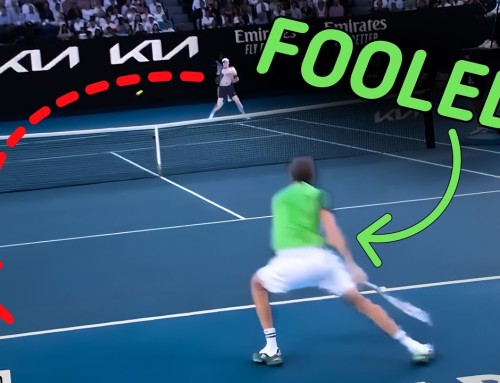
I have to admit something. I love doubles, and I especially love watching the bad boys play it.
So when Nick Kyrgios and Novak Djokovic teamed up together in Australia, I was genuinely giddy. Two career singles players, teaming up, going full chaos mode on a doubles court. I couldn’t wait to break it down.
What came out of it turned into a full doubles strategy lesson, and I think every level of player can take something from it.
Let’s start with time and positioning.
As Nick gets ready to return, he starts from a fairly standard spot behind the baseline. But watch what happens as the toss goes up, he takes a massive step forward into his split step. That single adjustment does two things at once. It improves his court position, and it strips time away from his opponents before he’s even hit the ball.
Because of that improved position, his takeback doesn’t need to be big either. There’s already so much pace coming off the return that a smaller, more compact turn is all he needs to redirect that energy right back at his opponents.
Here’s the part that genuinely surprised me. While Nick is hitting the return, Novak isn’t watching his own partner. His eyes and his stance are locked onto the opponent who’s most likely to intercept the ball next. If Nick’s return isn’t perfect, that player becomes target number one, and Novak is already prepared for it. That’s the kind of awareness that separates a good doubles team from a great one.
Now let’s talk about where to attack once you’re up at the net.
When Novak gets a floating return to put away, he’s got options everywhere. A sharp angle. A deep ball into the corner. Threading the needle between both opponents. Instead, he picks the simplest, smartest target of all, right at the feet of the closest opponent.
It might not look flashy, but it’s brilliant. Targeting the feet forces the ball upward even if the opponent somehow gets a racket on it, which means Novak or his partner get an even easier follow-up shot. It’s not about hitting a highlight-reel winner. It’s about stacking the odds heavily in your favor.
If there’s one theme running through this entire doubles strategy lesson, it’s the middle of the court. Everyone’s heard that the middle matters. Almost nobody actually covers it well.
At one point, Nick gets pulled way off the court chasing a wide ball. Novak, for a moment, is just watching, a small missed opportunity to start shifting with his partner in real time. But once he recognizes the gaping hole opening up in the middle, he sprints over to cover it, correctly prioritizing the higher-percentage shot his opponents are far more likely to go for. He can’t cover every angle at once, so he picks the one that matters most.
Later, Nick does this even better. When Novak gets stretched off the court, Nick doesn’t hesitate, he fully rotates all the way over to Novak’s side of the court, even though it leaves an angle exposed. He understands the tradeoff. The middle is simply more valuable real estate, and when your partner is completely out of the point, someone has to own it.
There’s another lesson buried in how these two chose to play as a team. Djokovic and Kyrgios were up against career doubles specialists who’ve made millions playing the format. Rather than trying to out-net-game the net specialists, Nick and Novak leaned hard into their baseline strengths, playing a lot of points from double back on return.
There’s zero shame in that, by the way. Even doubles specialists play double back when it’s the smartest path to winning the point. This is a doubles strategy lesson in itself: know where your strength actually lives, and don’t force yourself into your opponent’s game just because it looks more aggressive.
That said, once an opportunity opened up to attack, they took it. When a server stayed back instead of serving and volleying, Novak floated a safe crosscourt ball, and Nick immediately pounced, moving forward into an attacking position while Novak avoided the net player. Instead of two defenders against two attackers, it suddenly became an even fight.
That’s the mindset to carry into your own doubles matches. Starting back isn’t a life sentence. Look for the moment your opponent gives you a neutral or weak ball, and use it to upgrade your court position.
One more small but important detail, once you’re at the net with an advantage, don’t just stand there admiring your work. Watch how Novak, after redirecting a ball down at his opponent’s feet, doesn’t wait passively for the next shot. He moves forward again, taking even more time away and giving himself a better contact point to finish the point outright.
Chemistry aside, and these two clearly had a blast out there, the tactical lessons are real. Take time away early. Target the feet when you’re finishing points. Prioritize the middle over flashy angles. Play to your actual strengths instead of copying your opponents. And once you’re winning the exchange, keep pressing forward instead of settling.
That’s the kind of doubles strategy lesson you can actually take onto the court with your own partner this weekend.
Your Coach,
-Ian