Your swing looks nothing like Federer’s, and it’s not because you’re not athletic enough, flexible enough, or haven’t practiced enough.
The real reason is something almost nobody focuses on, because everyone’s too busy copying the obvious, surface-level stuff.
Beneath every one of Roger’s swings is one key element.
He accelerates the racket forward with his torso, which lets his arm stay relaxed and smooth.
Everyday players accelerate the racket with their arm, which keeps everything tight, rigid, and tense.
Here’s the trap so many players and coaches fall into.
They focus on what the racket is doing. The forehand path. The backhand finish. The serve position.
Then they simply try to copy that surface-level movement, without understanding that the racket moves because of what the torso does, not the other way around.
The internet is full of tutorials showing you how to copy Roger’s racket path, his contact point, his finish.
But it’s all backwards.
Those positions are the result of what his body already did. Not the cause of the swing.
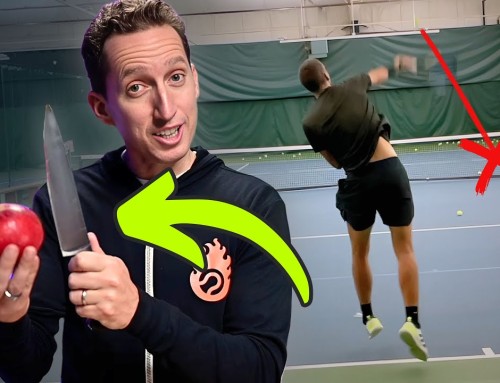
Copying his contact point and finish without copying his torso is like painting flames on your car and expecting it to go faster.
Oh wait. People actually do that, don’t they?
Let’s look at how this plays out across every major shot in tennis, and where everyday players consistently miss it.
Start with the forehand.
In Roger’s setup, relative to the baseline, his shoulders sit at roughly 90 degrees, and his hips are close behind.
At the moment of contact, his shoulders and hips are both facing straight forward, parallel to the baseline.
Everyone obsesses over how straight his arm is and how far forward the racket sits.
But that’s only possible because his torso already unwound that far.
By the end of his follow-through, his chest has rotated another 90 degrees, facing completely away from the camera.
Now compare that to an everyday player.
His setup position is actually solid. Shoulders just past 90 degrees, hips right at 90. Plenty of stored energy there.
But at contact, everything changes.
His shoulders are nearly 45 degrees short of where Roger’s were. His hips are even further behind.
That’s exactly why his racket isn’t far out in front, and why his arm isn’t extended.
If the torso never turns forward, the arm has nowhere to release the racket to.
Here’s the part that really stands out.
By the time this player’s hips and shoulders finally reach parallel to the baseline, the position Roger was in at contact, his swing is already over.
Roger kept turning well beyond that point.
Roger’s torso moves roughly twice as far, both into contact and across the entire swing.
That’s the entire reason his arm looks relaxed, his swing looks longer, and his finish looks effortless. It’s a byproduct of the torso, not the arm.
Now the one-handed backhand.
In Roger’s setup, his hips sit around 90 degrees to the baseline, but his shoulders turn significantly further, creating a deep coil through his upper body.
At contact, his shoulders have rotated a full 90 degrees from that starting point. His hips are facing the ball directly, and his chest is close behind.
That’s a massive unwind of stored energy, almost identical to the pattern on his forehand.
People love to say “stay sideways” on the one-handed backhand, but look at the actual numbers. There’s a huge amount of torso rotation happening, not stillness.
Now the everyday version of this same shot.
Hips start around 90 degrees, same as Roger. Shoulders turn a little further, but nowhere near as much.
At contact, the hips haven’t unwound at all. The shoulders have only moved 10 or 15 degrees.
So what’s actually swinging the racket from way back to all the way through contact if the torso barely moved?
The arm. Almost entirely the arm.
That’s exactly why this swing looks tight, rigid, and tense, and why the resulting shot tends to come out weak, short, and flat.
Now the serve.
In Roger’s trophy pose, notice the slant through his body, how he drops the right side down to create extra coil and store more energy in his torso.
As he drives up toward contact, his chest and hips initiate the movement first, and his arm follows behind.
Because the arm is passive here, it can stay relaxed and create a deep, powerful stretch, the racket drop position everyone admires.
At contact, his upper body has unwound more than 90 degrees from where it started. That rotation is the actual engine of his serve.
Now the everyday player’s trophy pose.
Far more level through the torso. Barely any coil, barely any dip or twist stored.
So when his arm starts to drop, it’s moving independently, without any help from the body.
Roger’s body was already uncoiling to create momentum, letting his arm stay loose. This player’s arm has to manufacture the racket drop entirely on its own, which makes it look mechanical and forced.
At contact, his hips and shoulders land in a position fairly close to Roger’s. But trace the full range of motion back to his starting point, and he’s well short of 90 degrees total rotation. Roger’s is nearly double.
Here’s the truth nobody talks about.
Until your torso moves the way Roger’s does, none of the other swing elements actually matter.
Chase surface-level racket positions first, and you’ll end up with a rigid, forced, choppy swing, the exact opposite of what makes his game look so smooth.
That’s why your swings still don’t feel right, and still don’t look anything like the pros.
You’ve simply been copying the wrong part of the swing.
So here’s a question worth sitting with.
Which of your three shots feels most disconnected from what the pros do? Your forehand, your backhand, or your serve?
The good news is this is absolutely trainable.
Real drills exist to rewire how your body initiates these movements, unlocking smoothness and fluidity across your entire game.
Most players never get there because they’re stuck focused on the wrong details.
Once you shift this one foundational piece, everything else tends to fall into place fast.
Thanks so much for watching, and for all your support. Talk to you again soon.
Your Coach,
-Ian