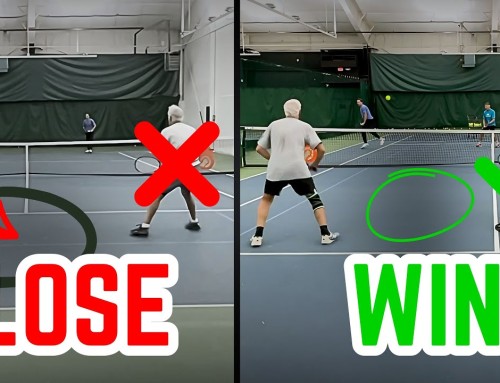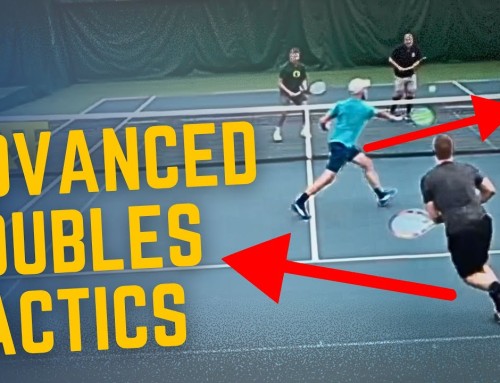
Watch any doubles match at the club level and you’ll see it happen point after point. It’s such a common doubles positioning mistake that most players don’t even realize they’re making it — including, probably, you.
Here’s the setup. Your opponent is about to hit a shot from the baseline. You and your partner are at the net. Where do you stand?
Most players try to cover as much of the court as possible, spreading out to guard the width of it. Sounds smart, right? Except it’s exactly backwards, and it’s the doubles positioning mistake that gives your opponents an easy target on almost every single point.
Let’s lay the foundation first.
A doubles court is 36 feet wide. Best case, you and your partner each cover about 6 feet of that with your reach. That means it would take six of you, fingertip to fingertip, to cover the entire width of the court. You and your partner simply cannot cover all of it. Not even close.
So if you can’t cover everything, you have to be smart about what you leave open and what you shut down.
Think about your opponent’s options when they’re hitting a shot at your net partner and you. Ignoring the lob for a second, there are really three targets available: right at one of you, straight down the middle between you, or a sharp angle around the far side of the other player.
Here’s the part almost nobody thinks about — those three targets are not equally difficult.
Down the middle is the easiest shot on the court. The net is at its lowest point there, there’s a wide alley of space to work with, and your opponent doesn’t have to change the angle of anything. It’s the shot every coach yells at you to stop leaving open, for good reason.
The next easiest is down the line — harder than the middle, but still very makeable.
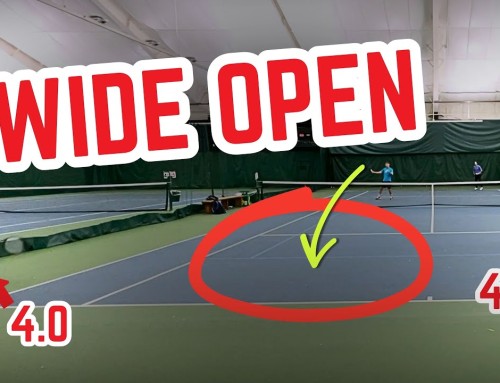
The hardest shot by far is the sharp angle out wide, past your partner. That shot requires threading a needle most players simply can’t thread consistently.
So here’s the doubles positioning mistake in a nutshell: most players position themselves to try to cover a little bit of everything, including that low-percentage sharp angle. High-level players do the exact opposite.
Watch top doubles teams and you’ll see it immediately. As their opponent sets up to hit, one net player locks down the middle — the easiest shot — and the other locks down the line — the second easiest shot. The sharp angle? Left open. On purpose.
They’re essentially telling their opponent: go ahead, try to hit that one. We know we can’t be in three places with two bodies, so we’re choosing to give you the hardest shot on the court and taking away the two easy ones.
That’s the whole strategy. Cover the two highest-percentage targets. Concede the lowest-percentage one. It sounds almost too simple, and that’s exactly why so few players actually do it.
Here’s where it falls apart for most club players, though — and this is the real doubles positioning mistake in action. It’s not just about where you start. It’s about whether you and your partner move together as the point develops.
I’ve watched it happen over and over in lessons: the ball shifts to one side, one partner tracks with it, and the other just… doesn’t. Maybe they’re worried about getting out of the way. Maybe they lose track of the ball. Either way, the gap between them doubles in an instant, and suddenly the “hard” shot down the middle isn’t hard anymore. It’s wide open.
The middle of the court isn’t a fixed spot, by the way. It’s constantly shifting based on where the ball is and where you and your partner are standing relative to each other. The moment either of you stops tracking that shifting middle, you’ve handed your opponent the easiest shot in tennis for free.
So how do you fix this?
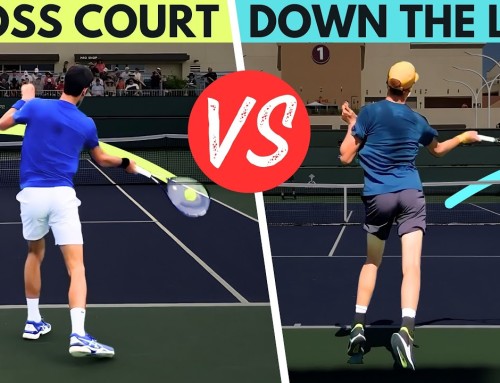
My favorite drill for building this awareness is what I call the figure-eight drill. One team hits everything crosscourt, the other hits everything down the line, and you rally back and forth in a calm, cooperative pattern. As the ball travels from side to side, all four players move together, side to side, tracking the ball and tracking each other.
It sounds simple — almost too simple — but watch closely during this drill and you’ll start to notice tiny gaps. One partner drifts a foot less than the other. One player hesitates for half a second before catching up. Every one of those small gaps is exactly the kind of opening that turns into a lost point in a real match.
Do this drill enough, and you’ll start to feel — not just think about, but feel — where the middle actually is at any given moment, and how to stay connected to your partner as it shifts.
Fix this one doubles positioning mistake, and you’ll make the game dramatically harder for your opponents and dramatically easier for yourself. It’s not about covering more court. It’s about covering the right court, together, every single point.
Your Coach,
-Ian