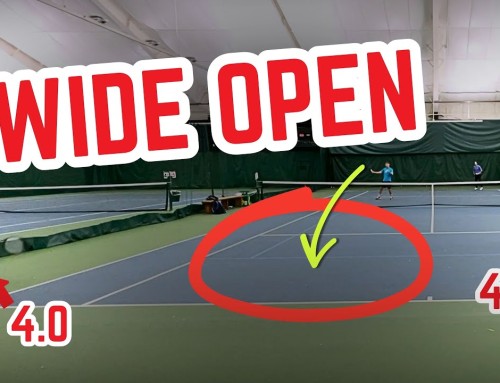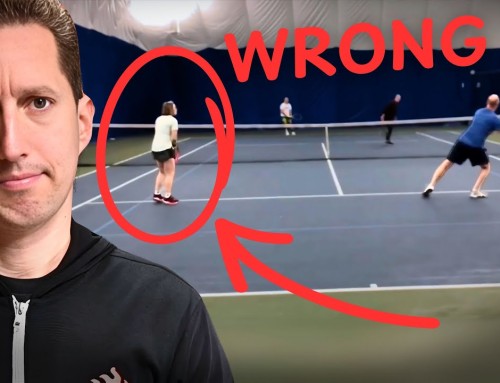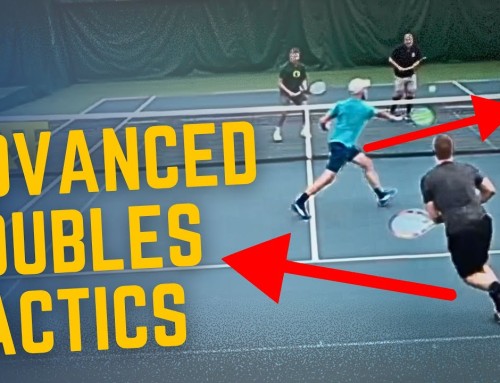
Learning how to control the middle in doubles is something hardly anyone below the 4.5 level actually does.
Last time, I showed you the four mistakes that leave the middle wide open.
Everyone knows they’re supposed to cover it.
Sadly, almost nobody follows through.
Here’s the four-step system I use to train players so the middle finally belongs to them.
Step one: move together with the ball.
The first skill is shifting right and left as a unit, so big gaps never open between you and your partner.
Here’s the setup.
As long as the ball stays inside a certain box, nobody has anywhere to go.
You keep the same distance from your partner and the center stays covered.
The moment the ball leaves that box, all four players have somewhere to go.
Somebody has to get the ball, which creates a gap, and any player who doesn’t move opens something easy for the other team.
So we set up a predetermined pattern.
My fellow coach and I hit everything crosscourt.
Our two students on the near side hit everything down the line.
It’s a cooperative rally, and every time the ball travels outside the box to the right, all four of us travel right.
Every time it travels left, all four of us travel left.
Here’s the critical point.
If one player moves to get the ball and his partner doesn’t match that distance at the same speed, a gap opens.
In the drill, his partner moved in the correct direction but at half the speed.
They started with a small amount of space between them, and ended with a much larger one.
That growing space is the real middle, and it’s a gigantic liability.
I’m not talking about the literal center line of the court.
Doubles is dynamic and the court is huge.
Training the correct direction and the correct intensity of movement is step one toward dominating the center.
Step two: pick intelligent targets at the net.
This phase teaches you to aim in ways that don’t throw you or your partner under the bus.
I start a rally to the right, and this time there’s no set pattern.
The net player has three main targets, each with a different level of risk.
Target one is the easiest, right over the middle of the net.
Target two is straight ahead down the line, where the net is a little higher and the court a little shorter.
Target three is the hardest, a sharp angle into that small sliver of court on the far side.
Targets one and two let you and your partner stay put, because the ball never leaves that imaginary box.
Target three is tempting, because the angle looks open.
But it’s open on purpose.
When the first shot went one direction, the opposing team shifted that way, knowing they couldn’t cover all three targets.
They left the toughest one open deliberately.
And if you make them run for it, your partner has to run too.
That sharp angle leaves a whole chunk of court open for a down the line reply, and your partner gets stranded.
Watch how the rally plays out.
Every time someone goes for target three, there’s a lot of scrambling.
Every time someone aims for target one or two, everybody relaxes.
Here’s the big secret to doubles success: pick intelligent targets.
You can go for target three, but only from a comfortable position with a high ball.
Go for it with a difficult shot below net level and you’re leaving your partner in limbo without firm footing.
Take the other path and the whole sequence changes.
When the player goes for target two, he and his partner stay in the position they just moved to.
They hit themselves into position, with nowhere to run before the next shot.
Then my partner takes a shot to the open court, target three, and look at what it does to me.
I had just finished covering the middle, and now I’m alone in the center and forced to shift away from it.
That shift is volatile, adds confusion, and creates extra work we didn’t need.
A big, sharp, fancy angle feels effective because your opponents might have to run.
But you and your partner have to run just as much, and if you don’t, you leave the middle wide open.
Step three: transition between offense and defense at the net.
In this phase, my students pretend the coach on the far side is mid-point, about to hit a groundstroke.
One student’s job is offense: get in the way, intercept the ball, put it away.
The other student, with the ball behind him, is in defense mode.
His job is to block the easiest target in the middle and stop an attack from the opposing net player.
Then the ball crosses crosscourt, and everything flips.
The offensive player becomes the defensive player, and the defensive player moves up to offense.
In doubles, every time the ball moves from baseline player to baseline player, a net player should make this transition.
Skip it, and you either stop pressuring the baseline player and miss interceptions, or you stop protecting the middle against the opposing net player.
In the live rally, we rally crosscourt and the net players are told no poaching.
You can see them itching to cut across, because they badly want the rally to end.
I hear it all the time: “I play doubles because I don’t want to run as much as in singles.”
Anyone who says that has never done this transition from offense to defense, over and over, on every single ball.
On the ad side, the direction mirrors the direction of the ball.
When the ball comes to our side, the players shift to defense.
When it goes to the other side, they shift to offense, again and again.
That’s the work it takes to check every box as a good net player and partner.
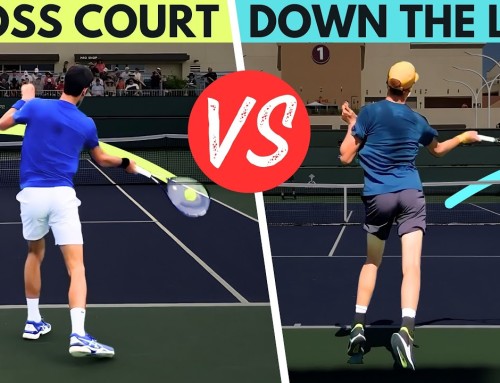
Step four: test the middle with down the line shots.
Now it gets really fun, because we stop hitting only crosscourt.
Occasionally we hit down the line to test the net players.
We test whether the offensive net player is ready to receive the ball.
More importantly, we test whether the defensive player is ready to block the middle when the attack comes.
Here’s what a fail looks like.
I hit down the line, and my net partner isn’t ready.
He’s disengaged from the middle and already moving up to offense.
He’s also turned his face to look at the opposing net player, hoping to poach the next ball.
He’s abandoning the most important part of the court and exposing an easy target, while stealing his own time.
The solution: square up to the opposing net player, keep your eyes on him, and hold a position in the middle.
Stay there until the ball clearly crosses your opponent at the net, which gives you the green light to attack.
Here’s what the correct version looks like, after a short break and conversation about it.
The ball goes down the line again, and this time he’s ready.
He eventually lost the point, but he made his opponent hit another shot.
That happened because his eyes were on the opposing net player, his stance was squared up, and his position was correct.
He saw the attack coming and intercepted it, which is what it means to cover the middle.
Here’s the frustrating part.
Almost nobody does this.
I’m not angry at these players.
Day after day I work with players whose tennis IQ is incredibly high, and they know exactly what to do on paper.
They know they’re supposed to cover the middle, but they leave early, watch the wrong thing, and stand in the wrong place.
These are two very experienced 4.0 players, and I see four or five players making the same mistakes all the time.
Here’s one more example of step four.
The coach hits down the line, the net player intercepts, and the opposing net player is standing there, watching, ready.
That was incredible anticipation, not reaction.
He watched the right thing at the right time, expected the ball in the middle, and was ready for it.
The same principles apply on the ad side, just in the opposite direction.
This isn’t going to be a popular lesson, because I’m showing real work and effort.
It isn’t five secret tips to add 20 miles per hour to your forehand.
It’s hard work, and I’ll say that out loud.
I also understand it isn’t easy to get four players on court for these drills.
But if you do them, you’ll vault over your peers.
The large majority of doubles players do none of this, and that’s why the middle gets exposed so often.
Everyone has been told a million times to cover the middle.
Yet the habits around coverage, visual focus, anticipation, and positioning are all backwards.
Do these drills, and learning how to control the middle in doubles becomes an incredible game changer for your team.
If this lesson helped, let me know in the comments.
Keep up the great work on your game, and I’ll talk to you in the next lesson.
Your Coach,
-Ian