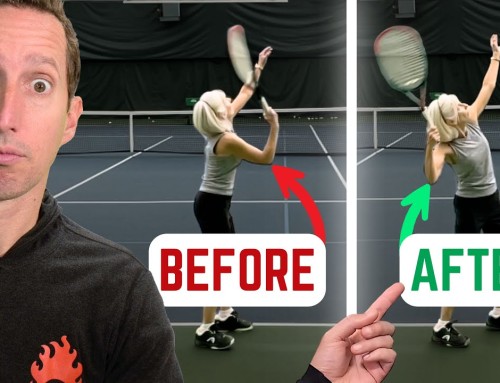
If you’re chasing instant serve power and nothing seems to be working, I want you to consider something most players never think to check: your toss location.
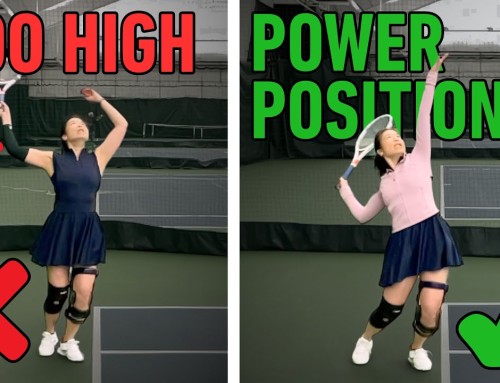
Same player. Same racket. Same court. And yet her serve looked like two completely different shots, all because of one adjustment to where the ball landed in the air.
If your serve feels weak, or awkward, or like you’re falling backwards right after contact, there’s a good chance your toss is the culprit.
Most players have no idea how far behind them their toss actually is, or how much power that’s costing them.
Here’s what got me thinking about this with my student.
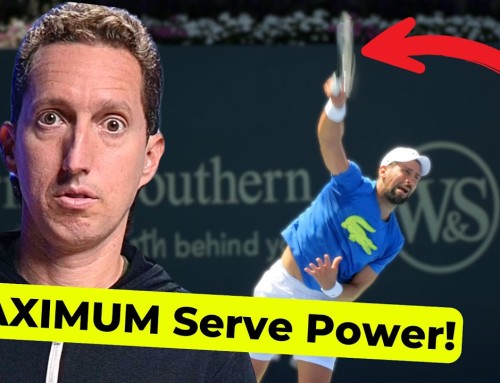
Watch Carlos Alcaraz or Iga Świątek serve, and you’ll notice their whole body is launching up and forward into the court — not just up.
If you drew a straight vertical line down from their contact point, that line lands several feet inside the baseline.
That forward toss location is what lets them collide two forces together: upward force to clear the net, and forward force to drive the ball at their opponent.
Both are essential, and both depend entirely on where the toss lands.
My student’s serve, before we touched anything, had none of that.
She had a genuinely smooth, flowing arm and racket motion — she’s clearly a talented athlete — but there was no launch, no explosion, nothing being transferred into the court.
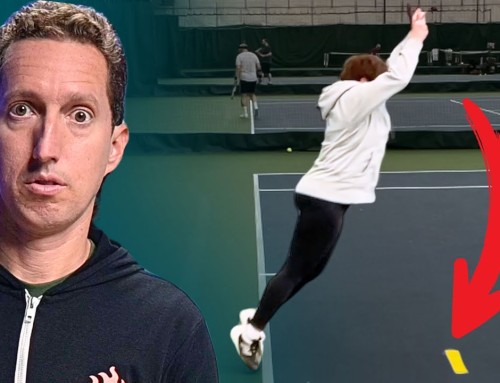
When I drew that same vertical line down from her point of contact, the ball was landing behind the baseline.
Not on it.
Behind it.
On average, across a bunch of her serves, contact was happening right around the baseline or a couple inches behind. There was simply no way to explode forward into a ball that was landing behind her.
So I marked a spot on the court — about a foot inside the baseline — and that became her new target for where the toss should fall.
Here’s where it got interesting. On her first few attempts, she was convinced she was tossing way out in front.
If you’d asked her beforehand whether she makes contact in front of her body or behind it, she’d have said “in front,” without hesitation — because that’s what every player is told.
But when she watched the video back, the ball was barely past where she started.
She was genuinely surprised, even a little deflated.
This is the gap between feel and real, and it might be the single biggest obstacle to improving at anything in tennis: what you think you’re doing and what you’re actually doing are very often two different things.
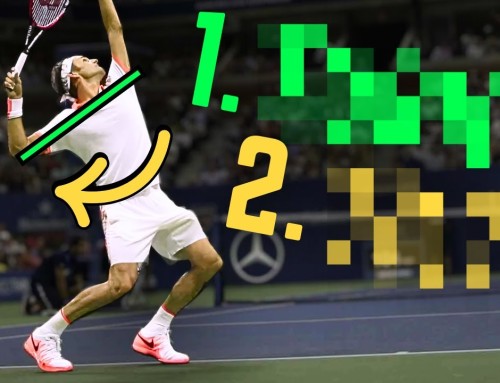
She’d also been told previously to toss with her arm traveling parallel to the baseline, because that’s what Federer does.
And technically, it’s true — his arm does travel roughly parallel to the baseline. But watch closely and his hand still carries the ball slightly forward as it rises, so his contact point ends up well inside the baseline anyway, just like Carlos and Iga.
Meanwhile, both of those pros actually raise their arm into the court at something like a 45-degree angle, not along the baseline at all. That’s the difference between style and substance.
Different pros do this differently, which is exactly how you know it’s not a fundamental law you have to follow — it’s just personal style.
What actually matters is landing the toss in the right spot, consistently, using whatever motion gets you there.
We kept pushing the target further into the court, and her shadow tosses kept improving — but her live hits kept sneaking back toward her old, safe location near the baseline.
That’s not laziness or lack of effort; that’s tens of thousands of repetitions pulling her back to a deeply grooved habit the moment real pressure.
Eventually I told her to stop aiming for the marker and just go past it — exaggerate the change on purpose. And that’s when everything shifted.
She left the ground. Her upper body hit that same 45-degree angle we saw from Carlos and Iga.
Her contact point landed a foot and a half to two feet inside the baseline — honestly a bit further than she needs long-term, but exactly the kind of overcorrection required to break a habit that deep.
We can always dial it back ten percent later and meet in the middle. What we couldn’t do was get there gradually.
That’s the real lesson here, and it applies to almost anything you’re trying to fix in your game: the first real breakthrough usually requires pushing yourself much further than feels reasonable.
If you’re nudging your toss, your grip, or your contact point just a little at a time, you may be moving in the right direction technically, but your habits will keep dragging you right back to where you started.
Sometimes you have to overshoot on purpose just to feel what the correct range actually feels like.
Once she felt that new location in her body, everything about her serve changed — more force, more flow, a whole different level of energy transferring through contact.
It didn’t look like the same shot anymore, even though nothing about her swing mechanics had changed. Just the toss.
If your serve has been feeling stuck no matter how much you work on your motion, take an honest look at where your toss is landing relative to the baseline.
It might be the one variable you haven’t actually tested yet.
Your Coach,
-Ian