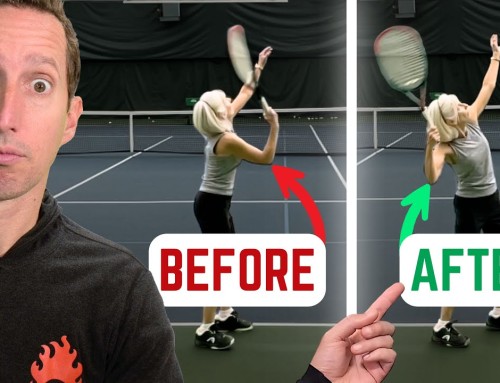
If you want to know how to pronate for powerful serves the way the pros do, I recently walked a student through exactly that transformation in under thirty minutes, going from zero pronation to a full, natural release just like the tour players.
Every high-level player pronates on their serve, and it’s one of the most misunderstood parts of the motion.
Pronation releases a stretch that gets built during the racket drop.
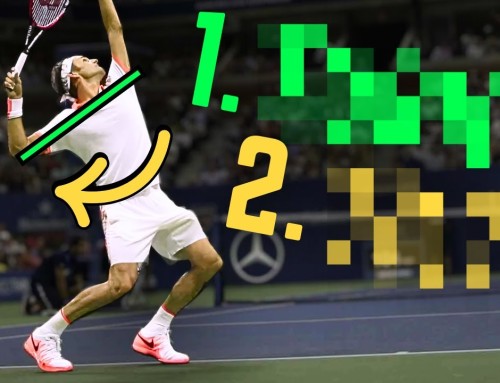
To create that drop, players do two things at once: they stretch the shoulder backward, and they turn the hand inward. Together, those two actions get the racket down low and “on edge,” meaning the frame of the racket leads the way upward instead of the strings.
If a player never released that inward turn, the frame would just chop straight into the ball — the racket has to rotate through nearly 180 degrees, from strings facing one side before contact, to facing the target at contact, to facing the opposite side afterward.
That’s the real “racket snap” people talk about — not a wrist flick, but a full unwinding of the arm, forearm, and shoulder together.
Here’s what made my student’s case so interesting: she already had incredible mechanics.
She built the stretch beautifully — shoulder back, hand turned in, great edge position, frame leading toward the ball just like the pros.
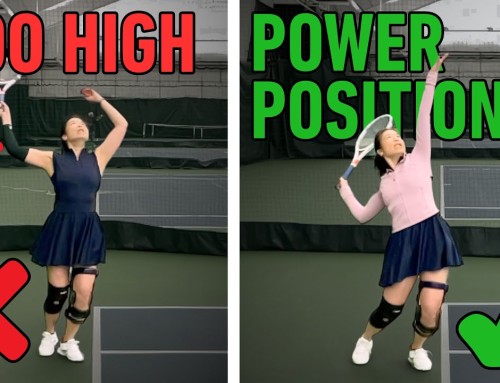
But right at the moment everyone focuses on — the split second around contact — instead of letting that stored energy continue rotating outward, she locked the racket down and actually reversed the twist, turning her hand back in the other direction.
The only way to do that is through a lot of muscling and tension, which is exactly what was capping her racket head speed.
Her arm looked stiff and rigid through contact, even though everything leading up to it was excellent.
So how do you fix something like that? Step one was simply walking her through each position of the serve by hand, without a racket in motion, so she could feel the difference between where she was locking down and where the release needed to happen.
Step two was shadow swings, completely hands-off, just letting her find the feeling of the racket transitioning smoothly from strings-left, to strings-forward at contact, to strings-right — without any pause, hitch, or clamp partway through.
Step three was adding real balls, alternating between shadows and hits. Her very first attempts still showed the same old habit — locking down right at contact instead of letting the racket continue through. That’s completely normal.
New movement patterns rarely show up perfectly on the first try, and sometimes when they do work, the ball goes somewhere unexpected, which can trick you into thinking you did it wrong when you actually didn’t.
After more reps, she hit a breakthrough: her very first swing where the racket actually released all the way through, from that edge position all the way past contact.
This is the part I want to emphasize, because it’s the single biggest key to learning how to pronate for powerful serves without hurting yourself — that release has to be passive.
You let the racket continue turning as a natural byproduct of the stored energy you built earlier in the swing. You don’t manufacture it by flipping or twisting your hand on purpose after contact.
That distinction matters more than almost anything else in this whole process.
There’s a difference between the biomechanically correct way to move, and what feels natural or intuitive in the moment — and those two things aren’t always the same.
Closing that gap is honestly one of the hardest parts of improving at tennis.
I also want to flag a real risk here. When my student tried to force the twist — actively muscling her hand to invert the racket instead of allowing the release to happen on its own — that’s a fast track to injury.
Add enough intensity to a forced, unnatural twisting motion at the shoulder or forearm, and it’s only a matter of time before something gets hurt.
My constant reminder to her throughout the session was simple: relax the hand, and let it happen — don’t make it happen.
That’s not just about smoother mechanics; it’s about protecting your arm.
By the end of our thirty minutes together, once she’d built up enough reps and started trusting the feeling instead of fighting it, the difference was obvious.
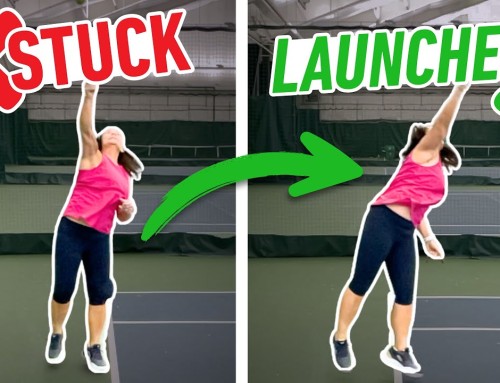
Her arm, which had looked locked and rigid at contact before, now moved fluidly through the entire release, unlocking real racket head speed and setting her up for a lot more power and spin.
If you’re working on your own serve, remember: build the stretch, trust the release, and never force the twist. Let the racket do what it wants to do.
Your Coach,
-Ian