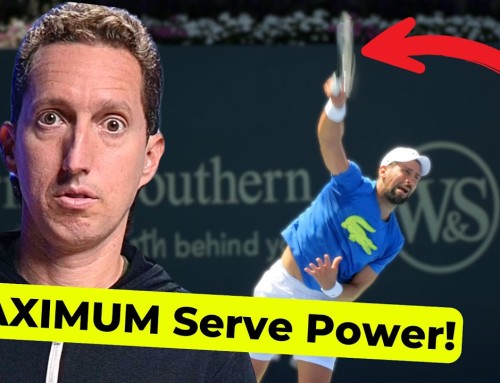
I recently worked with a high school player who was bigger, stronger, and more athletic than me.
During his evaluation he was absolutely crushing forehands, backhands, and serves. Powerful, confident swings. And then we played points together and he could not win a single one. Out of five service games he won exactly one point. Almost a golden set for me.
How is that possible?
The bottom line was simple. He had no idea how to harness his natural power and consistently put the ball where he wanted it to go. And that is a problem I see all the time at every level.
Here is how I taught him to fix it.
It all comes down to one phrase that I want you to memorize. The face sends it, the path bends it.
The ball is only touching your strings for a couple thousandths of a second, way faster than the blink of a human eye. In that instant, wherever the strings are facing is where the ball will start off going. Open face means the ball goes up. Flat face means the ball goes straight. Closed face means the ball goes down—that is the face sending it and the key to how to fix the waiter tray serve.
At that exact same moment, whatever direction the racket is moving determines the spin on the ball, which causes it to curve as it travels through the air. Swing upward through contact and you get topspin. Swing downward and you get backspin. When the path perfectly matches the angle of the face, the ball travels with very little spin at all. That is the path bending it.
Once you understand those two things, you can reverse engineer almost any miss and know exactly what to adjust on your very next swing—an essential step in learning how to fix the waiter tray serve.
Here is a real example from my session with this student. I challenged him to hit five crosscourt forehands past the service line in a row.
One shot came out too high with not enough spin to bring it back down into the court. On the very next swing he slightly closed his racket face and dropped his racket head a little lower to create a more vertical path. The result was a lower ball over the net with more curve on it, and it landed right where he wanted it.
When you hit the net, it almost always means your racket face was too closed. Open it up slightly on the next swing and you will clear the net again—an important adjustment when learning how to fix the waiter tray serve.
There is one more element that makes all of this more complicated, and that is swing speed. The slower your racket is moving, the less sensitive these variables are, but also the less competitive your shot becomes. A fast swing with a face that is even a degree or two too open will send the ball flying way long unless you also have enough topspin to bring it back down.
During our evaluation together my student was swinging at eight or nine out of ten and constantly losing control. When I gave him the challenge of making five forehands in a row he dropped all the way down to a three or four out of ten trying to be careful. Neither extreme works.
The best players at your local courts maintain a steady, confident swing speed without slowing down to keep the ball in play. They can do that because they understand how to adjust the face and the path at contact.
I had my student commit to a six out of ten swing speed so he could focus entirely on those two things. Face and path. Nothing else.
He made five forehands in a row crosscourt. Then five down the line. Then he applied the same concepts to his serve and started putting ball after ball in play without the hesitation he had earlier in the day.
Then we played points again, and it was like playing a completely different person.
That is what happens when a player stops guessing and starts understanding. Same athlete, same swing, completely different results.
Your Coach,
-Ian