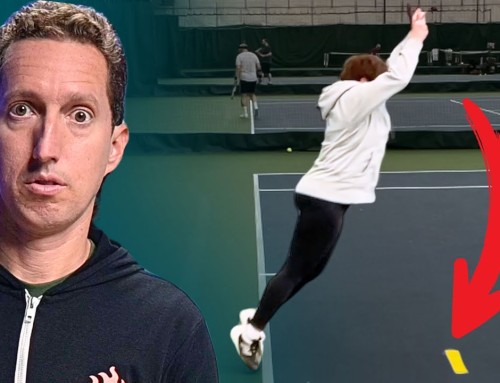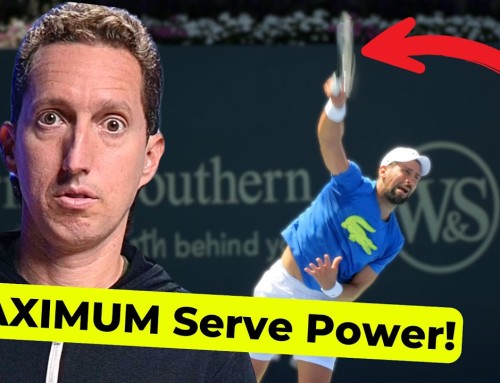
I watched a student of mine make almost every bad toss imaginable in under 60 seconds.
The ball went behind him. It went out to the right. It drifted all over the place. And every single time, he had no idea why.
I did, though. And once you understand what causes it, you’ll know exactly how to fix your serve toss for good.
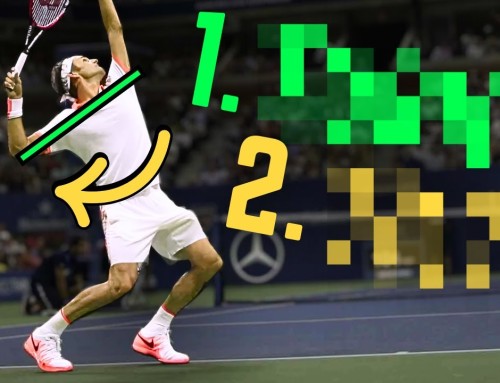
Before I show you what went wrong with his toss, let’s look at what goes right for the best players in the world. There are four technical checkpoints that determine whether you end up with a great toss or a terrible one, and once you see them, you can’t unsee them.
Watch Roger Federer. First, notice how low he starts with the ball and his tossing hand before he ever begins lifting it. That gives him a long, smooth runway to build momentum gently.
Second, watch his fingers. There’s no flipping, no flexing, nothing propelling the ball upward. He just lets it go. It almost looks like a magic trick, like the ball is levitating out of his hand on its own.
Third, watch his wrist. There’s a slight, extended bend at the bottom, and that same angle stays constant all the way through, right up until he releases the ball. No flicking, no hinging.
Fourth, look at his elbow. Fully straight at the bottom, and still fully straight the moment he lets go of the ball.
Put all four of those together and here’s what you get: one single hinge, the shoulder, doing all the work. Not the fingers. Not the wrist. Not the elbow. Just the biggest, strongest, most stable joint in the whole chain. That’s what creates maximum repeatability with the fewest possible variables.
Carlos Alcaraz does the exact same thing. Passive fingers. Neutral, straight wrist. Straight elbow. Low starting position with a long runway. One hinge, the shoulder, doing all the lifting.
Now let’s look at my student before we started training together.
The good news is his starting position was already low, so he had a solid runway. But watch his fingers, you’ll see the ball initially heading straight up, then suddenly veering backward. That’s because his index and middle fingers are flexing right at release, adding a hinge that shouldn’t be there.
His wrist, thankfully, stayed in decent shape, similar gentle bend at the bottom and at release. One box checked.
But his elbow was a different story. Slight bend at the bottom, and by the time he releases the ball, that bend has increased dramatically. He’s flexing at the elbow too.
So instead of one clean hinge like Roger and Carlos, he’s got three hinges firing at once: fingers, elbow, and shoulder. That’s not a small difference, that’s roughly three times the moving parts, which is exactly why his tosses were landing all over the court.
Out of the four checkpoints, he was only nailing two. If you want to fix your serve toss the same way we fixed his, here’s the process we used.
Step one felt almost too simple, and he was tempted to skip right past it. Racket in hand, no ball at all. Just practicing the motion itself, checking off all four boxes: long runway, no finger hinge, no wrist hinge, no elbow hinge, shoulder doing all the lifting.
Step two added the ball back in, but with no racket and zero focus on where the ball actually landed. The only job here was replicating clean mechanics without the pressure of hitting anything.
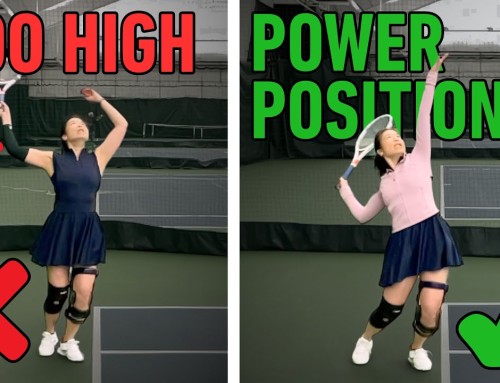
Step three is where things get interesting, because this is how you actually learn to fix your serve toss with real precision, not just clean mechanics. Watch the shape your hand traces as it rises, it’s basically a half circle. Where in that circle you release the ball determines everything. Let go too early, and the ball drifts out to the side. Hold on too long, and it ends up behind you. Somewhere in the middle, usually right around eye height, is the sweet spot.
We watched this play out in real time. One toss released a little late, above eye height, and the ball drifted behind him. Another released too early, below eye height, and the ball veered off to the side. Then he found it, releasing right at eye height, and the ball came down exactly where he needed it for a clean overhand strike.
After a handful of reps, he started developing real feel for it, and toss after toss began landing right where he wanted.
Step four was simply putting it all together. Lower starting position for a long runway, no finger flip, no elbow hinge, releasing right around eye height. From here, it’s just repetition, training this in as the new default until the old habit fades away.
If your toss has been driving you crazy, go check these four things for yourself: your starting height, your fingers, your wrist, and your elbow. Odds are, just like my student, you’re already checking a couple of these boxes without realizing it. The rest just takes a little focused practice to fix your serve toss and start putting the ball exactly where you want it, serve after serve after serve.
Your Coach,
-Ian