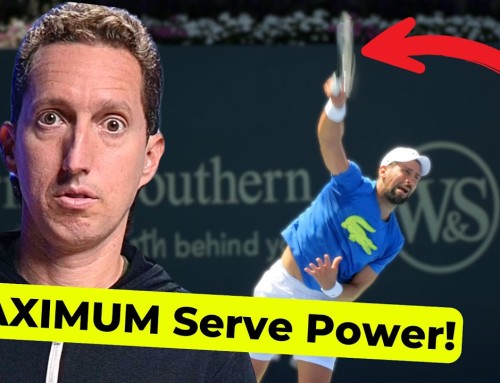
I want to show you something most coaches never point out, and once you see it, you’re going to notice it in every serve you ever watch again.
It’s not about racket speed. It’s not about your toss. It’s not even really about technique in the way most players think about technique.
It’s your forearm.
Specifically, there’s a shoulder tip for your serve that determines whether you end up with a weak, arm-only push or a genuinely huge serve, and almost nobody talks about it.
Here’s what I mean. Watch a weak serve and pay attention to the forearm as the player gets ready to swing up into contact. On a lot of players, that forearm barely moves. It stays close to vertical the entire motion, up and down, up and down, with almost no change in angle.
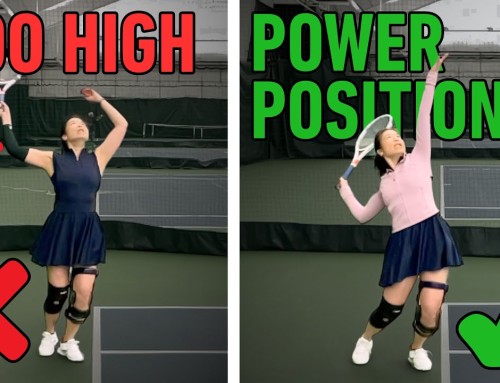
Now watch a medium-paced serve. The forearm drops quite a bit lower.
Watch a genuinely big recreational serve, and the forearm gets almost horizontal to the court.
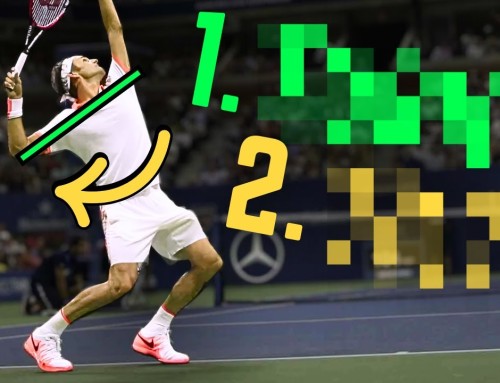
Now watch a world-class player like Novak. His forearm drops into a position that looks almost impossible. Some of that is elite flexibility, sure. But the pattern holds true at every level in between: the lower the forearm can get, the bigger the serve becomes.
What’s actually happening in that lower position is a combination of external shoulder rotation and supination of the hand and forearm. Together, those two things stretch the shoulder and create what we call the racket drop. The bigger that stretch, the bigger and longer the racket drop. And the bigger the racket drop, the more room you have to build acceleration before you ever touch the ball.
Here’s the real shoulder tip for your serve that changes everything: it’s physically impossible to hit a big, powerful serve with a shallow racket drop and no stretch in the shoulder. You simply run out of runway.
I saw this firsthand with a student I worked with recently. Watch his forearm on his very first serve, and the racket barely drops below the top of his head. His forearm stays vertical the whole way up. He’s not building any stretch at all, he’s basically just pushing the racket into the ball.
Fifteen minutes later, same player, completely different picture. His forearm drops significantly lower, and the tip of the racket gets down to about the middle of his back. That’s a massive change in a very short amount of time.
Before we get into how we fixed it, I want to talk about baseball for a second, because a good tennis serve mirrors the mechanics of an overhand throw almost exactly. This student happened to play a lot of baseball growing up, so I handed him a ball and asked him to just throw it, no racket, no thinking about his serve at all. When he threw naturally, his shoulder stretched and his forearm dropped almost to parallel with the court. The range of motion was already there. He just wasn’t using it when he picked up a racket.
That told me everything I needed to know. This wasn’t a physical limitation. It was a habit.
Step one was simple. I had him stand at the baseline without hitting a ball and slowly shadow his service motion, focusing purely on dropping that forearm and stretching the shoulder. First attempt, no ball involved, and his racket tip dropped all the way down to waist height. Proof that the range of motion was there the whole time.
Step two was to keep repeating that same motion while very slowly adding a little acceleration, still with no ball. This part matters. Go too fast too soon and the shoulder tenses right back up, and you lose the whole benefit of this shoulder tip for your serve before you even get to swing at anything real.
Step three was finally hitting real serves while trying to hold onto that same loose, relaxed shoulder and arm. There was clear improvement, though not yet all the way back to that waist-height drop he found during the slow practice reps. That’s completely normal.
I’ll be honest with you, there’s no light switch here. A fifteen-minute session isn’t going to erase years of habit overnight. But the change this player made in that short window was real, and if he keeps training this pattern, it’s only going to keep compounding.
If you’ve ever felt like your serve is stuck no matter how hard you swing, this might be exactly why. Go film yourself and check your forearm at the bottom of your motion. You might be far more capable than you think, and just like my student, the only thing standing in the way might be a habit you didn’t even know you had.
Your Coach,
-Ian