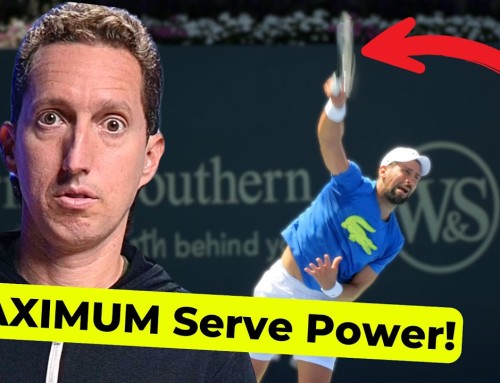
I just spent a few hours with a student who’s been playing tennis for 25 years. Twenty-five years. And in that time, she’s never once hit a serve with real power or spin.
Why?
Because she’s been stuck with a waiter tray serve her entire tennis life.
If you’ve never heard that term before, picture exactly what it sounds like: a waiter carrying a tray. Hand facing up, strings facing up, pushing the racket toward the ball like she’s serving you a drink instead of serving you an ace.
And here’s the crazy part — after just a few hours of drills, we transformed it. Completely.
I want to show you exactly how, because I promise you this isn’t about her suddenly getting stronger or more athletic in one afternoon. It’s about two very specific, very fixable problems.
Problem #1: No runway.
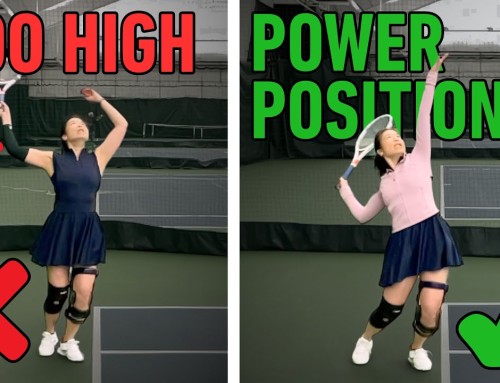
With her original serve, the tip of her racket barely dropped behind her back. That means she had almost no room to build acceleration before contact. Low range of motion equals low racket head speed. It’s just physics — you can’t generate speed you don’t have room to build.
Problem #2: No stretch, no release.
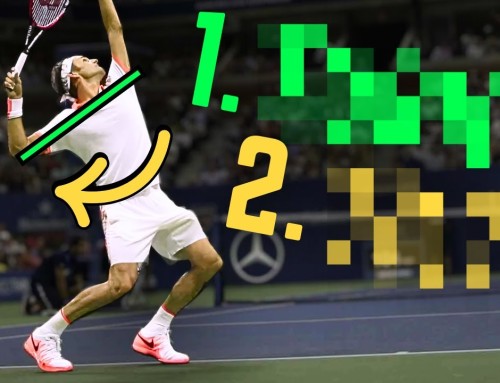
This is the real culprit behind every waiter tray serve. Watch any world-class player’s racket drop and you’ll notice something: the racket is “on edge,” not facing up. The tip falls well below the waist, the butt cap points to the sky, and the frame — not the strings — leads the way back up toward contact.
That position comes from a stretch in the shoulder. High-level players wind their hand and their shoulder like a rubber band, then release that stretch into the ball. That release is where the real power comes from — not the arm, not the wrist.
Think about a baseball pitcher or a quarterback like Patrick Mahomes. Watch either of them right before they release the ball — the hand and shoulder are stretched backward, loaded up, on edge. Then it all unwinds into the throw. Tennis is no different. If you’re stuck with a waiter tray serve, you’re skipping that entire loading phase.
So how did we fix it in a single session? Drastic measures — on purpose.
Drill 1: No racket. No ball.
I know, I know. You’ve been playing for years and you want to skip straight to hitting serves. Don’t. This drill is just about retraining the body to turn, drop the hand, and feel the stretch in the shoulder — gently, no forcing it, no going for “bonus points” on how far you can stretch. Just turn, drop, and feel it.
Drill 2: Connect the positions.
Now we link the turn-and-stretch position to the racket drop position — still no ball, still not swinging for real. We’re just building the pathway.
Drill 3: Add the racket, then a fake toss.
Once she could hit the position with a shadow swing every single time, I put the racket in her hand and had her move through it — still no ball. Then I added a fake toss off to the side, with instructions to just hit the same positions.
And this is where it got interesting.
The very moment a ball entered the picture — even a fake one she didn’t have to hit — her hand popped right back open. Racket face up. Waiter tray. Twenty-five years of habit kicked in the instant a ball showed up, even though nothing about the drill had actually changed.
That’s not a technique problem. That’s a habit problem. And it’s exactly why we don’t just hand someone a bucket of balls and tell them to “fix their serve” by repetition alone. You cannot brute-force your way out of a 25-year habit. You have to sneak up on it.
So we repeated the sequence — shadow swing, fake toss, shadow swing, fake toss — and every time the drop got shallow, I called it out immediately. Not close. Not yet. Again.
Slowly, the fake tosses started looking like the shadow swings. The tip of the racket kept dropping lower. The edge position kept showing up more often. She was starting to convince her old habit to sit down and be quiet.
Then came the moment of truth — her own toss, her own hit.
Her hand still opened up early. Old habits don’t disappear in one afternoon. But the racket dropped further than where she started, and something had clearly shifted.
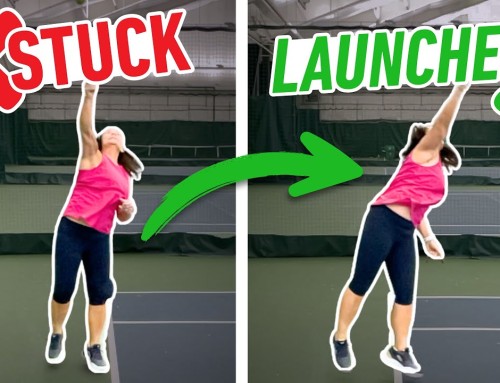
A few reps later, she hit one where the racket dropped low, turned on edge, loaded that shoulder stretch, and pulled up into contact completely differently than anything she’d done in 25 years. I was genuinely fired up watching it happen in real time.
That’s the breakthrough. Not a perfect serve landing in the box — that comes later, with time and repetition. The breakthrough is a body that finally knows how to move correctly, even if it doesn’t yet trust that movement under pressure.
If you’re fighting your own waiter tray serve, here’s what I want you to take from this: don’t add a ball until your shadow swing is automatic. Don’t judge yourself for reverting under pressure — that’s completely normal and it happens to every single player rebuilding an old habit. And don’t expect this to click in one session. Expect a lot of shadow swings. Expect a lot of fake tosses. Expect the process to feel slow before it feels fast.
Stick with it, and that runway and stretch will eventually become your new normal instead of your novelty.
Your Coach,
-Ian