I watched a student drive hard off his legs on his serve, load up, explode upward, put in real effort… and it was actively hurting his results.
Not helping. Hurting.
The problem wasn’t that he wasn’t using his legs. The problem was his leg drive timing was off, and once you understand why, you’re going to want to go check your own serve immediately.
Let me show you the analysis, because I think this is one of the coolest breakdowns I’ve ever done on this channel.
I paused the video the instant Novak Djokovic’s feet leave the court on his serve and started a timer. He’s in the air for 1.36 seconds total before touching back down. Now here’s the key number: at the moment he actually makes contact with the ball, only about half a second has elapsed. That means contact happens while he’s still less than halfway through his time in the air. He’s hitting the ball on the way up — still actively driving upward — and doesn’t touch back down until well after contact.
I ran the exact same analysis on Iga Świątek. She’s in the air for 1.4 seconds, remarkably similar to Novak. And at contact? Less than half a second has elapsed — again, significantly less than half her total flight time. Same story. She’s driving upward, hitting the ball while still ascending, then coming back down afterward.
This is the leg drive timing that every elite server shares, and it matters for a very specific physics reason. The serve needs energy transferred in two directions: forward, and up. The upward push matters because of simple geometry — you’d need to contact the ball from about 9 feet off the court to clear the net without any lift at all. Nobody’s that tall. So that upward leg drive is what generates the lift needed to clear the net and still bring the ball back down into the box.
Now here’s my student, same exact analysis.
He’s in the air for 0.26 seconds — much shorter than Novak or Iga, which is its own clue. But here’s the number that matters most: at contact, he’s basically already touched back down. Contact happens right as, or just after, he lands.
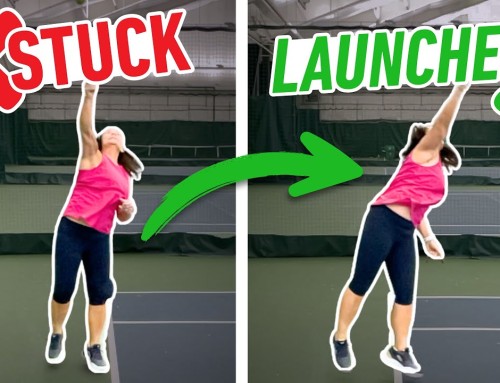
Watch his head relative to a fixed point on the fence behind him during the swing and you’ll see it immediately: up, up, up… and then down, down, down — and only then does he make contact with the ball. His leg drive timing has him hitting the ball while his whole body is already falling back toward the earth.
That’s a serious problem. He’s not just contacting the ball from a lower point physically — his momentum is actively working against him, pulling the ball’s trajectory downward at the exact moment he needs lift and clearance over the net. Stack a lower contact point on top of downward momentum, and you’ve made an already-difficult shot dramatically harder than it needs to be.
So what’s actually causing this leg drive timing problem? It’s not that he’s loading wrong or driving wrong. It’s a mismatch between when his legs are pushing and where the ball actually is in space.
Here’s what was happening: he drives up toward the peak of his jump, but the ball isn’t in reach yet at that peak — it’s still too high, too far away. So he ends up on the back half of the push, already descending, by the time the ball finally arrives.
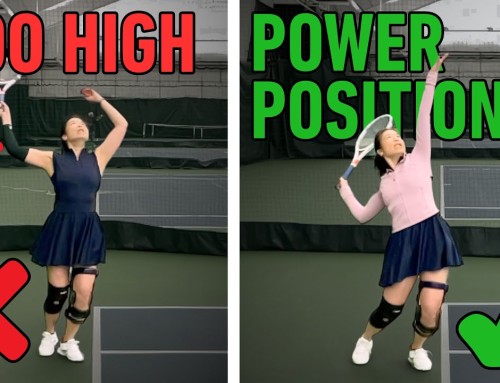
The fix isn’t complicated. Take some height out of the toss.
We didn’t touch his rhythm or his tempo. We just brought the toss down — from sailing almost out of frame above a fence line marker down to only about a foot above it. That’s it.
We reran the exact same stopwatch analysis after that change. Same total time in the air, 0.25 seconds. But this time, contact happened at just 0.1 seconds in — meaning he was still very early in his ascent, still actively driving upward, when he hit the ball. Watch his head this time: up, up, up, contact, then down. His leg drive timing finally matched where the ball actually was.
That one change means he’s now hitting from a higher point and with momentum actively helping him upward into contact — instead of fighting gravity and his own toss at the same time.
If your legs feel like they’re working hard on your serve but your results don’t match the effort, don’t assume you need more explosiveness or a bigger jump. Check your leg drive timing against your toss height first. If your toss is placing the ball above where your body actually peaks, your legs will always arrive at the party too late — and no amount of extra drive is going to fix that.
Get that timing to line up, and your serve gets easier, not harder, even though you’re doing less.
Your Coach,
-Ian