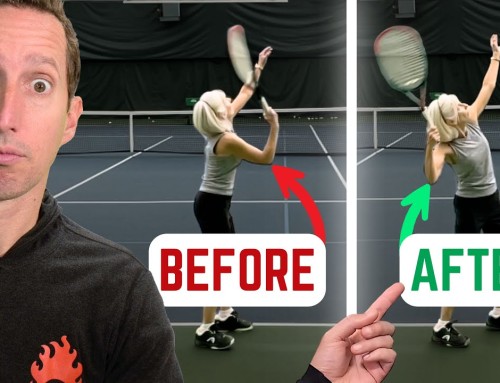
The worst habit in tennis…
I recently worked with a student whose second serve had a problem I see all the time. The ball flew in a straight line, made a flat pop sound off his strings, and landed with almost no safety margin. No curve, no dip, no bend. Just flat, fast, and risky.
After a few minutes working on the drills I’m about to show you, that same serve started curving into the box with a completely different sound. A click instead of a pop. That difference right there is serve spin, and it’s the single thing separating players who serve with confidence from players who serve while holding their breath.
Here’s why this matters so much. The curve created by spinning the ball gives you safety over the net and inside the lines, without ever needing to slow your swing down or hit tentatively. Every high level player relies on serve spin for their second serves, and most use it heavily on their first serves too.
So why don’t most players have it? It comes down to three things all pointing in the same direction, when they need to be pointing in three different directions.
Watch a great kick serve and you’ll notice the body is facing sideways, not toward the target. The racket path swings out to the side, almost along the baseline, not forward into the box. But the strings? The strings are still facing the box. Body sideways, swing sideways, strings forward. That combination is the entire secret.
Now compare that to what most players do. Their body faces the target. Their racket swings straight toward the target. Their strings face the target. Everything lines up in one direction, which feels natural and correct… and it’s exactly why the ball comes out flat every time. When your racket path and your racket face point the same way, you physically cannot create serve spin. It’s not about trying harder or swinging faster. It’s about geometry.
Think of it like slicing an apple. You wouldn’t press the flat face of the knife against it and expect a clean cut. You’d use the edge. A tennis racket works the same way. Meeting the ball squarely with the face of the racket will never produce real serve spin. You have to attack the back of the ball on edge, letting the racket travel past it rather than straight through it.
That’s exactly why we start with something that feels strange at first: shadow swinging sideways, out along the service line, instead of forward toward the box. It’s an exaggerated feeling on purpose, meant to break the habit of swinging everything toward the target.
From there we move to what I call hatchet throws. The student tosses the racket sideways a few times just to feel that direction, then tosses a ball and swings past it on that same sideways path, without changing the angle of his strings. Listen for the sound.
A real click means the strings are grabbing the ball, shifting, and snapping back into place. You cannot fake that sound. If you don’t hear the click, you haven’t created real serve spin yet, no matter how the swing looked.
The trickiest part comes next. Once players learn to face sideways and swing sideways, their instinct is to also turn their hand and strings sideways along with everything else. That sends the ball flying off to the side instead of into the box.
Learning to keep your body facing one way, your swing path traveling another way, and your strings facing a third way, toward the target, is genuinely the hardest part of building real serve spin. It’s also the part that changes everything once it clicks.
From here, it’s just about reps. Full motion hatchet throws from the service line, then from no-man’s land, then finally from the baseline, always keeping that same combination intact.
If your serve has always felt like a coin flip between too flat and too risky, this is your answer. It’s not about muscling the ball harder. It’s about learning to separate your body, your swing, and your strings into three different directions until real serve spin becomes automatic.
If you know a player who’s been fighting flat, error-prone serves for years, send this their way. Sometimes the fix isn’t more effort, it’s a completely different feeling to chase.
Thanks for reading, and I’ll see you on the court.
Your Coach,
Ian