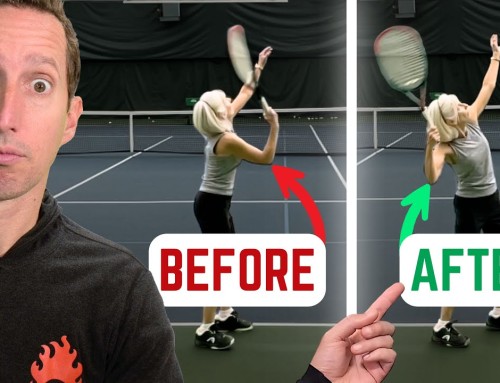
I want to walk you through the exact explosive drill for serve power that took one of my students from hitting with her upper body alone to unlocking her entire kinetic chain in just a few minutes of work together.
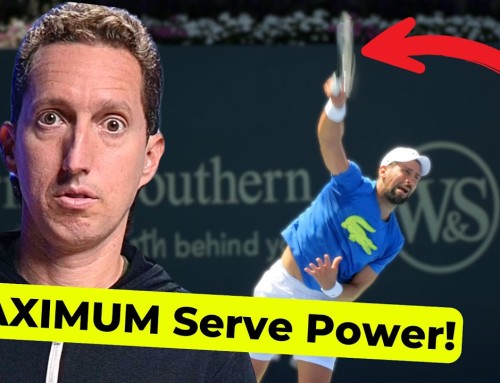
Before we get to the drills, let’s look at how the best players in the world store and release energy through their lower body. Watch Novak Djokovic get into his trophy pose, and pay attention to his legs.
At his deepest point, his front leg is bent to about 90 degrees at the knee, and his back leg is bent a little less than that — typical for a platform stance where the feet stay spread apart.
From that loaded position, timing matters enormously: right as the racket falls into the drop, his legs start driving against the court. That drive creates additional stretch through the shoulder and kicks off the unwinding of his entire body toward contact.
He actually leaves the court with both feet, then lands on his front foot — and that front foot lands at least a solid foot inside the baseline. That’s not incidental.
It shows he’s not just driving upward; he’s propelling all of that force and energy forward, toward his target, through the point of contact.
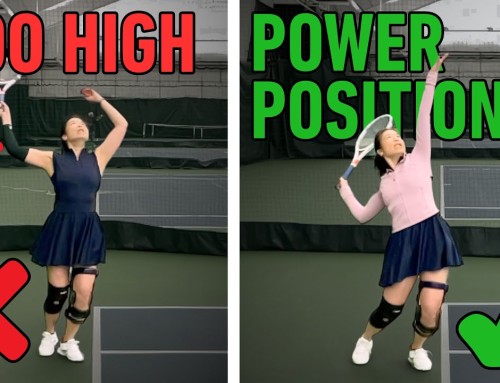
Now compare that to where my student started. Even in her casual standing position before she began her motion, there was no meaningful bend in her legs. And when she moved into her trophy pose, nothing changed — she was, essentially, just standing there.
The interesting part is that her upper body mechanics were already excellent.
Great racket drop, racket on edge behind her, butt cap pointed toward contact, smooth rotation all the way through the swing. All of her training up to that point had clearly focused on the upper body — which, to be fair, is the harder skill and the bigger lever to develop.
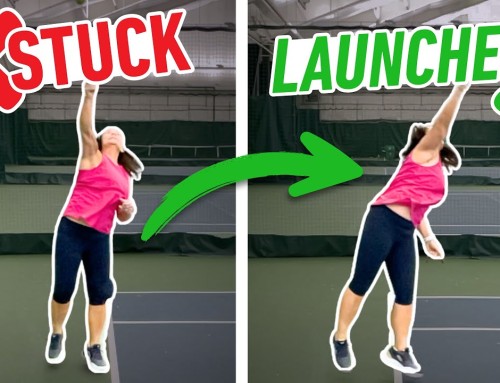
But it also meant she was leaving an enormous amount of power on the table by leaving her lower body completely passive. No knee bend, no upward drive during the racket drop, no leaving the court with both feet, and as a result, no landing inside the baseline.
All of that missing lower-body engagement meant she wasn’t getting the extra stretch, range of motion, or forward force that the pros generate.
So here’s the explosive drill for serve power we used to fix it, step by step.
First, I simply demonstrated the movement — driving off the court and landing with the front foot inside the baseline — and had her shadow it. She technically checked the box, leaving the court by an inch or two, but there wasn’t much intensity or strength behind it.
This is common.
Plenty of players are on the right track and just need a bigger push to actually feel the difference, rather than just going through the motion.
That’s where the real drill came in.
I placed a small plastic line on the court, roughly three to three and a half feet inside the baseline, and asked her to stand with her toes behind the baseline and broad jump clear past that line — a simple standing long jump, nothing tennis-specific about it.
On her very first attempt, she showed noticeably more force and intensity than anything we’d seen with her serve motion. After a few more jumps, she started engaging her entire body, pushing herself to clear that line consistently.
She even had a couple of false starts along the way, which is completely normal — this kind of total-body, explosive loading is genuinely demanding.
By the time she cleared the line, she was visibly winded, and she told me she couldn’t believe how high her heart rate had climbed.
That’s the point: she wasn’t used to loading, storing, and releasing her whole body with that kind of intensity all at once.
This is worth sitting with for a second — if you want to genuinely level up your serve, your whole body has to be engaged, in the right order, at the right time.
It takes real effort.
Anyone promising a shortcut to a huge serve without that kind of full-body coordination isn’t being straight with you.
If you’re already hitting serves in the 90 mph range, sure, there might be some polish left to find.
But if you’re currently in the 30–40 mph range, the real work is learning to coordinate your entire body together — which is exactly what this drill teaches.
After a solid long jump, we moved to drill three: shadow swinging while trying to clear that same yellow line with her front foot during the actual service motion.
Where she’d previously struggled just to get her foot past the baseline at all, her very first attempt after the long jumps had her clearing the line by a full extra foot.
To be clear, there’s no special benefit to jumping further than necessary — the point was simply to teach her body that it’s capable of storing and releasing far more force through the legs than she’d ever asked of it.
Finally, we moved to live hits using that same coordination. The difference was immediate and dramatic. Where her legs previously showed just a slight, casual bend, she was now getting close to a full 90-degree bend and actually using that stored energy to drive upward through contact.
One of the most striking results: her contact point rose noticeably — by roughly three to four inches — simply from driving up off the court instead of just reaching upward with her arm.
That extra height at contact is a massive geometric advantage for clearing the net and hitting the box with more margin, on top of all the added forward energy now transferring toward her target.
Add it all together — the extra stretch, the added racket head speed, the higher contact point, and the forward drive through the ball — and you get a serve that’s dramatically stronger, more athletic, and more confident, all from a lower body that used to sit there passively.
Your Coach,
-Ian