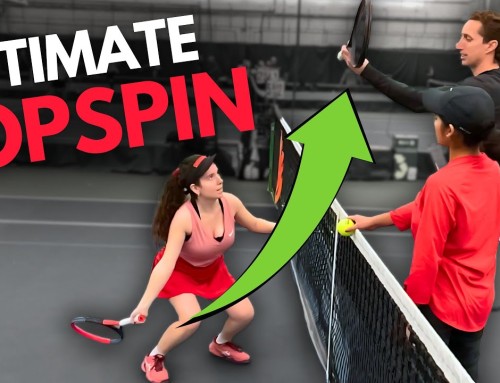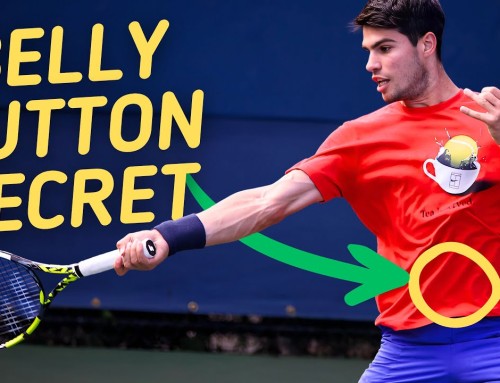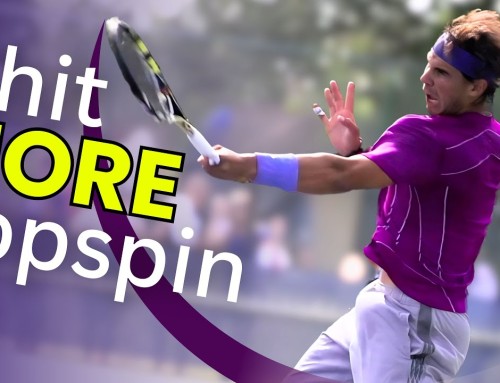
You think you’re hitting topspin, but you’re probably not.
And here’s the thing: it’s not just you.
Most tennis players don’t generate nearly enough spin to actually curve the ball for safety, confidence, or offense.
Want proof?
Watch enough club players swing and you’ll see moves that look like topspin, feel like topspin, but are all missing one critical thing.
The one element that actually makes the ball rotate forward, end over end.
Here’s the phrase that explains it: the face sends it, the path bends it.
Let’s dig into what that actually means.
The ball only touches your strings for about four thousandths of a second.
In that tiny window, wherever your strings are facing determines the ball’s starting direction.
Strings open and facing up sends the ball upward.
Strings facing forward sends it forward and down.
But direction isn’t the same as spin.
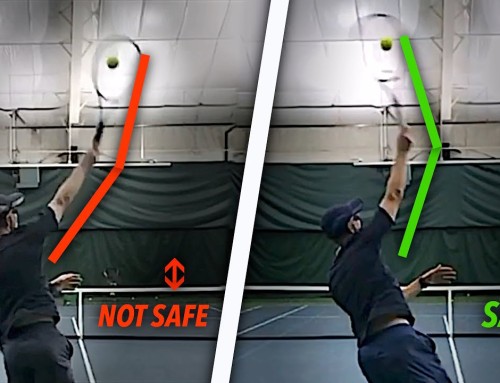
The path of your racket, as the ball touches the strings, is what determines the type and amount of rotation.
Racket traveling upward at contact rolls the ball forward, end over end. That’s topspin.
Racket traveling downward flips it the other way. That’s slice.
Racket traveling flat and level produces a flat, direct shot with almost no curve at all.
The steeper and faster that upward path is, the more forward rotation the ball gets.
Take a look at Jannik Sinner’s forehand, one of the biggest in the world right now.
Mark the point of contact. Then go back to the lowest point of his swing, right before it starts rising toward the ball.
Measure that angle, and you’ll find roughly 22 degrees of upward slope.
That’s what rolls the ball forward hard enough to let him aim higher over the net, swing harder, and still bring the ball down safely inside the lines.
Now compare that to the everyday player.
Same process. Mark contact. Find the low point of the swing.
Connect the dots, and you get about a 6 degree incline.
That’s nowhere near steep enough to create real forward roll.
It’s basically a flat, square hit with almost no meaningful curve.
Here’s what makes this so deceiving, though.
Look at the follow-through. Low to high. Finishing up over the shoulder.
That’s exactly what you’ve been told topspin looks like, right?
Except all of that upward motion happens after the ball has already left the strings.
Once contact is made, the ball is gone. Nothing that happens afterward changes its spin.
What actually matters is the path from the bottom of the swing to the point of contact. Nothing after that counts.
Here’s a second example.
Slightly steeper than the first, but still barely an upward slope.
Enough to roll the ball forward a little, but nowhere near enough to produce real, game-changing curve.
And a third example, where the player flips the racket over dramatically after contact.
A classic windshield wiper motion, exactly what so many players are told to do to create spin.
Except that flip happens after the ball has already left the strings too.
It feels like you’re massaging the ball forward. It looks satisfying in slow motion.
But it isn’t producing any additional spin at all.
You’ve probably heard the same cues over and over.
Brush up the back of the ball. Flick your wrist. Finish over your shoulder. Turn the doorknob.
Some of those cues are technically accurate, but if you’ve swung mostly flat for years, they only nudge your path slightly. Not nearly enough.
Others, like flicking your wrist or the windshield wiper cue, don’t work at all.
They just bolt extra motion onto the end of your swing without ever changing the actual path of your racket.
What you actually need is a completely different swing path. Likely double or triple the angle you’re currently using.
Now here’s the encouraging part.
You don’t need Jannik Sinner’s game to pull this off.
These next examples are everyday players I’ve worked with recently.
Look at how different their swings look. More confident. Faster. More aggressive.
You’ll see the windshield wiper. You’ll see the shoulder finish. You’ll see the low-to-high motion.
But none of that was bolted on because a coach told them to do it.
The actual path of the racket changed first, and everything else followed naturally.
Player one’s angle of attack toward the ball is actually steeper than Sinner’s.
That steep path is exactly what creates real curve and bend, bringing the ball back down safely inside the court.
Player two shows the same pattern. A steep upward attack that naturally carries the racket up over the shoulder.
He’s not finishing high because someone told him to. It’s simply the natural result of that steep path.
Player three has the steepest angle of the group, which is why his racket rolls over so aggressively after contact.
The windshield wiper isn’t the cause of his topspin. It’s the natural byproduct of it.
So here’s the real formula if you want serious topspin.
Step one: drop your racket lower than you think you need to, well below the point of contact, before swinging upward.
Step two: swing upward steeply, confidently, and aggressively. Steeper than feels natural at first.
Step three: as your swing path gets more vertical, you’ll likely need to close your strings slightly, tilting them down a bit more than your current flat swing path.
Skip that adjustment and the ball will probably sail long.
Here’s your challenge.
Set your phone up to the side and film your own forehand.
Pause right at contact. Go back and check the angle of your swing leading into that point.
If your path looks closer to flat than to a 45 degree angle, there’s real work to do here.
Do that work, and you’ll finally start hitting topspin the ball actually needs to curve, land safely, and let you swing with real aggression.
Good luck out there.
Your Coach,
-Ian