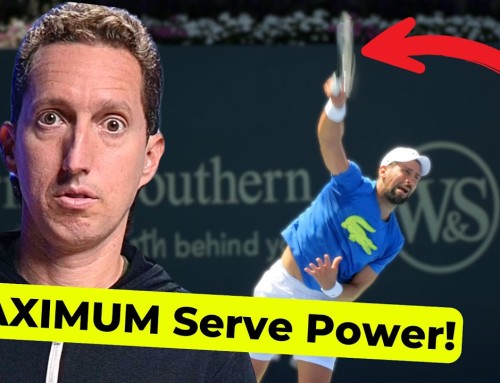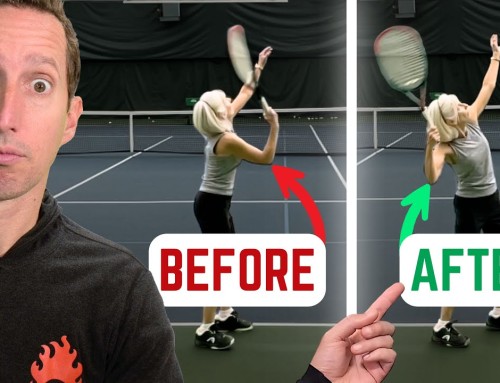
Federer’s effortless power on the serve comes from one place most players completely overlook.
Last lesson, we talked about how pros like Federer use their torso as the main power source on every shot.
The comments exploded with players asking for serve-specific drills to fix this.
So today, I’m walking you through exactly how to build real, full-body power on the most important shot in tennis.
Here’s the actual problem we’re solving.
Most players think they’re engaging the big, strong parts of their body on the serve.
The reality is, they’re not.
Millions of players are doing almost all the work with their arms, without even realizing it.
Let me show you exactly what that looks like.
Here’s Roger Federer in his trophy pose, right next to an everyday player.
A proper trophy pose comes down to two torso movements.
The first is a turn.
The camera sits directly behind Roger, but you can still see the entire front of his chest and the writing on his shirt.
The second is a tilt.
Notice how vertical the angle of his shoulders becomes.
That’s because a serve isn’t like a groundstroke, where force transfers mostly horizontally.
Contact happens high above the body, so the torso has to turn back and then tilt upward to deliver that energy vertically.
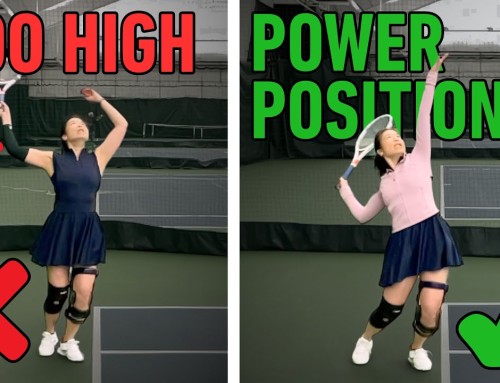
Now look at the everyday player.
No turn. No tilt.
Shoulders level. Hips level. His body never rotates back toward the camera at all.
By the time he reaches contact, his body angle actually looks fairly similar to Roger’s.
But he got there using a fraction of the force, because the biggest, strongest parts of his body were never loaded in the first place.
Here’s a lineup of other everyday trophy poses.
No turn, no tilt. No turn, no tilt. No turn, no tilt.
One shows a little turn, but still no tilt.
This is exactly where power disappears for most players.
Once the torso fails to load properly, the arm takes over, trying to recreate all the fancy swoops and angles manually.
That’s what produces those jerky, clunky, forced-looking service motions you see at nearly every local court.
Most players are swinging the racket with their arm, independent of their body.
The best players are swinging with their body, which lets their arm stay loose, relaxed, and fluid.
So before the drills, ask yourself honestly: do you turn? Do you tilt? And how would you even know?
Now let’s fix it.
Drill one: the helicopter drill.
This links your arms to your torso so your body can properly load and align before the swing even starts.
Phase one has two parts.
First, turn your body back about 45 degrees, with your arms locked to your torso the entire time. This rotation stores huge amounts of energy in the strongest parts of your body.
Second, tilt about 45 degrees. If you’re right-handed, your right elbow drops while your left elbow rises.
This turn-and-tilt transition is what actually stores smooth, powerful energy correctly.
Phase two of this drill is unwinding from that turned, tilted position back into a contact position.
This will feel stiff and unfamiliar at first, especially if you’ve never turned or tilted on your serve before.
Notice the unwind happens on an angle, not horizontally like a groundstroke. You’re pitching the body upward toward that high contact point.
This single movement is the engine behind every smooth, powerful serve.
Drill two: slow shadow swings.
Once the helicopter drill feels familiar, practice getting your body turned and angled correctly, then let your arms relax and simply come along for the ride as you unwind.
Compare the trophy pose from this drill to an original, untrained serve side by side.
The difference is dramatic. Far more athletic, far more strength stored in the position.
And notice, none of this involved coaching the hips or the knees directly.
They naturally fall into place once the torso is turning and tilting correctly.
Drill three: fake tosses.
Add a shadow swing while a ball gets tossed into the air nearby, purely to build timing between the new body-led motion and the arm.
Then progress to tossing the ball yourself during your own shadow swing, without hitting it.
This matters because the arm, now relaxed and passive, needs new timing entirely.
Before, the arm was doing all sorts of independent movement while the body stayed locked. Now it has to learn to follow a completely different rhythm.
Fake tosses create a stepping stone, so you’re not jumping straight from drills to a live serve with zero preparation.
Drill four: hit the ball.
By this point, you’ve layered slow shadow swings, tossed-ball practice, and self-toss repetitions before ever making contact for real.
Watch for the body leading the motion. Watch the shoulder and torso angle. Watch for smoothness and fluidity through the arm and racket.
Compare that to an original serve, full of clunky starts and stops, choppy racket movement, forced pronation.
That roughness exists because the body never reached a turned or tilted position, so the arm had to manufacture every movement manually.
Even if that original serve technically reached a decent racket drop position, the efficiency behind it was poor, because it wasn’t connected to the one thing that actually matters: the torso.
Follow these same four drills yourself, and you’ll start unlocking real, effortless power on your serve.
Your Coach,
-Ian