When you go for power, does the ball hit the back fence or bury into the net?
Most players never actually learn how to hit hard and stay consistent at the same time.
One of my students just did, and I’m about to show you exactly how.
Last video, you learned why copying Jannik Sinner’s forehand leads to erratic, inconsistent tennis.
The core issue was a huge transition in racket face angle that requires nearly perfect timing.
Without realizing it, everyday players build that same complication into their own swings, just like this student did.
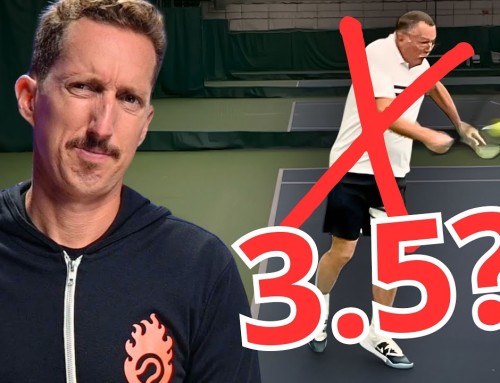
Here’s my student before we trained together, hitting some evaluation forehands.
Listen for the frustration.
One ball launches way too far. The next buries dead center into the net. Another goes into the net again.
Eventually he just gives up, takes his foot off the gas, and starts babying the ball in play.
Same story over in the opposite corner. Middle of the net, launched too far, occasionally a great shot, with almost no margin over the top of the net.
That’s not a formula for success.
Here’s why all that volatility exists.
It comes down to the angle of his racket face.
On the takeback, his strings sit wide open, angled upward.
Hit the ball straight from that position and it launches way too high, way too far.
So somewhere between takeback and contact, he has to flip and close that racket face at the last possible second.
Depending on exactly when he makes contact during that flip, the ball could genuinely go anywhere.
From the back camera, it’s even clearer. His strings start more than 45 degrees open toward the ceiling.
By contact, he’s forced to flip them all the way closed, facing straight down at the court.
Wide open to fully closed, with everything in between happening in a split second.
Let me show you how much this one detail actually matters.
Here are two shots. One clears the net with height and curves safely into the court. The other buries straight into the net.
The ball in the net came from a racket face slightly closed at contact.
The ball that cleared safely came from a racket face slightly open at contact.
That’s the entire difference, just a couple of degrees, between a ball landing in the net and a ball clearing by a healthy margin.
This is exactly why that big open-to-closed transition becomes so dangerous once you start swinging aggressively.
You’ve probably heard the common advice that your racket face should be slightly closed for topspin.
At a recreational level, that’s too closed.
We simply don’t generate anywhere near pro-level racket head speed.
For everyday players, a slightly open racket face at contact is what actually gives you height over the net, and combined with the right swing path, lets you curve the ball back down safely while still swinging aggressively.
The name of the game is doing that consistently, over and over.
So here’s the training I used with this student to hit hard without spraying the ball everywhere.
First, shadow swings, starting with the racket face closed instead of open, then maintaining that same angle all the way through to a square position at contact.
Normally I’d also recommend adjusting his grip long term, but he had a major tournament the following week, so we worked within what he already had.
Here are his first reps, starting closed and carrying that same angle forward.
Notice the racket opens slightly more at actual contact than during the shadow swings, but critically, he’s no longer starting from strings facing the ceiling.
That eliminates the big, unpredictable flip entirely.
Drill two moved him back to no-man’s-land, raising the intensity slightly.
Watch the racket face through setup and into contact now. No more flipping back and forth.
He starts reliably curving the ball with real margin for error, something his old swing never had.
Because he’s no longer forced to time a perfect flip, he can finally drop the racket lower with confidence before accelerating up into contact.
Here he is now hitting full shots from the baseline.
Racket taken back square or slightly closed, then dropped and accelerated upward from there.
Clean. Simple. No more big flip.
This single change is what opens the door to real trust, real confidence, and real acceleration without losing control.
Watch this shot compared to his earlier ones.
Height over the net, landing well inside the baseline.
None of his previous high shots had any real chance of landing in. Now he’s clearing the net by four or five feet and still landing safely inside the court.
That freedom only exists because his racket face finally starts closed instead of wide open, giving him room to drop and accelerate without blowing up his timing.
Watch these back-to-back swings. Watch the shape on the ball. Watch the net clearance.
He’s swinging with real confidence now, and the ball is curving and dipping back down into the court every time.
This is the exact shift I want you to make in your own game.
If you’re currently starting with an open racket face, this change is worth making.
And notice, none of this required changing his grip to get these results.
Your Coach,
-Ian