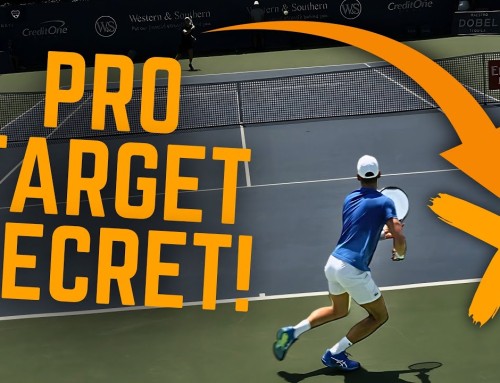
Fixing your ball tracking in tennis starts with understanding why “watch the ball” has never worked for you.
You’ve heard it thousands of times from coaches, friends, and even yourself.
Honestly, it has never solved the problem.
That’s because the problem isn’t what you know or what you can remember.
It’s what your body has been trained to do.
Until you retrain it, every reminder to watch the ball is just noise.
Last lesson, I showed you that even very experienced players don’t follow the ball all the way into contact.
Today, I’m showing you how to fix it step by step.
First, let’s talk about how not to change a habit, in tennis or anywhere else.
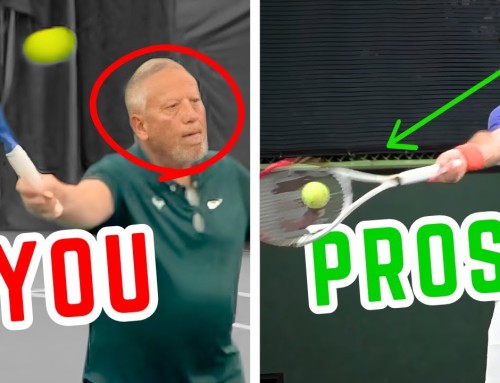
I recently sat down with the student from the previous lesson and showed him on the iPad that he was shanking easy forehand volleys.
His face was in a completely different place from the contact point.
Then I stepped in to demonstrate the right movement.
My face turned one way while my racket went another and the ball went somewhere else.
I exaggerated it on purpose, so he would exaggerate it too, keeping his eyes on the point of contact.
Then I said, “Your turn.”
On the very first feed after my demonstration, he repeated the exact same old habit.
Does that sound familiar?
Maybe your coach has told you what you were doing, demonstrated the fix, fed you more balls, and said, “Okay, your turn.”
Then the coach says, “No, that’s not it.”
Or maybe you got it right a few times, but a week later you were back to your old habit.
That’s normal, because habits are deeply ingrained.
I gave him feedback, paused the ball machine, and explained what was happening.
He kept falling back on the old pattern.
That’s because habits only change when you break the work into bite-sized chunks.
To give him credit, after several tries his eyes started shifting toward the side.
He was getting closer, but the real breakthrough came from the drills below.
Drill one: underhand tosses from close range.
This is the first step of your plan, and it worked for this student on the morning of day two.
I stood about three steps from the net on the other side, and he stood three steps from the net on his side.
I tossed the ball underhand, so it moved slowly with plenty of arc.
That makes it dramatically easier, which is the whole point.
His earlier practice used a ball machine at about 40 or 50 miles an hour.
If your eyes and face haven’t been trained to follow the ball into contact, that pace happens too fast.
You need to lighten the load so your brain and body can escape the rut.
There are two parts to this drill.
Part one is physically tracking the ball by turning your face and looking down your arm.
Part two is the hardest: leave your face at the contact point for a count of two.
He did a great job tracking the ball in, and then I watched his face leave with the ball.
This is the toughest part of the entire process.
Our brains badly want to know where the ball is going and whether it will stay in.
They want to know if the opponent will reach it and what happens next.
Brains are built for stories, and we want the ending of every shot.
Resisting that takes total concentration, which is why almost nobody has ever built this habit.
It takes time, discipline, and repetition.
Even tracking the ball into the racket is hard, but holding your face there like Federer or Alcaraz is harder.
After the feedback, the next ball was the first time in this player’s life that he tracked it in, made high-quality contact, and held his face there.
If you’ve watched slow-motion highlights of your favorite players for years, you know how satisfying that is.
You’ll also start to sense how difficult it really is.
No partner for soft tosses?
Use a ball machine, set the speed to the minimum, and raise the height to roughly the maximum.
That approximates an easy underhand toss.
Drill two: feed from farther back.
Now we make it slightly more realistic.
I backed up into no-man’s-land with a racket and fed the ball off the strings.
The ball travels farther and I have to hit it faster, which makes tracking harder.
The curiosity pull is stronger too, especially when the shot angles crosscourt.
Many of his shots went off to the side, which adds extra difficulty.
Keeping your face in one direction while the ball goes the other way is simple on paper and hard in reality.
That’s why we use small stepping stones between the easiest rep and a real match shot.
Drill three: back to the ball machine.
This is the same feed, speed, and distance he had been failing on over and over.
Now he tracks the ball into contact and leaves his face there.
The reps aren’t all the same quality, but they all move in the right direction.
From here, it’s repetition using these progressions.
If you feel overwhelmed on a real feed or in a rally, step back to softer, slower, closer feeds.
Build your precision, then climb again.
Habits don’t vanish because you want them to, watched a video once, or read a book.
New neurological pathways take exposure, time, and repeated reps of the right movement.
That’s why these stepping stones are necessary.
It doesn’t matter whether you’re overhauling your serve grip or simply working on ball tracking in tennis.
Every habit change is hard.
Treat it with respect, bring discipline, and you can improve any part of your game.
Keep up the great work, and I’ll talk to you again soon.
Your Coach,
-Ian