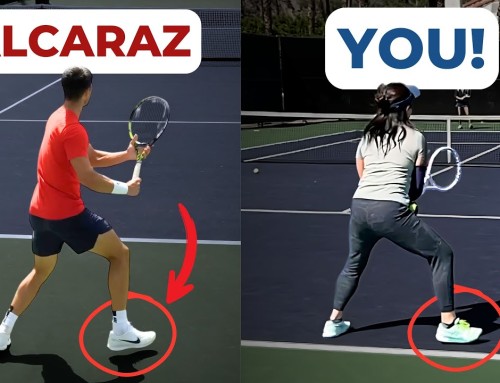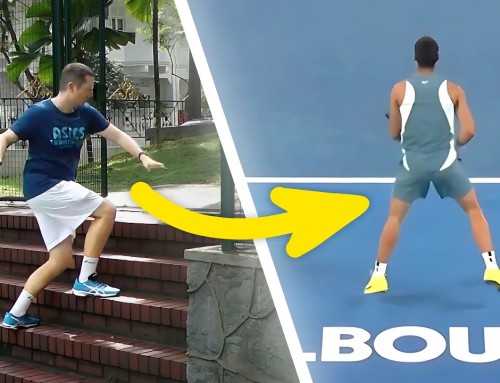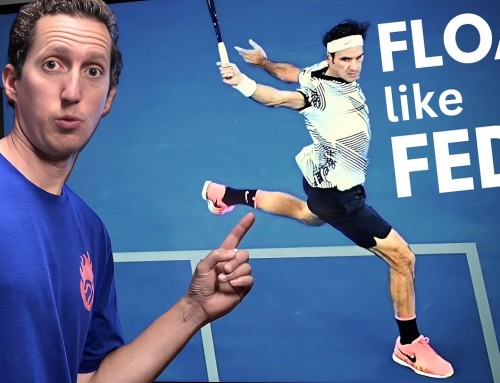
Your split step timing is almost certainly off, and it’s not your fault.
You’ve been given bad information about this move for years.
That’s why it feels clunky, awkward, and useless when you try it.
So you throw it out, assuming it just doesn’t work.
Let me prove otherwise.
Watch the pros split step and you’ll see something flowing, smooth, and graceful, almost like a dancer.
There’s a seamless transition between lifting off the court and moving to the next ball.
No wasted time. No stutter.
Now watch a 4.0 player try the same thing.
It’s abrupt, jerky, stop and start, and unathletic.
Most recreational players don’t even attempt a split step, which is worse.
At least this player is trying, but he’s working from bad information.
Here’s the lie.
Nearly every coach will tell you to time your split step so both feet hit the ground the instant your opponent makes contact with the ball.
Sounds logical, right?
It’s dead wrong.
Watch Jannik Sinner getting ready to return serve during point play.
Freeze the video right as he lifts off the court.
Now look at his opponent, who is just about to strike the ball.
Sinner has all this time to float in the air before his right foot pivots and he flows toward the ball.
Here’s another point on the deuce side.
Sinner lifts off, and his opponent has already hit the ball.
This time his left foot pivots, and he flows out to the left for a backhand.
On the WTA side, Aryna Sabalenka does exactly the same thing.
She lifts into the air, and the ball has already left her opponent’s racket.
Her outside foot pivots seamlessly and she’s ready for a forehand.
On another return, she leaves the court, the ball is already struck, and her left foot pivots to flow out for a backhand.
Neither player is landing when the ball gets hit.
In some cases, they haven’t even left the ground yet.
So why would the best players in the world spend time in the air after the ball has already been struck?
Here’s the answer.
It takes a human about a quarter to a third of a second to see the ball, process it, and react physically.
If your feet are already planted when your opponent makes contact, you’re dead in the water.
Your momentum screeches to a halt, and you start again from zero once your brain figures out where the ball is going.
Imagine I toss a tennis ball to either your right or left side for you to catch.
Your body wouldn’t respond instantly, because there’s a built-in delay.
In tennis, using that delay intelligently is the difference between clunky and slow, or flowing and fast.
That’s why good split step timing matters so much.
So how do you fix it?
Step one: check whether your timing is early.
You can tell by feel.
If your split step feels jerky or jarring, or both feet land flat on the court at the same time, you’ve killed your momentum.
You’re already behind for the next shot.
Compare that to the pros.
Their feet are never both flat on the court at the same time.
Their split step is timed later, so just before they land, they already know where the ball is going.
Then they slingshot their energy straight toward the next shot.
That’s why they look smooth and explosive while everyday players look stuck.
Here’s the good news.
This isn’t just for pros.
I recently worked with everyday players, and a few minutes of adjusting their timing made their movement smoother, more natural, and more athletic.
Here’s what one student looked like before any timing work.
Congratulations to him for even attempting a split step.
His feet touch down just as the ball leaves my racket.
It will take a quarter to a third of a second before he knows where the ball is going.
So his feet fully settle on the court, then he has to re-engage, lift his left foot, and pivot for a backhand return.
The pros do all of that in one fluid movement.
Now look at the difference after the adjustment.
I hit the ball, and he’s lifting into the air, watching and reading it.
Then his right foot pivots and he moves smoothly in that direction, with no dead time.
On the next ball, he lifts, reads where it’s going, and his left foot pivots as he moves out to his left for a backhand.
This player didn’t get fitter, faster, or younger.
He simply stopped following the lie and followed simple training exercises instead.
So next time you’re on court, ask yourself a question.
Does my split step feel like a flowing launch toward the ball, or a clunky stop and start?
If you want the exact step-by-step method I used to retrain the split step so it finally feels natural, tell me in the comments.
If enough people ask, it becomes my very next lesson.
Have you ever been told to land your split step when your opponent hits the ball?
I’m curious how many players were fed this bad information, so let me know below.
Your Coach,
-Ian