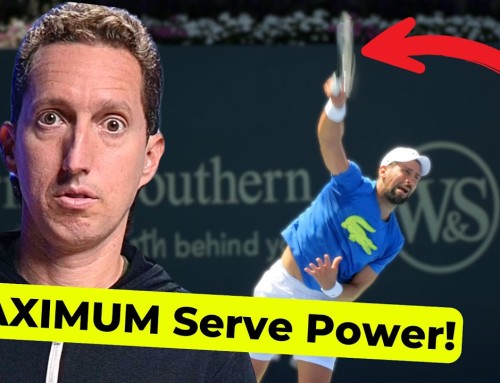
I recently worked with a solid 4.0 level student who had everything going for him. Great service motion. Great athlete. He could even crank flat serves at 100 miles per hour.
But his second serve had zero topspin. None.
With one simple exercise, he was able to unlock his first ever topspin serves. I’ll share exactly what we did in just a moment. But first, you need to understand what we’re actually trying to achieve — and why it matters so much.
When Djokovic hits a kick serve, watch what the ball does. It curves down into the service box with margin to spare over the net, and then it bounces up so high that even a six-foot-five opponent is jumping and hitting the ball at shoulder height. That combination of safety on the way in and stress on the other end is an incredibly powerful weapon. And it all comes from topspin.
Here’s how spin is actually created on any tennis shot.
Spin happens when the racket accelerates past the back of the ball in a specific direction. Swing upward past the back of the ball — that’s topspin. Swing across it from high to low — that’s backspin or slice. On a kick serve for a right-handed player, the racket needs to be accelerating upward and out to the right simultaneously. It’s a combination of topspin and sidespin, and it’s that exact combination that produces the curve and the high bounce.
So what was my student doing wrong? It’s the same kick serve topspin fix that most players need when they come to me with this problem.
When I looked at his contact point, his racket was almost completely vertical at the moment he hit the ball. Straight up and down. That means all of his racket’s momentum was traveling left to right across the back of the ball — which creates sidespin, not topspin. No curve on the way in. No high bounce on the other side. Just a flat, spinless serve that left him vulnerable on every second serve.
Here’s where it gets interesting — and a little counterintuitive.
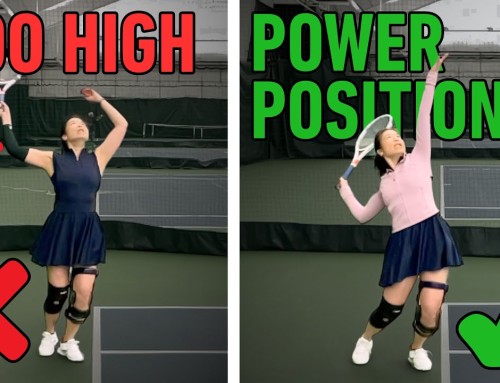
He was actually doing two things that most coaches recommend and that you’ll find all over the internet. He was meeting the ball right at the peak of the toss before it could drop, and he was reaching up as high as possible to make contact at the highest point he could. Both of those sound like good advice, right?
But look at what Roger Federer actually does on his kick serve.
The ball has dropped significantly from the peak of the toss. Because Roger has to let it drop in order to hit the ball with the racket still traveling on the way up. Think about that for a second — if your arm and racket are fully extended at the absolute top of your reach, there is nowhere left to go upward. You physically cannot accelerate the racket past the ball in an upward direction if you’ve already reached the top. So Federer lets the ball fall a little further, meets it while the racket is still moving upward through contact, and that upward path is exactly what creates the topspin on his kick serve.
The racket isn’t horizontal like a topspin groundstroke. It’s at roughly a 45-degree angle, accelerating up and to the right. That angle is everything.
Once my student understood what we were physically after, here’s how we fixed it.
The first thing I had him do was a simple feel drill — holding the racket in a horizontal position and rolling the ball up against the palm of his hand, just to get the physical sensation of the racket traveling upward through contact. It sounds almost too simple, but feeling it before trying to do it on a full serve is incredibly valuable.
The second drill was a natural progression — rolling the ball up the top of his hand and off his fingertips in a vertical direction. A little more realistic, a little more specific. He could feel the racket moving past the back of the ball in an upward path.
The third drill was where it really started to click. I had him start with his racket already in position — no full motion, just an abbreviated swing — so he could place the ball in the right spot and focus entirely on coming upward past the back of the ball. And that’s when we saw the curve for the first time. The ball wasn’t landing in the box yet, but the shape was there. The trajectory was there. The bounce was completely different.
That right there is the kick serve topspin fix most players are missing — not a swing overhaul, not a complete rebuild of the service motion, but understanding where to meet the ball and which direction the racket needs to be traveling when it does.
After just a few minutes of drilling, he started hitting full motion serves with the racket still traveling upward at contact. Not quite at Federer’s 45 degrees yet — there’s plenty more work to do — but directionally correct. And the difference in that bounce was immediate. Twice as high off the court compared to what he was hitting before.
On his very first attempt.
If you’ve been struggling to get any kick or curve on your second serve, chances are you’re making the same mistake he was. The fix isn’t complicated. You don’t need more power. You don’t need a new toss. You need the racket traveling in the right direction when it meets the ball — upward and through, not sideways across it.
That’s the kick serve topspin fix that changes everything.
Work on it, stay patient with the process, and I promise you’ll start seeing that curve and that high bounce sooner than you think.
Your Coach,
-Ian