I was working with a young coach on her teaching skills when a student walked up and said something I’ve heard a thousand times before.
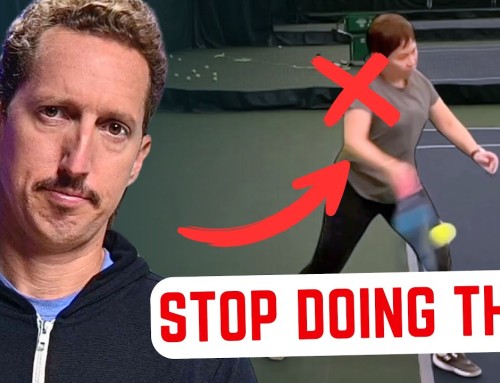
She’s been playing and taking lessons for years, and she just can’t hit with topspin. No matter what she tries, her forehand comes out flat.
The young coach gave her all the classic advice. Drop the racket head. Relax your wrist. Bend your knees. Swing low to high. The student nodded, went back to the baseline, and hit… exactly the same flat forehand she’d always hit.
Same result. Again. And again.
At this point I walked over and asked the young coach a simple question: has anything actually changed? Is she hitting with more topspin?
The coach admitted, no, nothing was different. And that’s when I knew we needed something drastic.
Here’s the thing about habits—telling someone to “swing low to high” a million times doesn’t mean their body knows how to do it. This student had heard that same phrase from coach after coach after coach. Varsity tennis. Club tennis. College tennis. Countless lessons. And she still hit flat, flat, flat, year after year after year.
Words alone weren’t going to fix this. We needed a topspin drill that forced her body to feel something completely different, something so exaggerated she couldn’t fall back into the same old habit.
So I brought her all the way up to the net, arm’s length away, and had her imagine there was a brick wall standing right behind the ball.
Her job? Hit the ball at net height… and don’t touch the wall. That meant her racket had to travel almost straight up, not forward. I even put my own racket right in her path so she had zero choice but to respect the boundary.
At first, her old habit crept back in—forward, forward, forward, just like it always had been. So we exaggerated even more. This is the key to breaking any old pattern: you don’t nudge it a little, you go all the way to the opposite extreme until your body finally understands what “different” actually feels like.
After a handful of practice swings, I dropped a real ball to her with the net still acting as her wall. And her face after she hit that ball? Pure shock. That’s the moment every coach lives for—the lightbulb going off, the “holy cow, what did I just do” reaction.
That’s what a properly designed topspin drill can do in minutes that a thousand verbal cues never could.
We moved her back to the service line, had her repeat the same vertical swing path, and I asked her to start noticing the sound of contact.
A flat shot has a pop, almost a boom. A topspin shot has a click—that split-second moment where the strings grab the ball, shift, and snap back into place. Once she could hear the difference, she could feel the difference.
Ten minutes. That’s all it took to turn a forehand that had been flat for years into one with real curve, real spin, real bite.
Think about that. This student put in countless hours of coaching, heard the same instructions over and over, and got nowhere. Then one focused topspin drill, built around exaggeration instead of repetition of the same old cues, changed everything in the time it takes to watch a sitcom rerun.
If you’ve been stuck hitting flat no matter how many times someone’s told you to “brush up” on the ball, this is your sign. Stop doing the same thing a little differently and expecting a new result. Go find a topspin drill that forces you to the opposite extreme, even if it feels ridiculous at first. That’s usually exactly what your game needs.
If you know someone who’s been fighting this same flat-forehand battle for years, send this their way. Sometimes all it takes is a different approach, not more repetition of the same one.
Thanks for reading, and I’ll see you on the court.
Your Coach,
Ian