I want to tell you something.
Take a rubber band. Hook a paperclip through it. Pull back.
Feel that tension? That stored-up energy just waiting to be released?
That is exactly what your body is supposed to be doing every single time you hit a forehand.
Most players think forehand power comes from swinging harder. From muscling through the ball. From gripping tighter and pushing more.
It doesn’t.
The players you watch on TV — Alcaraz, Djokovic, Sinner — they make it look effortless because it is effortless. Not because they’re stronger than you. Because they’ve learned how to store and release energy with their body in a way that most everyday players never figure out.
Let me break it down.
The foundation of forehand power tennis technique starts with one thing — creating a stretch in your body before you ever start swinging.
When you set up for a forehand, your hips and your shoulders should NOT be facing the same direction. Your hips face slightly toward the side fence. Your shoulders rotate further — past perpendicular to the baseline. That gap between where your hips are facing and where your shoulders are facing? That’s a stretch. That’s a coil. That’s stored energy just like the rubber band being pulled back.
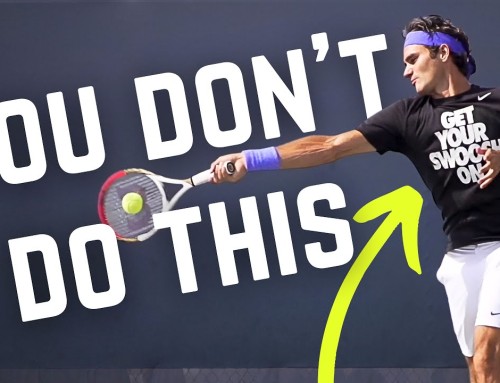
But it doesn’t stop there. As your body starts to unwind in the forward direction, something else happens. Your hand, your forearm, and your shoulder get laid back and stretched behind you. A second layer of stored energy stacking right on top of the first.
Two stretches. Two layers. All that force loaded up and ready to be sent through the ball.
This is actually why the modern open and semi-open stances have taken over professional tennis. It’s not just about court coverage — it’s about loading the biggest, strongest parts of your body so you can send maximum energy through the point of contact.
Storing the energy is only half the equation though. The other half — and honestly the part most players get completely wrong — is when you start to unwind.
Watch Djokovic in the middle of a rally. By the time the ball bounces on his side of the court, he is already in a full coil. Hips loaded. Shoulders turned past perpendicular. Racket back.
Everything stored and ready. And when does he start unwinding? When the ball is still six or seven feet away from him. He starts releasing early so that by the time the ball arrives at the contact point, his hips and shoulders have already fully transitioned forward. The big muscles do all the heavy lifting, the racket whips through naturally, and the whole thing looks like almost no effort at all.
Now contrast that with what most recreational players do.
The ball bounces — and the racket is still nowhere near a loaded position. The player scrambles to get prepared while the ball is already closing in fast. By the time they finally get coiled up and ready, the ball is right in front of them. There’s no time left to unwind. No time to release. So the body stalls out and the arm takes over, producing a fraction of the power that was possible.
The preparation was late. The energy got wasted. Sound familiar?
Here’s what makes it even more frustrating — a lot of players actually do a decent job of loading and coiling. They get the big pieces right. But then they lose all of it because their arm, hand, and wrist are locked up and rigid from setup all the way through contact.
Think back to the rubber band. You’ve got it pulled back, paperclip hooked in, all that energy stored and ready to fly. But right as you let go, imagine a blast of freezing cold air hits the rubber band and turns it completely solid. All that stored potential, going absolutely nowhere.
That’s exactly what a tight, tense arm does to your forehand.
Real forehand power tennis technique requires you to stay loose and relaxed between your shoulder and your hand so the energy can flow freely all the way out through the racket. When the arm stays soft, the hand naturally lays back as the body unwinds — creating that whipping, snapping effect you see in every elite forehand — and then it releases through contact like a slingshot letting go.
Tight arms produce weak shots. Loose arms produce powerful ones. Every single time.
So here’s the bottom line. If you want to hit your biggest, most effortless forehands, you need to store energy by coiling your torso and creating that gap between where your hips and shoulders are facing. Then add a second layer of stretch as your hand and arm lay back during the forward swing. Start unwinding early — before the ball even bounces on your side — so the big muscles do the work. And through all of it, stay loose and relaxed so that energy flows freely out through the racket.
When you get those pieces working together in the right sequence, the ball jumps off your racket in a way that genuinely surprises you. Your opponents feel it from the other side of the net.
And the best part? It actually takes less effort than what you’re doing right now.
That’s what real, effortless power feels like.
Your Coach,
-Ian